What an Australian reader searching for an international casino is actually choosing between
 Available in AU
International casino reads like one phrase, but in Australia it pulls in three different directions at once. Some readers mean a casino licensed outside Australia — typically Curaçao, Anjouan or the Kahnawake territory in Quebec — and some mean an online casino that takes bets in any currency. A third reading reaches for the international resort brands that operate land-based floors like Crown, The Star and SkyCity, none of which offer their table games online at all. None of those uses lines up with what a person in Australia can lawfully do online, and the rest of what follows traces what that gap actually costs a reader in 2026.
Data current as of 17 October 2026 · verified against the ACMA’s published blocking and formal-warning register
Table of Contents
- What “international casino” actually means in an Australian search
- Prohibition of online casino games under the Interactive Gambling Act 2001
- Fundamentals of how the ACMA enforces the prohibition
- Wellbeing, self-exclusion, and what an Australian reader can still control
- Eleven brands the ACMA has named
- How fast the blocklist grows
- Frequently asked questions
What “international casino” actually means in an Australian search
The three readings do not match each other, and the Interactive Gambling Act treats each one differently.
An online casino licensed outside Australia is, in the Act’s language, an interactive gambling service operated from outside Australia that supplies online casino games or online pokies to a customer physically in Australia. The Act makes it an offence for the supplier to make that offer. The offence runs against the operator, not against the player who clicks through, and there is no Australian licence category for online casino games. The Northern Territory Racing and Wagering Commission, which regulates 52 online bookmakers — Sportsbet, Bet365 and Ladbrokes among them — does so for wagering services only, which the Act treats as licensed. Casino games sit on the prohibited side of that line. The Commission has no full-time staff and meets once a month in Darwin, a useful detail about how thin the regulator is on a question the Act answers in a single line.
An online casino that takes bets in Australian dollars but sits offshore offers no Australian consumer protection. The site displays an Anjouan or Curaçao number on its footer; that licence binds the operator to its own regulator, not to an Australian complaints body. When a withdrawal stalls, the only recourse is the licensing body’s own dispute process — and Curaçao and Anjouan have well-documented problems enforcing against their own licensees. The Australian Consumer Law does not reach an offshore gambling site in any practical sense, because the operator has no Australian presence to sue. The Australian Taxation Office’s position on recreational gambling is that winnings are not assessable income and losses are not deductible, unless the person carries on a business of gambling — a useful fact for anyone wondering what an offshore win does to their tax return, and an answer that is independent of whether the activity is lawful.
A land-based international casino resort is a separate category. Crown, The Star and SkyCity are licensed and regulated in their respective state or territory. The Star Sydney is the subject of a separate NSW regulatory examination that has run since 2022, but that is a regulator-versus-operator question about a physical venue, not the question an Australian reader’s search returns. The land-based operators do not offer their table games online. The market an Australian reader’s search returns is the offshore one, and that is the market the rest of this section is about.
The corollary follows. The reader who searches for an international casino from Australia is not looking at a list of licensed options. They are looking at a market in which every brand on offer is in the same legal position: prohibited from being supplied to an Australian customer, and therefore outside any Australian consumer protection. The brands differ in the offshore regulator that issued their licence, in the corporate operator behind the brand, and in how many times the ACMA has chased them — but they do not differ on whether the activity is lawful in Australia. None of them is.
The reader’s working list, in other words, is not a ranking of places to play. It is a list of brands that the ACMA itself has named in its enforcement record. That distinction governs everything that follows.
Prohibition of online casino games under the Interactive Gambling Act 2001
The line is drawn by the Interactive Gambling Act 2001, as tightened by the Interactive Gambling Amendment Act 2017 and amended again in 2023. The Act makes it an offence for a person or company to provide a prohibited interactive gambling service to a customer physically in Australia. A prohibited service is one that supplies online casino games, online pokies, or in-play betting on a sporting event. Wagering on races and sports before the event is licensed, not prohibited — and that is why the 52 Northern Territory-licensed bookmakers sit on the other side of the line.
The 2017 amendments did three things that matter here. They extended the prohibition to online in-play betting. They clarified that the offer itself, not just the payment, is the prohibited act. And they gave the ACMA the power to direct Australian internet service providers to block offending sites at the DNS level. That last power is what produces the blocklist traced in the next section.
The 2023 amendments added a payment-level prohibition to the regime. From 11 June 2024, an Australian-licensed online wagering service cannot accept payment by credit card or other credit-related products, with penalties of up to $247,500 per breach. The restriction extends to credit-funded digital wallets — Apple Pay is touched when the underlying card is a credit product. Cryptocurrency was already outside the licensed system; the 2023 amendments reinforced that position. None of this changes the position on online casino games, which remain prohibited regardless of how the customer pays.
What sits on either side of the line, in 2026, looks like this. On the licensed side: wagering on races and sports before the event, lotteries and keno, and the land-based casino floors. On the prohibited side: online casino games, online pokies, online in-play betting on sport, and any credit-funded or cryptocurrency-funded payment to a wagering service. A reader who is reading this from Australia and who finds themselves at an offshore casino site is sitting on the prohibited side of the line, which is the entire reason the ACMA’s enforcement record exists.
The reform path that follows the 2023 amendments passed Parliament on 19 August 2026: the Interactive Gambling Amendment (Gambling Reform) Bill 2026 introduces advertising and inducement measures that commence 1 January 2027. That is a law with a start date. It does not bind a reader acting in 2026, and the ACMA’s enforcement record on a 2026 page is the record of the regime that is in force today. Reading the 2026 bill as the law of 2026 is a misreading — its operative date is six months into the future.
The consequence a reader needs to weigh is what each prohibition costs at the moment of the wager. The credit-card ban takes one funding route away from licensed bookmakers. The offshore prohibition takes the entire product away from unlicensed ones. The two sit on the same side of the consumer: both are protections aimed at the offer, not the punter. Both leave a reader holding their own funds and their own consequences, with the licensed market offering a smaller set of products and the unlicensed market offering a set that the law refuses to recognise.
Fundamentals of how the ACMA enforces the prohibition
The ACMA runs three levers, and what follows for an Australian reader using an offshore site depends on which one catches up with it.

A formal warning is the first lever. The ACMA writes to the operator identifying the breach and giving a window to comply. The warning is published on the ACMA’s website, naming the operator and the brand. The act of publishing is itself part of the enforcement — the warnings turn up in search results and in the ACMA’s own register. The ACMA has issued warnings to Dama N.V. over six casino brands (Bambet, Dazard, Level Up, Rocketplay, Wild Tornado, Cobra Casinos) in May 2022; to the same Dama N.V. over Woo Casino in March 2025 and over Spirit Casino in May 2025; to Bamboo Media over Ignition Casino and to Consolutetish S.R.L. over National Casino and Bizzo Casino in July 2025; to EOD Code SRL over Instant Casino in February 2025; to Sterplay Holding Ltd over Casino Intense in April 2025; to Hollycorn N.V. over Sky Crown and Blue Leo in September 2022; to Pulsup Ltd over RocketPlay in March 2026; and to Ryker B.V. over Jackbit and CasinOK in April 2026. The register is dense and recent — every brand in the comparison table later in this section comes from one of those warnings.
The second lever is civil penalty proceedings. Where the operator continues to offer prohibited services after a warning, the ACMA can seek penalties in the Federal Court. The penalties are published on the ACMA’s website and enforceable against any operator that holds assets in Australia — which most offshore brands do not, which is why the formal warning is the lever that does most of the practical work.
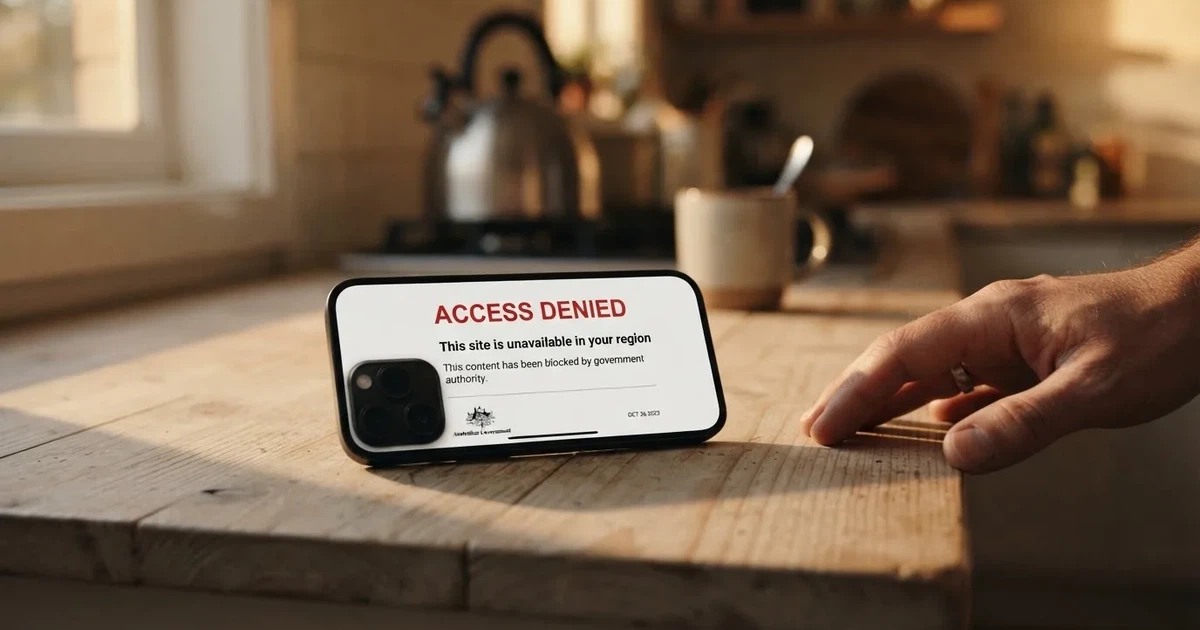
The third lever is ISP-level blocking, and this is the one an Australian reader will actually feel. The ACMA maintains a running list of illegal gambling and affiliate marketing sites and asks participating Australian ISPs to block them at the DNS level. The block stops the Australian reader reaching the site through the main ISP route, but it does not stop every route: a reader with technical knowledge can switch DNS, use a VPN, or reach the site through a mirror. The block is an availability barrier, not a knockout. The block does not freeze any balance the reader already has on the site either — a balance already accrued is unaffected by the block, which leaves the reader holding a balance on a site that, from their ISP, no longer resolves.
The consequence a reader needs to weigh is the third one. Once a domain is blocked, the operator’s customer support still functions, the operator still holds the balance, but the path a reader would normally use to log in and withdraw is shut. The dispute mechanisms that exist in the operator’s licensing jurisdiction become the only available route — a slow and uneven route that runs through Curaçao or Anjouan and that does not have an Australian-facing contact point.
The cumulative picture, by June 2026, is the figure an Australian reader should hold in mind. The ACMA had asked ISPs to block 1,751 illegal gambling and affiliate marketing websites since the first blocking request in November 2019. The single round reported on 26 June 2026 added twelve more: 7Signs, ChromaBet, Donbet, Duospin, Freshbet, Slots Gem, Jacks Club, Lucky Start, Pointsbetz, Spinrise, Vinyl Casino and Wildsino. More than 230 unlicensed services had left the Australian market entirely since the ACMA’s enforcement was strengthened in 2017. H2 Gambling Capital’s 2025 estimate puts the annual Australian loss to illegal gambling sites at about A$3.9 billion, with the share of gambling going through legal channels falling from 74% in 2021 to 64% in 2025.
The figures sit together. The blocklist keeps growing. The legal-channel share keeps eroding. The volume of money moving to offshore brands keeps rising. None of that changes the IGA’s prohibition, but it changes what an Australian reader is up against: a market large enough to absorb the cost of an ACMA warning and a domain block, and that rebrands and reincorporates faster than the regulator can chase.
Wellbeing, self-exclusion, and what an Australian reader can still control
The IGA’s reach is asymmetric: it stops the supplier, not the player. That asymmetry is by design — the legislature criminalises the offer, not the wager — but it leaves the Australian reader carrying tools the operator does not. Three of them matter, and so does a fourth sitting in the payments system.

BetStop, the National Self-Exclusion Register, went live in August 2023 and binds every Australian-licensed online and phone wagering service. A punter who registers with BetStop is excluded, for a chosen period between three months and a lifetime, from opening new accounts or placing bets with any licensed Australian bookmaker. The register covers the 52 Northern Territory bookmakers, the wagering arms of the state TABs, and the licensed lotteries. Offshore casinos are not connected to BetStop. The Australian reader who has registered with BetStop and who then opens an account with an offshore casino has not registered their exclusion with the offshore casino. The same exclusion runs against the licensed Australian market; the offshore market sits outside it.
The National Gambling Helpline on 1800 858 858 is free, available 24/7, with chat access through Gambling Help Online. The helpline is a resource for anyone affected by gambling harm, regardless of whether the gambling was through a licensed bookmaker, an offshore casino or a land-based venue. State-based face-to-face counselling services are reachable through the same number. The helpline is the right first contact for a reader who has reached the point of needing to talk — and a useful one for a reader who has not.
The third tool sits with the Australian reader’s own bank, and the banks have spent the last several years adding levers of their own. ANZ’s gambling transaction block works at the merchant category code level, refusing transactions tagged as ‘Betting/Casino Gambling’ on eligible personal cards. The block also covers transactions routed through a digital wallet such as Apple Pay on an eligible card — it is not just the physical card that is blocked. Once activated, removing ANZ’s block requires a 48-hour cooling-off period, and the bank warns that not all gambling transactions will be blocked and some non-gambling transactions might be blocked in error. Westpac’s gambling block works on the same merchant category code principle. Commonwealth Bank offers a gambling lock through the CommBank app with the same caveat — it stops most gambling transactions but cannot guarantee every gambling-coded purchase is caught. American Express, which has operated as a three-party scheme since launching its first charge card on 1 October 1958 and which the Reserve Bank of Australia’s July 2025 surcharge review proposes leaving outside the scope of any surcharge ban, is not subject to the same merchant-category rules in the same way — the block works at the merchant code level, and Amex processes transactions through its own network rather than the four-party Visa/Mastercard rails.
The bank blocks have one important consequence. They stop the transaction at the Australian end. The offshore casino does not see the request. The reader’s balance on the offshore casino stays where it is — the bank has no power to recover money already paid in. The block is forward-looking; it is not a refund.
The fourth tool sits in the payments system itself. PayID, the address-based layer on Australia’s New Payments Platform, shows the name of the account holder before the transfer is sent. Australian Payments Plus warns that being asked to transfer money to a PayID registered to an illegal gambling site is itself a strong signal of a scam. PayID is available at over 100 Australian financial institutions, with more than 25 million PayID identifiers registered by April 2025. Osko, the instant-transfer service on the same platform, settles bank-to-bank transfers in under a minute, 24/7, including weekends. BPAY, which has operated since 18 November 1997 through the online banking of over 140 Australian financial institutions and is offered by over 95,000 businesses, runs as the bill-payment service the licensed Australian wagering market uses for some transactions. The licensed market takes debit card, bank transfer, PayID/Osko and BPAY. It does not take credit cards or cryptocurrency. An Australian reader being asked for either by a gambling site is being asked for a payment method no Australian-licensed operator would accept.
By the end of 2025, Apple Pay, Google Pay and Samsung Pay transactions collectively accounted for around 45% of all card payments in Australia by number — a reminder that a bank-level block on a digital wallet is no small matter, given how much of the country’s card traffic now runs through wallets. AUSTRAC’s threshold-transaction-report rule, which requires reporting of transfers of A$10,000 or more, applies only to physical cash; ordinary electronic bank transfers are not subject to that per-transaction reporting requirement, regardless of the amount sent. Apple’s own position is that any Apple Pay surcharge comes from the merchant’s card processing costs, not from Apple, and that transaction limits and PIN requirements for Apple Pay purchases are set by the card issuer or merchant, not by Apple itself. The New Payments Platform, on which Osko and PayID run, has been accessible to the public since 13 February 2018 and is owned by New Payments Platform Australia Ltd, a non-profit whose 13 shareholders include the Reserve Bank and the major banks. Participants must keep the platform’s monthly outages to no more than two minutes; in 2021 the ACCC authorised merging NPP Australia with BPAY and eftpos into a single company, Australian Payments Plus.
The combined picture is not a complete one. None of the four tools reaches the offshore casino directly. BetStop excludes the punter from licensed Australian services; the bank’s block stops the transaction but not the existing balance; the helpline is a counselling resource; PayID’s name display is a signal, not a barrier. Used together, they cut off most paths an Australian reader would normally use to fund an offshore account — but each one leaves a gap, and the offshore market keeps finding new ones.
A reader who has already incurred a balance with an offshore casino and is now looking at a blocked domain and a stalled withdrawal has fewer tools than a reader who has not yet started. The bank block will not return what has been paid in. BetStop will not exclude a brand it does not bind. The helpline will counsel, not recover. The operator’s licensing body is the only dispute path that touches the operator, and Curaçao’s and Anjouan’s dispute mechanisms are slower and less effective than an Australian regulatory complaint would be.
Eleven brands the ACMA has named
The eleven brands are not recommendations. Each one is on the ACMA’s published enforcement record for offering prohibited services to Australians. The reader’s working list is what the regulator has named — not what an affiliate page ranks. The table summarises what the ACMA has published: the date of each warning, the operator the ACMA named, and what other sources have to say about the brand. The “Listings” column follows a strict rule: where research had no data on a brand, the cell is left blank; where research could only confirm what listing pages report, the column names the sources the listings came from. No row implies more than the ACMA itself has published.
| Brand | ACMA action and date | Operator named by the ACMA | Listings |
|---|---|---|---|
| RocketPlay | formal warning, March 2026; earlier warning May 2022 | Pulsup Ltd (March 2026); Dama N.V. (May 2022) | Gambling Insider |
| Level Up Casino | formal warning, May 2022 | Dama N.V. | Westpac |
| Woo Casino | formal warning, March 2025 | Dama N.V. | — |
| Spirit Casino | formal warning, May 2025 | Dama N.V. | — |
| National Casino | formal warning, July 2025 | Consolutetish S.R.L. | ACMA, AUSTRAC, BetStop |
| Bizzo Casino | formal warning, July 2025; earlier 2022 | Consolutetish S.R.L. (July 2025); TechSolutions (2022) | Gambling Insider |
| Ignition Casino | formal warning, July 2025 | Bamboo Media | — |
| Instant Casino | formal warning, February 2025 | EOD Code SRL | ecoPayz, PayID |
| Jackbit | formal warning, April 2026 | Ryker B.V. | — |
| Casino Intense | formal warning, April 2025 | Sterplay Holding Ltd | AUSTRAC, BetStop, Gambling Insider |
| Sky Crown | formal warning, September 2022 | Hollycorn N.V. | — |
The table covers what the ACMA itself has published. Each row reads the way the ACMA’s register reads, with the operator named in the operator’s own corporate form and the date as it appears on the ACMA’s site. Two rows — RocketPlay and Bizzo Casino — show the same brand appearing twice, each time under a different corporate vehicle. That is the pattern the ACMA’s enforcement record has produced: a brand warned in 2022, the operator changes its corporate form, and the brand reappears on the ACMA’s register in 2025 or 2026 under a new name. The brand name persists. The operator behind it shifts.
The “Listings” column is the article-language rendering of the listings the brand appears on. Five of the eleven brands — Woo, Spirit, Ignition, Jackbit and Sky Crown — have no listing pages research could find. The other six appear on at least one listing: Gambling Insider, Westpac, the ACMA itself, AUSTRAC, BetStop, ecoPayz or PayID. The listings confirm the brands exist on the Australian-facing pages of those sources; they do not confirm anything about the brand’s underlying operations.
Each brand is then read through in turn, in the order of the table.
RocketPlay — two operators named, one brand
The ACMA’s March 2026 warning to Pulsup Ltd is the second bite at this brand. Dama N.V. was warned over Rocketplay in May 2022 alongside five other brands. The rebranding exercise — Dama N.V. in 2022, Pulsup Ltd in 2026 — does not change what Rocketplay offers Australians: online casino games, prohibited under the IGA, outside any Australian licensing frame. What a reader can read off the two warnings is that the brand survived the 2022 round under new ownership and reappeared on the ACMA’s register four years later. The 2026 warning tells a reader that the operator behind the brand has changed at least once and that the regulator has chased both.
Two ACMA warnings to one brand in four years, with the regulator’s action producing a rebrand rather than a withdrawal, is a record that does not favour the brand.
Level Up Casino — one of six brands in a single warning
Dama N.V. was warned in May 2022 over Level Up Casino alongside five other brands in the same corporate stable: Bambet, Dazard, Wild Tornado, Cobra Casinos, and Rocketplay. Level Up’s pitch in the affiliate market has been its tiered loyalty programme — a feature that, like every other feature on the site, is irrelevant to the IGA’s prohibition. The relevant facts are what is on the ACMA’s register: a single formal warning to the corporate operator in May 2022, and no Australian licence category the brand could sit under. The Westpac listing exists because the bank’s gambling-block page references the brand’s merchant category code.
The loyalty programme is the marketing artefact; the prohibition is what binds.
Woo Casino — the operator’s return to the register in 2025
Dama N.V. was warned again in March 2025, this time over Woo Casino. The 2022 warning covered six brands; the 2025 warning is its own published event. Two warnings to one operator in three years is the ACMA’s record of a corporate group continuing to operate the same line of business through different brand names. The “Woo” brand has not been on the ACMA’s register before March 2025; the operator behind it has been on it twice.
Dama N.V.’s return to the register in 2025 with a fresh brand name is the operator’s pace, not the regulator’s success.
Spirit Casino — the operator’s third warning in three months
The same Dama N.V. was warned in May 2025 over Spirit Casino, two months after the Woo Casino warning. Two warnings to one operator in two months is the ACMA’s record of a corporate group continuing to operate through different brand names. Spirit Casino did not appear on the register before May 2025; Dama N.V. did, and had, by then, been warned over six brands plus Woo.
Two warnings in two months is the operator’s pace, not a sign that the regulator is winning.
National Casino — a fresh operator family on the register
Consolutetish S.R.L. was warned in July 2025 over National Casino. The operator is a different corporate vehicle from Dama N.V., and the ACMA’s record does not connect the two. What the record shows is that the ACMA’s enforcement programme has spread well past the first few Curaçao-domiciled operators it named in 2022. National Casino sits on the register under a fresh operator name.
Consolutetish S.R.L. is a new corporate name on a register that was previously dominated by Dama N.V. — the ACMA’s reach has widened.
Bizzo Casino — the same two-operator pattern as RocketPlay
Consolutetish S.R.L. was warned in July 2025 over Bizzo Casino; the brand was already on the ACMA’s record from a 2022 warning to TechSolutions (CY) Group Limited and TechSolutions Group N.V. Two operators named, one brand. The pattern is the same as RocketPlay’s: a brand warned in 2022, the operator changes its corporate form, and the brand reappears on the ACMA’s register in 2025 under a new name.
Two operators named against one brand is the same pattern as RocketPlay, and the pattern is what the reader should weigh.
Ignition Casino — first warning to Bamboo Media
Bamboo Media was warned in July 2025 over Ignition Casino. Bamboo Media is a corporate name that had not previously appeared on the ACMA’s register; the July 2025 warning is the regulator’s first action against that operator. What a reader sees on the ACMA’s page is a single warning to a single operator, in 2025.
One warning, one operator, one brand — the register’s simplest line, and the easiest to dismiss as a one-off.
Instant Casino — affiliate-marketed into Australia
EOD Code SRL was warned in February 2025 over Instant Casino. The Instant Casino brand has been marketed to Australian readers through affiliate pages, which is the route that put it in front of Australian readers in the first place. The warning is the ACMA’s first action against EOD Code SRL on the public register. The ecoPayz and PayID listings sit at the payments layer: ecoPayz is a payment wallet that processed transactions for the brand, and PayID is the address-based instant transfer that an Australian reader might be asked for at deposit.
Affiliate marketing is the route that brought Instant Casino in front of Australian readers; the ACMA’s warning is the route that put it on the register.
Jackbit — warned alongside a sibling brand
Ryker B.V. was warned in April 2026 over Jackbit and CasinOK. The warning covers two brands under the same operator, which is the same pattern Dama N.V. has been warned on twice. Two brands in one warning is a faster path through the ACMA’s register than one at a time, and it tells a reader that Ryker B.V. is running multiple brands simultaneously.
Ryker B.V. is the operator; Jackbit and CasinOK are two brands off the same corporate shelf.
Casino Intense — first warning to Sterplay Holding
Sterplay Holding Ltd was warned in April 2025 over Casino Intense. Sterplay Holding Ltd had not previously appeared on the ACMA’s register; the April 2025 warning is the first action against this operator. What a reader sees is a single warning, to a single operator, in 2025. The AUSTRAC, BetStop and Gambling Insider listings exist because the brand’s name appears on those pages in the contexts they cover — AUSTRAC and BetStop for player-protection purposes, and Gambling Insider for industry coverage.
Sterplay Holding Ltd made its register debut in April 2025 over Casino Intense — fresh on the regulator’s list.
Sky Crown — the oldest entry on the register
Hollycorn N.V. was warned over its Sky Crown and Blue Leo casino services in September 2022. The ACMA’s register gives the action and the operator; it does not give the brand’s current status or whether Sky Crown is still accepting Australian customers in 2026. What the register does say is that, in September 2022, the ACMA named Hollycorn N.V. and named the brands Sky Crown and Blue Leo. Sky Crown is the older entry in the table; it is also the only entry without a 2025 or 2026 warning, which is a function of when the brand first appeared on the register, not of any current compliance.
The brand’s register entry dates to 2022; its 2026 status is not what the register confirms.
How fast the blocklist grows
The arithmetic belongs to this section: the running total of blocked sites — 1,751 by June 2026, since the first blocking request in November 2019 — gives a rate that is worth setting out for an Australian reader who wants to know what the cumulative picture looks like.
Averaging 1,751 sites over the 79 months from November 2019 to June 2026 works out to roughly 22 blocked sites a month across the lifetime of the regime. The most recent round reported on 26 June 2026 asked ISPs to block twelve sites in a single announcement, a pace that sits in the same band as the long-run average. The figure is a band rather than a point because the monthly rate has not been uniform: the ACMA’s published blocking requests come in batches, with some months producing no announcement and others producing ten or more at once. Across the lifetime of the regime, a band of roughly twenty to twenty-five blocked sites a month captures both the long-run average and what recent rounds have done.
The figure carries a condition. It is a count of sites, not of operators — Dama N.V. alone accounts for nine brand entries across two warnings, and one operator’s portfolio of brands can produce a noticeable share of a single round. Reading the figure as “the ACMA names twenty to twenty-five new brands a month” is closer to what the data shows than “twenty to twenty-five new operators a month.” H2 Gambling Capital’s 2025 estimate puts the annual Australian loss to illegal gambling sites at about A$3.9 billion, with the legal-channel share falling from 74% in 2021 to 64% in 2025. The blocklist keeps growing and the legal share keeps eroding, and the two trends are running in the same direction.
Frequently asked questions
What does “international casino” actually mean in Australia?
It can mean one of three things, none of which lines up with what an Australian can lawfully do online. An offshore online casino licensed in Curaçao or Anjouan; a land-based resort brand like Crown or The Star; or any online casino that takes Australian dollars. Only the first category is what the search returns, and only that category is on the ACMA’s enforcement record.
Can an international online casino legally accept players located in Australia?
No. The Interactive Gambling Act 2001 prohibits an interactive gambling service from supplying online casino games or online pokies to a customer physically in Australia. The 2017 amendments extended the prohibition to online in-play betting. The offence is the operator’s, not the player’s, but the offer itself is unlawful and the ACMA enforces against the operator.
Does an overseas gambling licence carry any weight for an Australian player?
It carries the weight of the regulator that issued it. Curaçao and Anjouan licences bind the operator to those jurisdictions, neither with an effective Australian-facing dispute mechanism. A balance dispute is governed by the operator’s licence terms, which from an Australian reader’s position is slower and less accessible than an Australian regulatory complaint would be.
What protections, if any, apply to an Australian using an international casino site?
Effectively none of the protections Australian readers take for granted. The Australian Consumer Law does not reach an offshore operator in any practical sense. BetStop’s exclusion does not bind offshore sites. The bank’s gambling block stops the next transaction but does not recover money already on the site. The ACMA’s enforcement is against the operator, not the player.
Who can an Australian contact if an international casino site will not pay out?
The first line is the operator’s customer support; the second is the licensing body’s dispute process, accessible but slow. The third is the National Gambling Helpline on 1800 858 858, free and 24/7, with chat at Gambling Help Online. The helpline is a counselling resource, not a regulator with reach over an offshore operator, but it is the right contact for a reader feeling the harm.
Written by the editors at Casino Jackpot Hub.