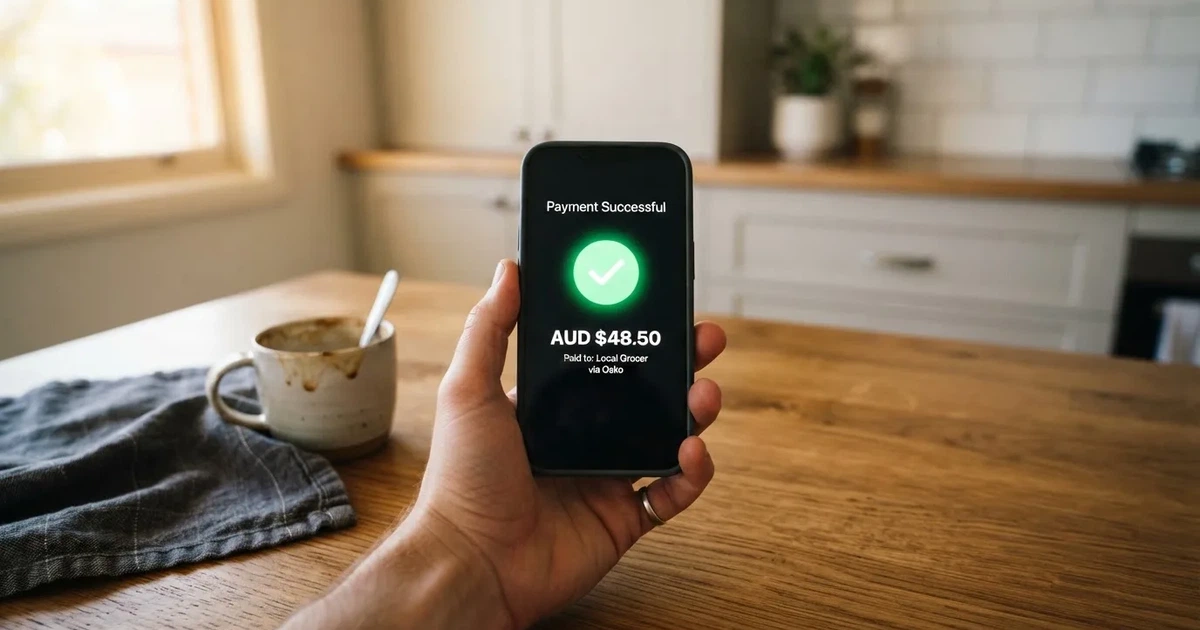
The $10 PayID no-deposit casino bonus in Australia, in plain terms
 Available in AU
The pitch is short: ten dollars of bonus credit, no deposit, just hand over a PayID and the money appears. It sounds clean. PayID is a real Australian payment service, used by more than a hundred local banks and built into the apps people already have. So the question this page actually answers is not how to claim the bonus. It is what the bonus is, why it looks Australian when it is not, and what it costs the person who takes it.

Currency snapshot: 17 October 2026, checked against the Australian Communications and Media Authority register of formal warnings and blocking requests.
Table of Contents
- Responsible gambling comes first
- What PayID actually is
- Why PayID is attached to the bonus pitch
- Bonuses, free spins, and what a $10 no-deposit offer really moves
- Landscape of brands the ACMA has acted against
- The blocking arithmetic
- The legal frame the offer sits inside
- How payments shape the offer
- What the offer actually moves, in numbers
- The credit-card ban, in context
- The numbers behind the warnings
- How a careful reader reads the offer
- What changes in 2026
- Tax, in one paragraph
- The cleanest summary
- Frequently asked questions
Responsible gambling comes first
Gambling Help Online · 1800 858 858 · 24 hours

If a $10 PayID no-deposit bonus is starting to feel less like a freebie and more like a problem, free confidential support is one call away. The National Gambling Helpline runs around the clock at 1800 858 858, and Gambling Help Online carries live chat and self-help tools in plain language. None of it requires giving a name.
BetStop, the National Self-Exclusion Register, has been live since August 2023. It is the strongest single step a punter can take, because every Australian-licensed online and phone wagering service has to honour it. A self-excluded person cannot open new accounts, and marketing has to stop. There is a waiting period before the exclusion lifts, which is the point of it.
The register only covers operators it can compel. An offshore casino sits outside that reach, which is why self-exclusion has to be paired with the practical step of telling the bank. Westpac’s gambling block refuses authorisation of transactions bearing the merchant category code “Betting/Casino Gambling” on eligible cards. ANZ runs a similar block through its app, and it also covers gambling transactions routed through Apple Pay on an eligible card. Turning the block on is a one-way switch: ANZ imposes a 48-hour cooling-off period before it can be turned off again, and the bank publishes a candid caveat that some non-gambling transactions may be blocked in error.
Offshore play carries no Australian consumer protection, no local complaints body and no recourse if a withdrawal is refused. If a balance is left on a site that gets blocked, that balance is, in practical terms, gone.
What PayID actually is
PayID is an identifier, not an account. A mobile number, email address, ABN or Organisation Identifier gets linked to an Australian bank account, and anyone sending money types the PayID instead of a BSB-and-account-number string. The system is run by Australian Payments Plus, the country’s domestic payments provider, and it sits on top of the New Payments Platform, an Australian infrastructure that launched in February 2018 and processes payments close to real time, twenty-four hours a day.

The Reserve Bank of Australia regulates the platform itself and runs the Fast Settlement Service that closes out each transaction individually. By April 2025 there were more than 25 million registered PayIDs in circulation, and Osko, the instant-transfer service that uses PayID addressing, gets bank-to-bank money across in under a minute, including on weekends. None of that is the casino offer. It is just the rail.
The reason a scam-prevention rule matters here is the name check. Before a transfer is sent, the payer is shown the name registered against the PayID at the receiving account. It is the single feature that protects people from mistyped numbers and from being routed to the wrong payee. AP+ has built a public warning around it: if anyone is asked to transfer funds to a PayID on an illegal gambling site, that site is almost certainly a “scambling” website — AP+’s own term for a scam site dressed up as gambling.
PayID never contacts a customer directly. Any text or email claiming to be from PayID is fraudulent. PayID never asks anyone to send money in order to receive money, and it does not “upgrade” accounts. These are the basics, and they are the first things to remember when an offer asks for a PayID up front: the identifier was designed to be safe to share, not to be used as proof of identity at a gambling site.
Why PayID is attached to the bonus pitch
The offer leans on a real Australian name to look domestic. A punter who knows PayID from their own banking app assumes the casino is Australian, regulated, and one step away from being trusted. The mechanics are different. A no-deposit bonus is a marketing cost: the operator credits the player’s account with bonus funds before any deposit is made, hoping the bonus keeps the player on the site long enough to lose it back plus a margin. A PayID, in that context, is a targeting tool, not a payment. The site wants a bank-linked identifier so it can build a profile of an Australian customer, and a $10 bonus is the price of that profile.
What that profile is worth, and what it costs the punter, is the rest of the page.
Bonuses, free spins, and what a $10 no-deposit offer really moves
The dollar figure is the headline. The arithmetic sits behind it. A no-deposit bonus of $10 is small in absolute terms, but the wagering requirement that comes with it is usually expressed as a multiple of the bonus, the deposit, or both. If the requirement is thirty-five times the bonus, the player has to turn $350 of bets over before any of the bonus money converts to withdrawable cash. That is a lot of action on ten dollars, and the longer a session runs, the more the house edge compounds.
Two figures determine the real cost. The first is the wagering multiple: a low multiple turns the bonus into a quick trial, a high multiple turns it into a long grind. The second is the RTP of the games the bonus is allowed on. Slots commonly sit in the ninety-to-ninety-six per cent range, and the gap between the RTP and one hundred per cent is the expected loss per dollar wagered. Run $350 of bets through a ninety-six per cent slot and the expected loss is $14. The “free” ten has become a fourteen-dollar bill before the bonus is cleared.
A few offers add a maximum-cashout cap, which is the ceiling on how much of the bonus balance can ever be withdrawn even after wagering is complete. A $50 cap on a $10 bonus is a five-times payout ceiling: a lucky run that produces $200 in bonus funds still pays out $50. Free spins, when they come bundled with the cash bonus, usually run on a single nominated slot and pay in bonus funds rather than cash. They are a marketing device, and the value is whatever the chosen slot’s RTP and the spin price happen to be.
The honest summary: a $10 PayID no-deposit bonus is a chance to play with house money, for a small stake, on terms the operator chose. Whether the arithmetic favours the player or the house depends on the wagering multiple, the RTP of the eligible games, and whether there is a cap on the payout. None of those numbers appear in the pitch.
Landscape of brands the ACMA has acted against
The brands below are not a ranking and not a recommendation. Each one appears because the Australian Communications and Media Authority issued a formal warning over it for offering prohibited services to Australians. The point of the table is to make the offer landscape visible, not to send a reader to any of them. Online casino games and online pokies cannot be licensed anywhere in Australia; whatever licence a site displays at the foot of its homepage is not an Australian one, and the ACMA’s own warnings are over the offering, not over a particular licence claim.
| Brand | ACMA action and date | Operator named by the ACMA | Subject support |
|---|---|---|---|
| RocketPlay | Formal warning, March 2026 | Pulsup Ltd (RocketPlay); earlier Dama N.V., May 2022 | — |
| Level Up Casino | Formal warning, May 2022 | Dama N.V. | Westpac’s gambling block list (Westpac) |
| Woo Casino | Formal warning, March 2025 | Dama N.V. | — |
| Spirit Casino | Formal warning, May 2025 | Dama N.V. | — |
| National Casino | Formal warning, July 2025 | Consolutetish S.R.L. | AUSTRAC and Wikipedia coverage |
| Bizzo Casino | Formal warning, July 2025; earlier 2022 | Consolutetish S.R.L.; earlier TechSolutions | — |
| Ignition Casino | Formal warning, July 2025 | Bamboo Media | — |
| Instant Casino | Formal warning, February 2025 | EOD Code SRL | EcoPayz and PayID listings |
| Jackbit | Formal warning, April 2026 | Ryker B.V. | — |
| Casino Intense | Formal warning, April 2025 | Sterplay Holding Ltd | AUSTRAC, iTnews and NAB coverage |
| Sky Crown | Formal warning, September 2022 | Hollycorn N.V. | — |
The ACMA’s most recent published blocking round, reported on 26 June 2026, asked Australian internet service providers to block 12 more illegal gambling websites: 7Signs, ChromaBet, Donbet, Duospin, Freshbet, Slots Gem, Jacks Club, Lucky Start, Pointsbetz, Spinrise, Vinyl Casino and Wildsino. None of those is on the list above, and the table above is not exhaustive. It is the set the ACMA has put on formal-warning record, not the set of every offshore casino targeting Australians.
A row marked “—” under “Subject support” carries no information one way or the other; the warning stands, and the absence of a column entry is not a denial of the brand’s connection to PayID. Where a source did appear, it is named in the column on the same terms the source uses it: a Westpac gambling-block list is a Westpac gambling-block list, not a Westpac endorsement of the brand.
The blocking arithmetic
The ACMA’s first blocking request went out in November 2019. Since then, the running total of blocked illegal gambling and affiliate marketing websites has climbed past 1,751 as of the round reported in June 2026. That is the figure to anchor the rate against. Working it through: roughly six and a half years of blocking, just under 1,751 sites removed, gives a band of roughly 250 to 280 sites blocked per year on average, with a clear upward tilt in the most recent reporting rounds. The exact year-on-year rate moves because blocking rounds cluster around enforcement drives rather than running evenly, so the honest read is a band, not a single figure: somewhere between a site a day on the quietest stretch and a small flurry per announcement.
That is the ACMA’s enforcement rate. It is what the regulator does to the supply side. The demand side is harder. H2 Gambling Capital’s 2025 estimate puts Australians’ annual losses to illegal gambling sites at about A$3.9 billion, with the share of gambling flowing through legal channels falling from 74 per cent in 2021 to 64 per cent in the same window. The gap between A$3.9 billion in losses and roughly 270 sites blocked per year is the gap the reader needs to hold in mind. Each blocked site is a small win against an industry that recruits faster than it is cut off.
The enforcement rate is the key to understanding the risk. The reality is that an offer advertised today can be blocked tomorrow, and a balance left on a blocked site is, in practice, a balance the player does not see again.
The legal frame the offer sits inside
Legal and offshore payment rails
| Rail | Legality in Australia |
|---|---|
| PayID | Domestic (authorised) |
| Debit Card | Domestic (authorised) |
| Credit Card | Prohibited for licensed wagering |
| Crypto/Offshore | Prohibited for licensed wagering |
The Interactive Gambling Amendment (Gambling Reform) Bill 2026 passed Parliament on 19 August 2026. Its advertising and inducement measures commence on 1 January 2026. The bill is law with a start date; on a 2026 page it is not yet in force. Reading the offer landscape against that calendar, a $10 PayID no-deposit bonus advertised now sits under the rules that have governed the market for the better part of a decade, with tighter inducement rules landing at the turn of the year.
The individual player is not prosecuted. The IGA targets the provider. That distinction matters, because it does not turn an offshore casino into a safe place to play; it turns it into an unregulated one. There is no Australian complaints body, no local dispute resolution and no way to compel a withdrawal. The site can be blocked with money still on it. That is the legal frame, and it is the reason a bonus worth ten dollars can end up costing more than ten times that.
How payments shape the offer
PayID sits inside the local payments rail, but the offer sits outside the local rule book. The cleanest summary of where the rails and the rules diverge:
- PayID is operated by Australian Payments Plus and is offered by over 100 Australian financial institutions. The identifier is built into the apps people already use.
- Osko, the instant-transfer service that runs on PayID addressing, gets money across in under a minute, twenty-four hours a day, including weekends.
- A PayID transfer shows the registered name of the recipient before the transfer is sent, and that name check is the single defence against misdirected payments.
- The Interactive Gambling Act 2001, as amended in 2023, bans Australian-licensed online wagering services from accepting credit cards or credit-related products. PayID-linked bank transfers are not the same instrument and are not banned by name, but the surrounding restrictions shape how the channel can be used.
- The Reserve Bank’s July 2025 review proposes removing surcharges only on eftpos, Mastercard and Visa transactions, leaving American Express outside the proposed surcharge ban. That is the regulator’s view on card costs, not on gambling.
- Apple Pay, Google Pay and Samsung Pay together accounted for around 45 per cent of all card payments in Australia by number at the end of 2025. Apple Pay itself does not charge consumer fees; any surcharge is the merchant’s, and transaction limits and PIN rules are set by the card issuer or merchant, not by Apple.
The picture that falls out is a payments network designed to be safe for everyday use, and a casino offer that borrows the network’s name without sitting inside its rules. PayID is safe to share with a legitimate payee. PayID is not a credential that authorises a gambling site to credit an account, and the moment a PayID is given to a site asking for ten dollars of free play, the identifier is being used for something other than what it was built for.
What the offer actually moves, in numbers
A worked example is the easiest way to see the mechanics. Take the small-stakes assumption: a $10 no-deposit bonus, a thirty-five-times wagering requirement, eligible play on a 96 per cent RTP slot, and a stake of $0.50 per spin.
- Required turnover: $10 × 35 = $350 in bets before the bonus converts.
- Spins to clear: $350 ÷ $0.50 = 700 spins.
- Time to clear, at five seconds per spin: 700 × 5 seconds = 3,500 seconds, which is roughly 58 minutes of play.
The expected loss over those 700 spins, at 96 per cent RTP, is $350 × (1 − 0.96) = $14. So the “free” ten dollars has cost fourteen dollars in expected loss before the bonus is cleared, and the player has done it in under an hour.
Three things change that picture. A higher wagering multiple lengthens the session and raises the expected loss in line. A lower RTP on the eligible game widens the gap. A maximum-cashout cap, if there is one, sets the ceiling on what survives the grind. None of those numbers are in the pitch, and the wagering multiple and the eligible RTP are exactly what the operator chooses when it designs the offer.
A second worked figure is the session cost. Run the same 700 spins at the same $0.50 stake through the same 96 per cent RTP slot, and the expected loss is unchanged: 700 × $0.50 × (1 − 0.96) = $14. The session and the bonus clear give the same number, because the cost of play and the cost of clearing the bonus are the same arithmetic. The only thing the bonus adds is a constraint: the player has to keep playing until the turnover is met, which means the player cannot walk away while ahead. That constraint is what makes the bonus worth offering.
The credit-card ban, in context
The 2023 amendment to the Interactive Gambling Act 2001 makes it an offence for an Australian-licensed online wagering service to accept credit cards or other credit-related products. Penalties reach $247,500 per offence, and the ban took effect on 11 June 2024. Debit cards, bank transfers, PayID, Osko and BPAY remain the legal deposit rails.
An offshore site asking for a credit card is asking for an instrument that an Australian-licensed operator cannot legally accept. A credit-card deposit to an offshore casino is one of the clearer red flags a punter can see: it tells the punter that the operator is not running under Australian rules, and it tells the punter that any protection the card network might have offered is being routed around. The same logic applies, in a softer form, to crypto deposits. Crypto is not banned by name, but it is outside the licensed channel, and outside the licensed channel sits outside Australian consumer protection.
The legal deposit rails are listed for a reason. They are the instruments the Australian framework accepts, and they are the instruments a reader who stays inside the framework uses. A PayID is on the list because PayID is a domestic rail; a PayID routed to an offshore casino is not on the list, because the casino is not.
The numbers behind the warnings
The ACMA’s blocking total has a long tail. November 2019 was the first blocking request. By June 2026 the running total had passed 1,751 illegal gambling and affiliate marketing websites, and more than 230 unlicensed gambling services had left the Australian market since 2017. The July 2025 formal-warning round covered Ignition Casino, National Casino and Bizzo Casino; the February 2025 round covered Instant Casino; the May 2022 round covered six Dama N.V. brands including Level Up and Rocketplay; the September 2022 round covered Hollycorn N.V.’s Sky Crown and Blue Leo. Dama N.V. returned to the register in March 2025 (Woo Casino) and May 2025 (Spirit Casino). Each entry is a formal step taken by the regulator against a specific operator offering prohibited services to Australians.
H2 Gambling Capital’s 2025 estimate puts annual losses to illegal gambling sites at about A$3.9 billion. The legal-channel share fell from 74 per cent in 2021 to 64 per cent in the same window. The two figures together describe a market that is shrinking on the legal side and growing on the illegal one, with the ACMA’s blocking rate — roughly 250 to 280 sites per year over the period from November 2019 to June 2026 — running well behind the pace of new arrivals.
For the punter, the pace matters more than the total. A site advertised today can be on a blocking list next month, and a balance on that site becomes, in practical terms, stranded.
How a careful reader reads the offer
Start at the offer, not the brand. The pitch says ten dollars, no deposit, just hand over a PayID. Two things are not in the pitch: the wagering multiple and the eligible games’ RTP. Both are on the site’s terms page, and both are the only numbers that tell the punter what the offer costs.
Read the terms before claiming. If the wagering multiple is forty or higher, the bonus is a long grind at low stakes. If the eligible games are restricted to a handful of high-house-edge slots, the cost compounds. If there is a maximum-cashout cap, the upside is bounded regardless of how the session runs.
Check the operator’s Australian status. The ACMA’s register of formal warnings is public and searchable. If the brand is on it, the operator is on notice for offering prohibited services to Australians, and any licence the site displays is not an Australian one. A Curaçao or Malta licence is a foreign licence; it gives the punter whatever protections that jurisdiction provides, and it gives the punter none of the protections an Australian licence would.
Use the bank rails, not the credit rails. A PayID transfer, a debit card or a bank transfer keeps the punter inside the local framework. A credit card or a crypto deposit to an offshore casino routes around it.
Set the gambling block before claiming. Westpac’s merchant-category-code block and ANZ’s app-level block are one-way switches with a cooling-off period. Turning them on before the bonus is claimed removes the option of an unauthorised top-up, and the bank publishes the caveat that some non-gambling transactions may be blocked in error. That is a fair trade for the protection.
Know the recourse. If a withdrawal is refused on an offshore site, there is no Australian body to complain to, no local dispute resolution, and no way to compel the operator. The site’s own complaints procedure is the only procedure, and the site’s own licence jurisdiction is the only jurisdiction. That is the offer’s actual shape.
What changes in 2026
The Interactive Gambling Amendment (Gambling Reform) Bill 2026 is law with a start date. Its advertising and inducement measures commence on 1 January 2026, which means inducements that are lawful today may not be lawful from the start of next year. A $10 PayID no-deposit bonus is exactly the kind of inducement the bill targets, because it is a credit to a player’s account before any deposit is made and is designed to recruit a customer rather than reward an existing one.
The bill is not in force on a 2026 page. The offer is being marketed now, under the rules that have applied since 2017. The reason to flag the bill is that the inducement rules of 2026 are not the inducement rules of 2026+1, and a punter who treats the offer as a stable product is treating it as something it is not.
Tax, in one paragraph
Gambling winnings of a recreational player are not assessable income in Australia. Section 6-5 of the Income Tax Assessment Act 1997 excludes them, and losses are not deductible unless the person carries on a business of gambling. A $10 bonus payout that survives wagering is, tax-wise, the same as a $10,000 jackpot: not income in the ATO’s eyes for a recreational player. The model is “check with the ATO” for anyone whose gambling stops being recreational, and the moment it becomes income in the ATO’s eyes is the moment it becomes a different problem.
The cleanest summary
A $10 PayID no-deposit casino bonus is a marketing offer from an offshore operator that uses an Australian payment identifier to look Australian. PayID is real and safe to share with a legitimate payee. An offshore casino is not a legitimate payee for that purpose. The bonus is small in dollars and large in mechanics: a wagering multiple, an eligible-game RTP and a maximum-cashout cap determine what the offer actually costs, and none of those numbers appear in the pitch.
The ACMA’s enforcement is real and it is getting faster: 1,751 blocked sites since November 2019, with the most recent round closing twelve more in June 2026. H2 Gambling Capital’s 2025 estimate of A$3.9 billion in annual losses to illegal sites is the figure that says the enforcement is not yet keeping pace. The legal frame, the inducement rules landing on 1 January 2026, and the bank-level gambling blocks that already exist are the reader’s side of the same picture.
If the offer is taken, the reader takes it knowing what it costs. If the offer is the reason a reader has started thinking about gambling more than they meant to, the helpline is 1800 858 858, the chat is at Gambling Help Online, and BetStop has been live since August 2023.
Frequently asked questions
Does a casino actually credit $10 the moment I share a PayID?
No. PayID is an addressing system, not a credit instrument. A casino that promises to credit an account on receipt of a PayID is using the identifier as a marketing tool; the $10 is a bonus credit the operator chooses to attach to it, and the terms attached to that credit — the wagering multiple, the eligible games and the maximum-cashout cap — determine what the credit is actually worth.
Is PayID itself legitimate?
Yes. PayID is operated by Australian Payments Plus, offered by more than 100 Australian financial institutions, and regulated through the Reserve Bank of Australia’s oversight of the New Payments Platform. More than 25 million PayIDs were registered by April 2025. The system is safe to share with a legitimate payee, and Osko transfers using PayID addressing clear in under a minute, twenty-four hours a day.
Why would an offshore site ask for a PayID before paying out a $10 bonus?
Because a PayID is a bank-linked identifier that tells the operator the customer is Australian and locatable. The $10 bonus is the price of that information. The site is building a profile of an Australian customer, and a PayID is the cheapest way to do it.
What is the catch with a $10 no-deposit bonus that only needs a PayID?
The catch is in the terms, not the pitch. A wagering requirement of thirty-five times the bonus means $350 of bets before the bonus converts to cash. On a 96 per cent RTP slot, that is an expected loss of $14 against a $10 credit, so the bonus costs more to clear than it pays out before the clear. A maximum-cashout cap, if present, bounds the upside regardless of how the session runs.
Does using PayID with an offshore casino count as banking with an Australian institution?
No. The bank-to-bank transfer happens on Australian rails, but the recipient is an offshore operator outside Australian consumer-protection law. The bank has not vouched for the recipient, the ACMA has no jurisdiction over the recipient, and there is no Australian complaints body the punter can use if a withdrawal is refused.
Is a PayID casino bonus regulated by ASIC or the ACMA?
No Australian regulator licenses online casino games or online pokies. The ACMA enforces the Interactive Gambling Act 2001 against providers offering prohibited services to Australians, and ASIC’s role is financial-services regulation, not gambling licensing. A $10 PayID no-deposit casino bonus is, by definition, an offer from an operator outside that framework.
Prepared by the Casino Jackpot Hub editorial staff.