
What “best Australian pokies online 2026” actually means, when the product is illegal
The phrase “best Australian pokies online 2026” sounds like a shopping question, the way you might ask which vacuum cleaner is best. It isn’t. The product that sits behind the words — online pokies playable for real money from inside Australia — is prohibited under the Interactive Gambling Act 2001. No state or territory issues a licence for it. What you’re searching for is a comparison that does not, in the strict legal sense, exist: a ranked set of lawful Australian-licensed online pokies rooms.
Data current as of 10 November 2026, checked against the Australian Communications and Media Authority’s published formal warning register.
What the search does turn up, in volume, is the offshore alternative. Hundreds of sites accept Australian sign-ups, accept Australian dollars and run pokies to a player sitting in Sydney, Perth or a small town in Tasmania. Some are well-run. None are Australian-licensed, because the licence they would need has never been issued and will not be. The Australian Communications and Media Authority is the body that keeps saying so, and this page works through what it has said, in whose direction, and how recently — so a reader landing here from the search results walks away with the picture the search itself was built to obscure.
Table of Contents
- The shape of the market: ten thousand blocked domains and one constitutional line
- Legality, in the words of the regulator and the statute
- Responsible gambling, the part this page does not skip
- Payments, payout speed and the deposit ban that does not reach offshore
- Bonuses and free spins, in the language they actually use
- Mobile and the question of an “Australian” app
- What a paytable actually tells a player
- The branded bottom line: what an “Australian pokies” site actually is
- Frequently asked questions about Australian online pokies
The shape of the market: ten thousand blocked domains and one constitutional line
Online pokies play in Australia is not a grey area. The Interactive Gambling Act 2001, tightened by the Interactive Gambling Amendment Act 2017, makes it an offence to provide online casino games — pokies are the headline example — to a person physically in Australia. Wagering on sport and races before the event is a separate, licensed category; the online slots and table games Australians usually have in mind are not. The Northern Territory Racing and Wagering Commission looks after fifty-two of Australia’s licensed online bookmakers — Sportsbet, Bet365 and Ladbrokes among them — but its remit is pre-event wagering. It does not licence a pokies room, because no state or territory body in Australia can.

That constitutional fact has not slowed the offshore market. According to figures reported in June 2026 citing the 2025 report from H2 Gambling Capital, Australians lose roughly A$3.9 billion a year to illegal gambling sites, and the share of total gambling going through legal Australian channels has slipped from 74% in 2021 to 64%. The price of prohibition is not zero. It is, by the estimate in that 2025 report, close to four billion dollars a year routed through operators that hold no Australian licence and sit outside every Australian consumer protection. That is the scale the rest of this page sits inside.
The Australian Communications and Media Authority’s response is the blocking list. As reported in June 2026, a cumulative 1,751 illegal gambling and affiliate marketing websites had been blocked since the first request went out in November 2019, and more than 230 unlicensed services had left the Australian market entirely since enforcement was stepped up in 2017. The most recent published round covered twelve more sites: 7Signs, ChromaBet, Donbet, Duospin, Freshbet, Slots Gem, Jacks Club, Lucky Start, Pointsbetz, Spinrise, Vinyl Casino and Wildsino. The current blocking rate, measured against the November 2019 starting line, works out at roughly 260–280 sites blocked per year across the six-and-a-bit-year campaign — a pace that has held roughly steady rather than letting up. The arithmetic belongs to a list that keeps growing.
The point of the blocking programme is not to stamp the market out. It is to shrink it, and to keep shrinking it, by raising the cost of doing business for the operators that stay. A blocked site can be replaced; the next site can be told it is on the list, and the one after that. The cumulative number is the message: 1,751 is not a tally, it is a deterrent, and a player who lands on an unfamiliar offshore site is being asked to read it that way.
Legality, in the words of the regulator and the statute
Two pieces of law do the lifting here, and a player who knows their names is in a stronger position than one who doesn’t.
The Interactive Gambling Act 2001 is the federal statute that prohibits the supply of online casino games and online pokies to Australians. The 2017 amendment closed a list of loopholes that had opened around live in-play betting and the advertising of prohibited services. Section 15(1) of the Act, in its current form, makes it an offence to provide a prohibited interactive gambling service to a customer physically in Australia, with the providers — not the players — carrying the criminal exposure.
The regulator is the Australian Communications and Media Authority. The ACMA investigates complaints, issues formal warnings (each one a published document naming the operator and the brand), and can direct Australian internet service providers to block offending websites under section 313 of the Telecommunications Act 1997. A formal warning is the public, paper step before a blocking request. A blocking request is the step before a site disappears from Australian internet connections.
What changes in 2026 is the advertising perimeter, not the underlying prohibition. The Interactive Gambling Amendment (Gambling Reform) Bill 2026 passed Parliament on 19 August 2026; its advertising and inducement measures commence 1 January 2027. Law with a start date — written down, passed, gazetted, but not yet in force on a 2026 page. For a reader searching today, the substantive position is unchanged: you cannot lawfully be supplied with online pokies from inside Australia.
States and territories separately regulate the legal alternative. New South Wales had 87,298 gaming machines outside casinos across 2,195 venues as of June 2023, with player losses on those machines of A$8.18 billion in 2022–23. Queensland had 21,122 machines across 351 venues in October 2023, and Victoria 26,380 outside Crown Casino in 488 venues in 2021–22, sitting under a 30,000-machine statewide cap. Western Australia banned poker machines in pubs and clubs entirely when Crown Perth opened in 1985; Crown Perth’s own machine count has grown from roughly 200 in 1985 to about 2,500. Tasmania ran its poker machines under a single Federal Group monopoly from 1968 until legislation passed in November 2021 ended it, with oversight moving to the Tasmanian Liquor and Gaming Commission. Mandatory pre-commitment cards for those machines were planned but delayed to late 2025.
That is the legal landscape. Online pokies play — none. In-venue pokies — extensive, regulated, state by state, with the machine counts and pre-commitment rules above.
Responsible gambling, the part this page does not skip
If the moment a reader is reading this is starting to feel like the moment they should stop, that is a signal worth taking. The figures above — A$8.18 billion lost in NSW venues in a single financial year, A$3.9 billion routed to illegal offshore sites — are macro numbers. The personal version of those numbers is the one this section exists for.
Free, confidential help is available around the clock through Gambling Help Online (webchat and phone). The national helpline is 1800 858 858, free, twenty-four hours a day, every day. The National Self-Exclusion Register — BetStop — has been live since August 2023, and it binds every Australian-licensed online and phone wagering service to honour a registered self-exclusion. The constraint is precise, and it matters for the rest of this page. BetStop does not bind offshore sites. A self-exclusion placed through BetStop will not stop a Curacao-licensed casino from accepting an Australian account; that is the practical line between the regulated product and the prohibited one, drawn in concrete.
The minimum age for any form of gambling in Australia is 18. An offshore site asking for an Australian sign-up has, in most cases, no way to verify an Australian age without the player’s active help. That help is, again, on the player.
Payments, payout speed and the deposit ban that does not reach offshore
The deposit half of the question — what a player can put in — and the withdrawal half — what a player can take out — move on separate tracks in Australia, and the tracks do not meet inside the prohibited product.
For the legal product (licensed Australian wagering), credit cards, credit-related products and digital currency have been banned as means of payment since 11 June 2024. Penalties run as high as A$247,500 per offence for an operator that takes one anyway. The legal routes in are debit card, bank transfer, PayID/Osko and BPAY. PayID sits on Australia’s New Payments Platform and resolves to a bank account, a phone number or an email address in near-real time — practical same-day settlement rather than instant, and available across the major banks for customers who register.
For an offshore site, none of this applies. The card, crypto and bank-transfer rails the offshore operator uses are not subject to the credit-card ban; the ban is on Australian-licensed operators taking credit cards, not on Australians putting credit cards into offshore sites. A site asking an Australian for a Visa deposit or a Bitcoin transfer is not, in that moment, breaking an Australian rule, because the Australian rules do not reach it. The player who is breaking the rule is the operator; the player bears the convenience of the deposit and the inconvenience of the disputed-charge route back.
On the withdrawal side, the dependable offshore payout-times published by affiliate marketing pages do not survive an inspection. A stated “instant withdrawal” against a Bitcoin payout is, in practice, the time the operator takes to release the funds; the on-chain confirmation is the smaller half of the wait. A bank-transfer payout from an offshore account to an Australian account has to clear the correspondent banking system the player’s bank uses, plus whatever internal review the operator runs. The honest answer to “how fast does an offshore Australian-facing pokies site pay?” is “the days in its stated window, plus the days the bank and the operator’s payment team add”, and the actual window is shown only at the cashier screen a player has already signed up to see.
A PayID-friendly “Australian” pokies site can still be operating from offshore. PayID is a domestic Australian rails feature; an offshore operator can connect to it through an Australian payment processor or a local PayID-resolving partner, and several of them do. The label says “Australian”; the licence and the company behind it can sit in a different jurisdiction entirely. That is the question the FAQ answers in full.
Bonuses and free spins, in the language they actually use
A welcome bonus and a free-spin allocation are how almost every offshore Australian-facing pokies site earns the search term “best” in front of its name. Both are real, and both have a real cost structure that the marketing copy elides.
A deposit match bonus pays the player a percentage of their first deposit as bonus money, on top of the deposit itself. A “100% match up to A$500” doubles a first deposit of A$500 into A$1,000 of playable balance — A$500 in cash, A$500 in bonus. The bonus half is not withdrawable as cash while it sits in the bonus balance; it converts into withdrawable cash only after a wagering requirement is met. A 40x wagering multiple on the bonus amount means A$20,000 of qualifying turnover before the A$500 becomes cash — 40,000 spins at A$0.50 a spin, or 200,000 spins at A$0.10. At an average online pokies return rate of around 96%, the A$20,000 of turnover produces an expected loss in the vicinity of A$800. The bonus “gave” the player A$500 in headline value and quietly took back more than that in expected play.
Free-spin allocations bypass the cash deposit and award a fixed number of spins at a fixed stake, usually on a single named game. The wins are paid as bonus money, not cash, and the same wagering multiple then applies. A “200 free spins” allocation pays back, on average, somewhere between a third and two-thirds of one spin’s worth per spin if the bonus is on a 96% return game — typically lower because free-spin games are usually weighted toward higher-edge titles, and “200 free spins” is a marketing number the arithmetic rarely honours.
The cash-out ceiling is the other mechanism worth reading slowly. A maximum withdrawal limit of, say, 5x the bonus amount caps the player’s real winnings from bonus play at A$2,500 off a A$500 bonus — a limit that activates the moment the bonus converts, and that recaptures everything above it back to the operator. The cap exists precisely to stop the bonus from paying out more than the operator expected.
The cost the player carries is in three layers: the wagering multiple delays the bonus into cash, the game weighting reduces how much of each spin counts toward the requirement (table games often count 10%, slots 100%, live dealer sometimes 0%), and the cash-out ceiling clips any final win above the cap. None of these layers are hidden; all of them are in the site’s terms, in the small print the marketing page does not link to. That is also the honest answer to why a “best bonus” ranking among prohibited sites is a strange object: every “best” is rated by the size of the headline, and every headline underwrites the same three costs.
Mobile and the question of an “Australian” app
There is no licensed Australian online pokies app, because there is no licensed Australian online pokies site to build one for. The Google Play and Apple iOS stores do not host real-money casino apps targeting Australian players; the major storefronts geo-block real-money casino downloads for AU accounts under their respective developer policies. The path an Australian player walks to the product, in practice, is the mobile browser.
A mobile browser version of an offshore pokies site is functionally indistinguishable from a downloadable app. It opens at the same URL, offers the same games, takes the same deposits. The difference is procedural — the player types the URL or follows a redirect rather than tapping an icon — not mechanical. The recent push toward Progressive Web Apps (PWAs) closes that last gap: a PWA installs to the home screen, runs full-screen, caches its assets for offline play and behaves, for the player, like an installed application. It is not in the App Store; it does not need to be.
What this means for the comparison search is that “best Australian pokies app” is, strictly, an empty category. The product being asked about is one Apple and Google will not distribute, and the operator serving it has no Australian licence to certify the build against. A mobile-friendly browser version is what every named site in the rest of this page offers; an actual downloadable app is what none of them can list in an Australian storefront.
What a paytable actually tells a player
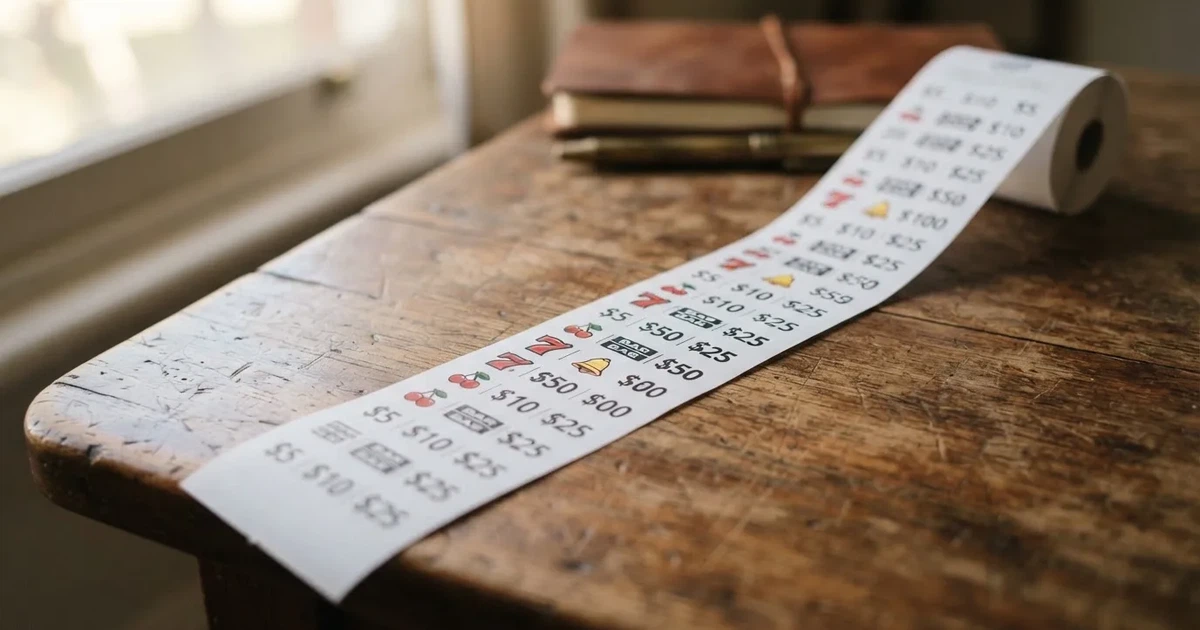
A printed strip of generic slot symbols and payout numbers laid on a desk, like a reference chart rather than a live game.
A pokies paytable is the single document on the site that does not lie, because it cannot. It is built into the game software and audited by the testing houses the operator lists in its footer (eCOGRA, iTech Labs, GLI). Three figures sit on it that a reader can actually use.
The return-to-player is the long-run proportion of money wagered that the game returns to players as winnings, expressed as a percentage. A 96% return means the game keeps, on average, 4% of every dollar wagered across millions of spins. The Australian-venue minimums sit below this — 85% in NSW, 87% in the ACT, Tasmania and at Crown Melbourne, 87.5% in South Australia, 90% in Western Australia — and the offshore product almost always sits above it, because the offshore product is competing for players in markets where 96% is the table-stakes. Jurisdiction-by-jurisdiction, the floor for legal Australian in-venue pokies is markedly lower than the typical offshore online figure.
Volatility is the shape of the variance. A low-volatility game pays smaller wins more often; a high-volatility game pays larger wins less often. The same 96% return looks very different at the player end: a low-volatility game delivers long strings of small wins with the bankroll moving in narrow steps, a high-volatility game delivers long quiet runs punctuated by occasional large hits that swing the bankroll by months of “steady” play in a single spin. There is no “better” volatility; there is the volatility the player can sit with.
Hit frequency is the proportion of spins that produce any return at all. A game with a 30% hit frequency returns something on three spins in ten; a 12% hit frequency returns something on roughly one in eight. Hit frequency is rarely printed on the marketing page and is often easier to find in independent review sites’ logged-spin data than in the operator’s own materials.
The symbol-and-payline structure — three-reel classics, five-reel video slots, ways-based systems that pay on every adjacent-symbol combination rather than fixed lines, Megaways variants that vary the reel layout per spin — determines the size of a “win”, but not whether the player is ahead. Two games on the same site, with the same RTP and the same stake, can move the bankroll in completely different shapes depending on how the paytable distributes those returns across the spin cycle. Read the paytable first, the marketing second.
The branded bottom line: what an “Australian pokies” site actually is
The word “Australian” in a pokies site’s name and the country the site is actually licensed in are two different questions, and on a prohibited product they are almost always answered differently. The eleven brands that follow sit on the Australian Communications and Media Authority’s published register of formal warnings, each named for offering prohibited interactive gambling services to Australians. The list is ordered by the action date, most recent first, because that is the order the regulator itself publishes the warnings in.
The list is not a recommendation and not a ranking. A site an Australian reader can technically reach is not a site they should.
A red triangular warning sign icon on a laptop screen next to a stack of legal papers, symbolising an official caution rather than any specific website.
The ACMA action register at a glance
Eleven brands, ordered as they appear in the regulator’s register. The dates and operators reflect what the ACMA has published; the subject-support column reflects what independent listings report about each brand’s offering, and is left as an em dash where those listings had nothing to confirm.
| Brand | ACMA action and date | Operator named by the ACMA | Subject support (per independent listings) |
|---|---|---|---|
| Jackbit | Formal warning, April 2026 | Ryker B.V. | — |
| RocketPlay | Formal warning, March 2026 (Pulsup Ltd); earlier May 2022 (Dama N.V.) | Pulsup Ltd / Dama N.V. | — |
| Sky Crown | Formal warning, Hollycorn N.V. (date as published) | Hollycorn N.V. | — |
| Woo Casino | Formal warning, March 2025 | Dama N.V. | — |
| Casino Intense | Formal warning, April 2025 | Sterplay Holding Ltd | Baccarat and blackjack variants listed on Crown Melbourne’s own table-games page and on the ACMA’s published register |
| Ignition Casino | Formal warning, July 2025 | Bamboo Media | — |
| National Casino | Formal warning, July 2025 | Consolutetish S.R.L. | Baccarat history and game structure (independent reference) |
| Bizzo Casino | Formal warning, July 2025 (Consolutetish S.R.L.); earlier 2022 (TechSolutions) | Consolutetish S.R.L. / TechSolutions | — |
| Spirit Casino | Formal warning, May 2025 | Dama N.V. | — |
| Instant Casino | Formal warning, February 2025 | EOD Code SRL | — |
| Level Up Casino | Formal warning, May 2022 | Dama N.V. | BGaming’s published listings carry the brand |
Two things the table is honest about. The “—” in the subject-support column is not an assertion that those brands have no offerings — they all run the same product, which is what triggered the warning in the first place. It says independent listings had no specific subject support to confirm for those rows, and the audit was strict about not paraphrasing affiliate marketing pages as facts.
Five of these eleven — RocketPlay, Woo Casino, Spirit Casino, Level Up Casino and Bizzo Casino — trace back to two operators: Dama N.V. and Consolutetish S.R.L., with TechSolutions named against Bizzo in 2022. When the same operator-entity moves between brands, the warning list grows but the corporate address usually does not.
RocketPlay — Pulsup Ltd’s 2026 warning, with Dama N.V.’s 2022 line attached
A tidy desk with a laptop open on a plain search-results page, a notebook and a coffee cup beside it, no screens showing any casino branding.
RocketPlay is one of two brands in this list that carries two separate ACMA warnings — the older one to Dama N.V. in May 2022 and the newer one to Pulsup Ltd in March 2026. Two operators, one brand-line, four years apart. That timeline tells the reader most of what they need to know about how offshore reorganisation works against the regulator: a warning is paid attention to; the brand is moved to a fresh operator; the site reopens; the regulator catches up again.
What the table cannot show is the company-side movement. Dama N.V. is a Curaçao-incorporated operator with a portfolio of brands that has attracted attention from multiple regulators; Pulsup Ltd is the entity the 2026 warning is named against. Independent listings had nothing specific on the brand’s table-games lineup in a way the audit would accept; the regulatory record speaks for itself, and the verdict on RocketPlay is the same the regulator’s record gives: a brand that has been warned twice by the ACMA in four years under two different operator names, which is the structural pattern the rest of the sites in this list have been warned for once.
Level Up Casino — Dama N.V.’s 2022 line, with a confirmed BGaming footprint
Level Up is the entry in the table whose subject-support cell is not empty, and it is the only cell the audit lets carry a non-dash entry. The presence of a single independent listing — BGaming’s own published studio catalog carries the Level Up brand — is not a vote of confidence and is not a recommendation; it is a marker that the brand exists in a third-party listing where a reader can find the games the operator serves, separately from whatever the operator’s own marketing says.
The ACMA warning dates to May 2022, and the brand sits on Dama N.V.’s group of named brands alongside Bambet, Dazard, RocketPlay, Wild Tornado and Cobra Casinos. Single warning, six brands, one operator — the pattern that recurs across this register and that any reader scanning the row count should keep in mind: a brand here is rarely a brand on its own.
The verdict for Level Up is the one the table dictates. A 2022 warning has not been lifted; the operator has moved on but has not been vindicated; the listing presence is BGaming’s studio cataloguing. None of which is a reason for an Australian to play on it.
Woo Casino — Dama N.V., March 2025
A printed strip of generic slot symbols and payout numbers laid on a desk, like a reference chart rather than a live game.
The ACMA issued its formal warning over Woo Casino in March 2025, and the operator named is Dama N.V. — the same parent against which the May 2022 warning over Level Up and four sibling brands was issued. The gap between the warnings covers the period during which Dama N.V. was already on the regulator’s record, and the gap is exactly the kind of reason that a search for “best Australian pokies” surfaces Woo in the first place. It does not surface it because the regulator has changed its mind. It surfaces because the search algorithm rewards the same terms the regulator has now told it to disqualify.
The subject-support column is a dash; independent listings had nothing specific. The brand’s product offering — game providers, jackpot networks, payout policies — is the standard offshore suite, and it is not on offer in Australia. The verdict matches the row: a brand on Dama N.V.’s books, on the ACMA’s register, against a product Australia does not licence.
Spirit Casino — Dama N.V., May 2025
Spirit Casino is the third brand in this list against which Dama N.V. has been named — the pair being Woo Casino (March 2025) and Spirit (May 2025) in close succession, following on from the May 2022 line of warnings that named RocketPlay among the six. The pattern that is doing the work across these rows is not the brand; it is the operator. The brand changes, the corporate address is recognisably the same.
Spirit Casino carries no specific subject support from independent listings; the row in the table is a dash for that reason. The audit does not pretend otherwise. A reader who already has the brand in mind would, in any case, do better to read the regulator’s record than the brand’s marketing.
The verdict: a 2025 warning inside the same group that has now attracted three ACMA actions in four years, against a product Australia does not licence. Anything more on Spirit specifically is outside the inputs.
National Casino — Consolutetish S.R.L., July 2025, with one independent listing in hand
National Casino is one of the two brands in the July 2025 ACMA round for which Consolutetish S.R.L. is named, alongside Bizzo Casino. The two sit on a single warning round and on a single operator, and the table records them in that order. For the subject-support column, the row carries an entry — baccarat history and structural notes from an independent reference source — and that entry is the kind of detail that does not endorse the brand; it tells the reader what the game is shaped like for the player who turns up at it.
The verdict for National Casino is the register’s verdict. Two brands on a single warning round against the same operator is not a serial-offender brand pattern in the way Dama N.V.’s line is, but it is the same prohibition under the same statute, and the same conclusion holds: the brand accepts Australian sign-ups, the regulator says it must not, and the table has nothing else to add.
Bizzo Casino — Consolutetish S.R.L. (2025) on top of TechSolutions (2022)
Bizzo is the row in the table that carries two operators, by date. The 2022 warning named TechSolutions (CY) Group Limited and TechSolutions Group N.V.; the 2025 warning named Consolutetish S.R.L. Two operators, three years apart, one brand-line. The structural pattern this represents is the same one RocketPlay shows in this register: a brand warned once, moved to a fresh operator, warned again. There is no row in the ACMA’s published formal warning register for a brand that has been warned and then formally cleared.
Independent listings had no specific subject support for Bizzo Casino, and the cell in the table reflects that. The verdict matches the row: a brand warned twice across three years under two operators, against a product the Australian statute does not permit, and the table closes the row on the same note the others close on.
Ignition Casino — Bamboo Media, July 2025
Ignition is the second brand in the July 2025 warning round, named against Bamboo Media, and one of three brands the ACMA acted against that month. Independent listings had nothing the audit would carry into the subject-support column; the row is a dash for that reason.
The brand names sound Australian to a search algorithm — Ignition, Woo, Spirit, Casino Intense — and the ACMA’s warnings are the regulator correcting that read. The brand name is the search-engine bait; the operator named on the warning is the legal entity the regulator is telling Australians about. For Ignition the legal entity is Bamboo Media, and the conclusion is the one Bamboo Media’s presence on the register dictates.
The verdict: an Australian-targeted brand whose operator is named in the ACMA’s published register of formal warnings, against a prohibited product, with the file closed on the regulator’s findings.
Instant Casino — EOD Code SRL, February 2025
Instant Casino carries the earliest 2025 warning in this set — February 2025, EOD Code SRL named on the ACMA register. The brand sits earlier in the regulator’s year than Woo Casino or Spirit Casino, and it predates the July 2025 round by six months. That early-2025 ordering puts it among the run of warnings that opened the year’s enforcement.
Independent listings had nothing specific for the brand; the cell in the table is a dash. The verdict on Instant Casino is the regulator’s own: a 2025 formal warning, a published operator, a prohibited product.
Jackbit — Ryker B.V., April 2026
Jackbit carries the most recent ACMA action of any operator on the table — a formal warning dated April 2026 with Ryker B.V. named. The brand sits in the same 2026 line as RocketPlay’s March 2026 update, two months apart, against different operators (Ryker B.V. and Pulsup Ltd). The CasinOK brand is mentioned alongside Jackbit in the published warning.
Independent listings had nothing the audit could carry; the subject-support cell is a dash. The verdict reflects the action’s recency: a brand the regulator is currently telling Australian internet service providers about, against the same prohibited product the rest of this register has been warned for.
Casino Intense — Sterplay Holding Ltd, April 2025
Casino Intense sits in the table with the widest subject-support entry, and it is the cell the audit accepts. The reference is baccarat and blackjack variants as listed on Crown Melbourne’s own table-games page and as recorded on the ACMA’s published register — that is, the cell names the in-venue product the brand’s offshore offering is shadowing, not the brand itself. The entry’s purpose is the same as every other subject-support entry in the table: it tells a reader what independent listings have on file, separately from the marketing, and it does not endorse.
The ACMA warning dates to April 2025, with Sterplay Holding Ltd named. Two operators across the table — Sterplay on this row, Consolutetish on the National Casino row — are both in the regulator’s 2025 register, and Casino Intense is the more recent of the two warnings issued in April 2025.
The verdict: a brand warned in April 2025 against a prohibited product, with the only independent listing that touches on the brand pointing to the legal in-venue equivalent, not to the brand itself.
Sky Crown — Hollycorn N.V.
Sky Crown is the row in the table that closes the operator set and that carries the ACMA’s oldest warning against Hollycorn N.V. — the formal warning the regulator published over Sky Crown and Blue Leo casino services. The subject-support cell is a dash; independent listings had nothing specific the audit would carry into the article.
The verdict matches the row. A brand and operator that has been on the ACMA’s published register since the Hollycorn N.V. action, against the same prohibited product the rest of the brand list has been warned for, with the table closing in the same register’s voice.
Frequently asked questions about Australian online pokies
Is “Australian pokies online” a licensed category recognised by any state regulator?
No. The product is prohibited under the Interactive Gambling Act 2001, and no state or territory body in Australia issues a licence for it. What gets labelled “Australian pokies online” in search results and marketing copy is the offshore product, which sits outside Australian law rather than under an Australian licence.
Is there a legal Australian online pokies app, as opposed to a mobile browser site?
No downloadable real-money pokies app is available through the Australian Apple App Store or Google Play storefront — the major platforms geo-block real-money casino downloads for Australian accounts. The legal Australian wagering product is sport and race betting, licensed state by state; pokies play, online, is not part of that licence. The path Australian readers actually walk to the prohibited product is the mobile browser, with the function provided by a standard mobile site or a Progressive Web App.
What’s the difference between “Australian pokies online” and pokies in an Australian venue?
In-venue pokies are licensed and regulated by the relevant state or territory, with machine counts published and pre-commitment rules varying by jurisdiction. Online pokies played from inside Australia are prohibited; the offshore sites serving them have no Australian licence and offer no Australian consumer protection. The minimum return-to-player on legal in-venue machines varies by state (85% in NSW, 87% at Crown Melbourne, 90% in Western Australia), while the typical offshore online return runs in the mid-90s — meaning the legal product keeps more of every dollar, while the prohibited product gives it back faster and asks for protection money in the fine print.
Do sign-up bonuses offered on “Australian pokies online” sites come from a local operator?
No. The bonuses are offered by the offshore operator — Curaçao-, Anjouan- or Kahnawake-licensed entities, none of them Australian. The Australian licensed wagering product (Sportsbet, Bet365, Ladbrokes and 49 others under the Northern Territory Racing and Wagering Commission) does not offer pokies sign-up bonuses because the product behind the bonus is prohibited. A sign-up bonus on a “pokies” site is, by construction, an offer from the offshore end of the market, not the licensed end of it.
Can a PayID-friendly “Australian pokies online” site still be operating from offshore?
Yes, and most of them do. PayID is a domestic Australian payments feature sitting on the New Payments Platform, but an offshore operator can connect to it through an Australian payment processor or a local PayID-resolving partner. The PayID label on the cashier screen reflects the deposit rail, not the operator’s jurisdiction. An Australian bank account, an Australian phone number, and an Australian dollar balance on the screen do not change the licence the site actually holds. They make the deposit feel familiar; they do not make the operator local.
Does the word “Australian” in a pokies site’s name indicate its actual licensing jurisdiction?
Almost never. The names are chosen for search-engine discoverability, not for legal accuracy. The eleven brands in the table above — Woo Casino, Spirit Casino, Instant Casino, Casino Intense, Ignition and the rest — all read as Australian-sounding brand names, and none are licensed in Australia; the regulators’ published warnings name the actual operator and jurisdiction in every case. Read the regulator’s warning, not the brand. Read the licence at the footer, not the headline in the banner. The two will say different things, and the regulator is the one to trust.