
Apple Pay at online casinos in Australia — what an Australian punter can actually do with a digital wallet
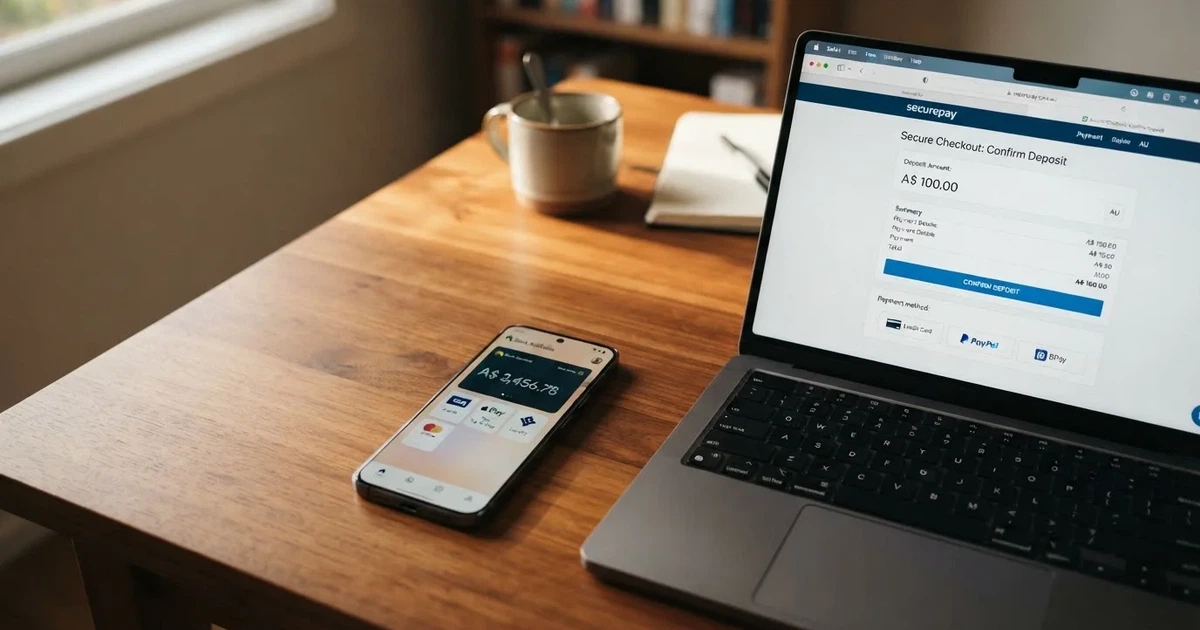
Apple Pay has reshaped the way Australians pay at the supermarket, the servo and the pub. By the end of 2025, Apple Pay, Google Pay and Samsung Pay together accounted for around 45% of all card payments in Australia by number, which is no longer a footnote about a fancy wallet for early adopters. The question this page tries to answer honestly is whether that same wallet has any real place at an online casino when the player sits in Australia, and what an Australian punter should expect when an offshore site lists Apple Pay at its cashier.
Current as of 17 October 2026. Cross-checked against the Australian Communications and Media Authority’s published blocking requests and formal warnings.
Table of Contents
- How Apple Pay actually settles at an online casino
- What the ACMA’s blocking record actually shows
- Why no Australian-licensed online casino takes Apple Pay
- The operators the ACMA has formally warned
- What a punter should do before tapping Apple Pay at any of these sites
- Responsible gambling in a market where the casino is unlicensed
- Frequently asked questions
How Apple Pay actually settles at an online casino
An Apple Pay deposit is, at the bank end, a card transaction. The wallet tokenises the underlying debit or credit card, the merchant’s payment gateway reads it as a card authorisation, and the issuing bank either approves or declines. Nothing about the token makes it a different payment rail: the merchant’s processing contract is still with the card network, the network still charges its interchange, and the merchant’s bank still collects its acquiring fee. Apple itself does not charge consumers for using Apple Pay in stores, online or in apps, so any surcharge the punter sees at the cashier comes from the merchant’s own card-processing fee, not from Apple.

That distinction matters more than it sounds, because it explains why an Apple Pay deposit behaves at a casino exactly the way a Visa or Mastercard deposit behaves, and not the way a PayID or Osko bank transfer behaves. A PayID transfer is a real-time bank-to-bank credit through Australia’s New Payments Platform — a transfer of actual funds, settled in under a minute twenty-four hours a day through more than 100 Australian financial institutions. An Apple Pay tap is still a card authorisation, even when the wallet hides the card number. The punter who picks Apple Pay at the cashier is paying with their card, in the eyes of their bank, in the eyes of the merchant, and in the eyes of any gambling block the bank has switched on.
Limits sit with the card issuer, not with Apple. Apple states that transaction limits and PIN requirements for Apple Pay purchases are set by the card issuer or merchant, not by Apple itself, so a maximum stake the punter sees at a casino cashier is the issuer’s floor or the merchant’s ceiling, not a setting Apple has made. Westpac’s gambling block, for one, works at card level — it refuses authorisation of transactions registered under the merchant category code “Betting/Casino Gambling” on eligible personal credit and debit cards — which means an Apple Pay deposit from a Westpac card on which the block is active will bounce at authorisation, however cleanly the wallet performs.
The settlement question is the one most guides leave unanswered. The research on offer does not publish a consistent Apple-Pay-specific payout time, because there is no Australian operator licensed to take casino deposits to measure it against. At an offshore site the Apple Pay withdrawal request still needs the casino’s own manual checks completed before the settlement lands back in an Australian account, which can mean the punter is waiting on the casino’s fraud team, the card network and the issuing bank rather than on a single rail. Reporting Apple Pay as faster than a card withdrawal at these sites is a guess dressed as a finding.
What the ACMA’s blocking record actually shows
The cluster of facts worth staring at is the ACMA’s blocking record, because that is where the regulator has said, in writing and on the record, what it thinks of the offshore casino market. According to the ACMA as reported in June 2026, a total of 1,751 illegal gambling and affiliate marketing websites had been blocked since the first blocking request in November 2019, and more than 230 unlicensed gambling services had left the Australian market since enforcement was strengthened in 2017. That is the headline, but it flattens out the pace.
The blocking-rate calculation the page is built around is the average number of sites the ACMA has directed Australian ISPs to block per year since the first request in November 2019. The inputs are the running total of 1,751 blocked sites and the date of the first blocking request, November 2019. The first request sits inside November 2019 rather than on a known day of that month, so the denominator is best read as approximately six and a half years between November 2019 and the June 2026 report. Worked through, the rate lands in a band of roughly 250 to 290 sites per year — call it the order-of-magnitude figure, not a precise monthly average, because the ACMA publishes in rounds, not on a fixed cadence, and any single round can shift the annual figure by tens of sites in either direction.
The thing the band makes visible is that the ACMA has been blocking sites faster than the unlicensed market has been opening new ones, which is the only honest reading of a number that has reached four digits. The round reported on 26 June 2026 alone asked Australian ISPs to block 12 more illegal gambling websites — 7Signs, ChromaBet, Donbet, Duospin, Freshbet, Slots Gem, Jacks Club, Lucky Start, Pointsbetz.com, Spinrise, Vinyl Casino and Wildsino — and that single round is consistent with the long-run rate rather than exceptional.
What the band cannot tell a punter is whether any particular site they are looking at has already been blocked, is queued for a block, or has slipped through a round entirely. The ACMA publishes blocking requests in batches, the courts uphold them in their own time, and the ISPs implement them at the network edge, so a site that is live in a punter’s browser today can be unreachable tomorrow with a balance still on it.
Settiement at the cashier — what the wallet does and does not change
Set against that blocking record, the cashier story becomes shorter. At an offshore casino the punter choosing Apple Pay is choosing to deposit with a card the wallet has tokenised, against an operator the ACMA has either formally warned or, in many cases, has had blocked. The casino’s own terms treat the Apple Pay transaction as a card transaction for the purposes of bonus eligibility, withdrawal rules and any internal “processing fee” the casino layers on top. There is no Apple Pay rail that bypasses the casino’s own checks; the wallet is a way of presenting the card, not a way of presenting a separate kind of payment.
That is also why a punter with a bank’s gambling block active sees Apple Pay decline at the merchant the same way the underlying card would decline, even though the wallet itself is functioning normally. ANZ’s gambling transaction block, activated in the ANZ app, blocks gambling transactions made through a digital wallet such as Apple Pay on an eligible card, not just the physical card. Commonwealth Bank’s gambling lock, applied through the CommBank app, automatically blocks most gambling transactions, though the bank states it cannot guarantee all gambling-related purchases will be stopped. Westpac’s block operates at the card authorisation step. In each case the punter is told the wallet refused the payment when, in fact, the issuing bank refused the authorisation that the wallet was passing through.
A practical wrinkle sits on the other side of the block, too. Once a customer turns on ANZ’s gambling block, removing it again requires a 48-hour waiting period, and the bank warns that not all gambling transactions will be blocked and some non-gambling transactions might be blocked in error. So a punter who switches the block off to deposit, then back on, is sitting through two days during which neither block is fully off and neither block is fully on — a deliberate cooling-off the bank has built in because the operator is not the only party whose incentives matter at this step.
Why no Australian-licensed online casino takes Apple Pay
The deeper answer is that no Australian-licensed online casino exists at all. The Interactive Gambling Act 2001, strengthened by the Interactive Gambling Amendment Act 2017, makes it an offence to provide online casino games, online pokies or in-play betting to a person in Australia, and no state or territory licenses them. What is licensable is wagering on races and sport placed before the event, lotteries and keno — in practice licensed by the Northern Territory, where the Northern Territory Racing and Wagering Commission regulates 52 of Australia’s online bookmakers — including Sportsbet, Bet365 and Ladbrokes — which are licensed in the Territory for tax reasons, and where the commission has no full-time staff and meets once a month in Darwin. The licensed wagering market is real, the licensed online casino market is not, and the punter who wants pokies on a phone has no legal Australian site to take them to.
What the licensed wagering market is allowed to take, by payment method, has been tightened sharply. Under the Interactive Gambling Act 2001 as amended in 2023, Australian-licensed online wagering services cannot accept payment by credit card or other credit-related products, a restriction that also constrains gambling use of linked digital wallets like Apple Pay. The rule reads on the page like a separate credit-card ban, but its effect at the wallet is direct: the punter cannot fund a licensed wagering account from a credit card, and that includes the credit card that sits behind an Apple Pay token. Legal deposit routes for licensed wagering are debit card, bank transfer, PayID/Osko and BPAY — none of which is a credit instrument and all of which clear through an Australian bank rather than a card network. A licensed site asking an Australian for a credit card or a crypto deposit is operating outside the Australian rules.
The credit-card ban sits inside a broader prohibition structure. Penalties for an Australian-licensed operator taking a credit card reach A$247,500, and the ACMA investigates, issues formal warnings and directs ISPs to block illegal sites in the way the blocking record above shows. The individual player is not prosecuted — the IGA targets the provider, not the punter — but an offshore site gives no Australian consumer protection, no complaints body and no recourse if a withdrawal is refused, and it can be blocked with a balance still on it.
The 2026 reform package, briefly
The Interactive Gambling Amendment (Gambling Reform) Bill 2026 passed Parliament on 19 August 2026; its advertising and inducement measures commence on 1 January 2027. That is law with a start date, not yet in force on a page published in this year, and the page should be read accordingly. The reform widens what counts as an inducement and how it is policed, but the credit-card rule, the offshore prohibition and the ACMA’s blocking powers were already the live frame for any Apple Pay transaction an Australian punter might attempt in 2026.
Tax, briefly
Gambling winnings of a recreational player are not assessable income under section 6-5 of the ITAA 1997, and losses are not deductible, unless the person carries on a business of gambling — which is the model only, and a punter in that position should check with the ATO. Most readers will read past this, which is the right amount of attention for most readers to give it.
The operators the ACMA has formally warned
The brands below are not a ranking. The list reflects the brands the ACMA itself has named in formal warnings issued under the Interactive Gambling Act 2001. Each is described for what the regulator has said about it, not as a recommendation. None of the eleven is licensed to take Australian players. Online casino games cannot be licensed anywhere in Australia, whatever licence the site displays.
| Brand | ACMA action and date | Operator named by the ACMA | Subject support |
|---|---|---|---|
| RocketPlay | Formal warning, March 2026 | Pulsup Ltd (Rocketplay.com.au); earlier Dama N.V., May 2022 | — |
| Level Up Casino | Formal warning, May 2022 | Dama N.V. | listings-only (Westpac) |
| Woo Casino | Formal warning, March 2025 | Dama N.V. | — |
| Spirit Casino | Formal warning, May 2025 | Dama N.V. | — |
| National Casino | Formal warning, July 2025 | Consolutetish S.R.L. | listings-only (AUSTRAC, Wikipedia) |
| Bizzo Casino | Formal warning, July 2025; earlier 2022 | Consolutetish S.R.L.; earlier TechSolutions | — |
| Ignition Casino | Formal warning, July 2025 | Bamboo Media | — |
| Instant Casino | Formal warning, February 2025 | EOD Code SRL | listings-only (ecoPayz, PayID) |
| Jackbit | Formal warning, April 2026 | Ryker B.V. | — |
| Casino Intense | Formal warning, April 2025 | Sterplay Holding Ltd | listings-only (AUSTRAC, iTnews, NAB) |
| Sky Crown | Formal warning, September 2022 | Hollycorn N.V. | — |
A blank in the subject-support column means research did not surface an Apple Pay connection; a “listings-only” entry means the only sources for a connection are the listings themselves, not a confirmation that the brand processes Apple Pay end-to-end. The column reads the way the research reads on this point: most of the brands have no verified Apple Pay footprint in the data the page is built from.
RocketPlay
RocketPlay was named by the ACMA in March 2026 in a formal warning issued to Pulsup Ltd over Rocketplay.com.au. The same brand sits on an earlier formal warning to Dama N.V. from May 2022, when Dama N.V. was warned over six casino brands including Rocketplay, Bambet, Dazard, Level Up, Wild Tornado and Cobra Casinos. The ACMA’s record says the site was offering prohibited interactive gambling services to Australians. Research did not surface a verified Apple Pay connection; the brand sits on the page because the regulator has acted against it, and the absence of a wallet link in the data is itself the point.
For a punter choosing between this and the next site on the list, what matters is that RocketPlay is a brand with a current ACMA warning at a different corporate parent to its 2022 one — the corporate entity behind the site has moved, but the brand and the regulator’s view of it have not.
Level Up Casino
Level Up Casino was named by the ACMA in May 2022 in a formal warning to Dama N.V. covering six brands; Level Up is one of the six. The subject support here is listings-only, meaning the data points to Level Up through Westpac’s published merchant-category-code block list rather than through a verified wallet integration. The punter should read the entry as a brand the ACMA has named, with a possible rather than confirmed Apple Pay connection.
The judgment that closes the entry: a brand whose only Apple Pay trace is a bank’s block list is a brand whose casino product a punter’s wallet will be rejected from paying, not one whose wallet integration has been independently confirmed.
Woo Casino
Woo Casino was named by the ACMA in March 2025 in a formal warning to Dama N.V., one of two warnings the same operator received within three months — Spirit Casino followed in May 2025. The regulator’s record on Dama N.V. is now an unusually long one, and Woo sits at the head of the second cluster. No Apple Pay footprint was surfaced in research for this brand.
For the punter, the Woo Casino entry is a test of whether the second warning to the same operator changes the calculus. It does not, on the data here — the regulator’s view is consistent, and the brand’s product remains an unlicensed one.
Spirit Casino
Spirit Casino was named by the ACMA in May 2025 in the second of the two Dama N.V. warnings. It sits, in the ACMA’s published record, alongside Woo Casino as a brand owned by the same operator and warned for the same kind of conduct — offering prohibited interactive gambling services to Australians. No Apple Pay connection was surfaced for Spirit Casino.
The judgment: the second warning to Dama N.V. inside three months is not a doubled penalty, it is the regulator doing what it has done since 2017, which is naming the operator, naming the brand and asking ISPs to enforce.
National Casino
National Casino was named by the ACMA in July 2025 in a formal warning to Consolutetish S.R.L. Consolutetish was warned that month over both National Casino and Bizzo Casino. The subject support is listings-only, meaning the only sources linking National Casino to the payments stack on this page are AUSTRAC and Wikipedia entries, not a wallet-integration confirmation.
For a punter comparing National Casino with Bizzo Casino, the corporate parent is the same and the ACMA’s view of it is the same; the only thing that separates the brands is the brand name and the bonus code, neither of which the regulator has weighed.
Bizzo Casino
Bizzo Casino was named by the ACMA in July 2025 in the Consolutetish S.R.L. warning, and an earlier formal warning over Bizzo Casino was issued in 2022 to TechSolutions (CY) Group Limited and TechSolutions Group N.V. The July 2025 warning is the second formal warning tied to Bizzo Casino since 2022, which is the longer track record on the ACMA’s list and the more deliberate choice the regulator has made over the brand. No Apple Pay footprint was surfaced in research.
The judgment: a brand that has received two ACMA formal warnings under two different operators in three years is a brand the regulator has put more weight into blocking than the median one on this list. That is not a reason to choose or reject it for play — neither is the regulator’s role — it is information about who has been looked at most carefully.
Ignition Casino
Ignition Casino was named by the ACMA in July 2025 in a formal warning to Bamboo Media. Bamboo Media was warned that month over Ignition Casino alone, not in combination with another brand. No Apple Pay connection was surfaced in research for Ignition Casino.
Instant Casino
Instant Casino was named by the ACMA in February 2025 in a formal warning to EOD Code SRL. The subject support is listings-only, meaning the data points to Instant Casino through ecoPayz and PayID entries rather than through a confirmed Apple Pay integration. The punter reading this should treat “Instant Casino accepts Apple Pay” as a claim the listings make, not as one research has verified.
Jackbit
Jackbit was named by the ACMA in April 2026 in a formal warning to Ryker B.V. Ryker B.V. was warned that month over Jackbit and CasinOK, in a single action. No Apple Pay connection was surfaced in research for Jackbit.
Casino Intense
Casino Intense was named by the ACMA in April 2025 in a formal warning to Sterplay Holding Ltd. The subject support is listings-only, meaning the data points to Casino Intense through AUSTRAC, iTnews and NAB entries rather than through a verified wallet integration. The punter reading this should read it the same way they read Instant Casino: the payments-stack claim is the listings’ claim, not research’s.
Sky Crown
Sky Crown sits on a Hollycorn N.V. formal warning the ACMA published in September 2022, the same warning that covered Hollycorn’s Blue Leo brand. Sky Crown is the older of the two Hollycorn brands the regulator has named in a single action. No Apple Pay connection was surfaced in research for Sky Crown.
The judgment: a brand on a 2022 formal warning whose operator has not reappeared in the ACMA’s published record since is not a brand the regulator has stopped watching, only one the regulator has not had to publish on again in the data the page is built from.
What a punter should do before tapping Apple Pay at any of these sites
The honest list is short. Confirm whether the site is licensed to take Australian players — for online casino games the answer is no, by force of the Interactive Gambling Act 2001. Check whether the issuing bank has a gambling block active on the card behind the wallet — Westpac, ANZ and Commonwealth Bank all publish how their blocks treat Apple Pay and digital-wallet transactions, and each warns that the block is not perfect. Decide whether the operator the wallet is paying has been formally warned by the ACMA — the table above is the surface that lets a punter do this without visiting every brand’s “About” page. Read the casino’s own terms on card withdrawals, bonus eligibility and any processing fee the operator applies to Apple Pay transactions, because the wallet does not change those terms, only the surface the punter pays through.
The deeper read sits one level below that list. The marketing word for offshore casinos is “trusted”, and the ACMA’s blocking record is the test of it. The H2 Gambling Capital 2025 report estimates that Australians lose about A$3.9 billion a year to illegal gambling sites, and that the share of gambling going through legal channels fell from 74% in 2021 to 64%. A market that loses 36 cents in the dollar outside legal channels is a market the trusted-by-marketing claim has to clear before a punter believes it. The arithmetic the regulator has published — the blocking rate, the formal-warning count, the estimated loss — sits beside any Apple Pay deposit, and it does not change whether the wallet is approved.
Responsible gambling in a market where the casino is unlicensed
The player-protection machinery that exists in Australia is built for the licensed market, and the unlicensed market does not connect to it. BetStop, the National Self-Exclusion Register, has been live since August 2023 and binds only Australian-licensed online and phone wagering services — an offshore casino is not connected to it, so a punter who has self-excluded through BetStop is still able to deposit at the brands on the table above if their card’s gambling block is also off. The National Gambling Helpline on 1800 858 858 is free, available twenty-four hours a day, and offers chat at Gambling Help Online for anyone who would rather type than talk. A punter at an offshore site who finds themselves chasing losses, chasing time, or chasing a deposit that did not clear should treat the helpline as the first call, not the last.
The bank-side blocks are the second layer. Westpac’s card-level block, ANZ’s card-and-wallet block and Commonwealth Bank’s in-app gambling lock are imperfect — each bank’s own page says so — but they are the only layer a punter can switch on without the operator’s consent, and they apply to Apple Pay transactions exactly the way they apply to the underlying card. A punter who is not at the helpline stage and not at the BetStop stage is at the bank’s block stage, and the block’s 48-hour cooling-off at ANZ is not a glitch, it is the design.
Frequently asked questions
Is it legal for an online casino to accept Apple Pay from a player in Australia?
No online casino may lawfully offer its games to an Australian resident under the Interactive Gambling Act 2001; the payment method used does not change that. Apple Pay deposits at offshore sites are accepted by the operator but take place outside the Australian licensing frame, and the punter has no Australian consumer protection, no complaints body and no recourse if a withdrawal is refused.
What is the smallest deposit an Apple Pay casino site usually asks for?
The brands the ACMA has named in formal warnings generally publish a minimum deposit that sits in the low double-digit dollar range for cards, and Apple Pay inherits that minimum because the wallet presents a card authorisation. Where a punter sees a higher minimum at the cashier, it is typically because the issuing bank has applied its own floor or the operator has gated a particular bonus behind a higher first deposit.
Does an Apple Pay withdrawal clear any faster than a card withdrawal at these sites?
There is no Australian operator licensed to take casino deposits, so there is no consistent Australian payout-time data to compare. At offshore sites the Apple Pay withdrawal request still needs the casino’s own manual checks completed before the settlement lands back in an Australian account, and any speed advantage is operator-specific rather than wallet-specific.
Can Apple Pay be used at every offshore pokies-style site, or only some of them?
Only at sites whose payment gateway supports Apple Pay as a card-presenting method, and only at sites whose operator has not been blocked by the ACMA since the punter last visited. Research did not surface a verified Apple Pay integration for most of the brands the ACMA has formally warned, and the listings-only connections that exist are the listings’ claim, not a confirmed end-to-end integration.
Does depositing with Apple Pay add an extra fee at these casino sites?
Apple itself does not charge consumers for using Apple Pay, so any fee the punter sees comes from the merchant’s own card-processing surcharge, not from Apple. Some offshore operators layer their own processing fee on top of that, and the punter should read the cashier page for the merchant’s surcharge and the casino’s terms for any operator-level fee before authorising.