
Live roulette with English-speaking dealers in Australia: what is actually available and what is allowed
A live roulette wheel is the simplest table game in a casino to watch and one of the hardest to place legally in Australia. The streaming technology, the English-speaking dealer, the bitcoin deposit and the PayID withdrawal are all real — none of that changes the underlying prohibition on online casino games to Australians under the Interactive Gambling Act 2001. What this page sets out is the choice a reader genuinely has: what the table looks like, what the wheel configurations pay, who the regulator is, where the licensed product ends and the offshore product begins, and which brands the Australian Communications and Media Authority has already had cause to name.
Current as of 17 October 2026; licence and warning records cross-checked against the ACMA’s published register of formal warnings and blocking requests.
Table of Contents
- How Australia’s gambling law treats a live roulette stream
- Player protection routes that only apply inside the licensed part of the market
- Crypto funding does not change the wheel
- What changes when the wheel has a different number of zeros
- How a live roulette payout is processed compared with a slot payout
- Patterns do not help. The wheel has no memory.
- Brands the ACMA has officially warned
- What the blocking rate says about the pace of the regulator’s work
- What a “live dealer who speaks English” actually means at the table
- A few things an honest page should say plainly
- Frequently asked questions
How Australia’s gambling law treats a live roulette stream
The Interactive Gambling Act 2001 (IGA), tightened by the Interactive Gambling Amendment Act 2017, makes it an offence for a company to supply an online casino game to a person physically in Australia. The law names the activity rather than the technology. A live roulette stream from a studio in Riga or Malta is “a casino game supplied online” exactly as much as a software-generated spin — the dealer being live and the chat box being live does not move the table from one regime to another. No state or territory licence is available for online casino products. The product is prohibited at the supply end, not the player end: the IGA targets the provider, and the individual Australian who places a bet is not prosecuted.
What is licensable is wagering on races and sporting events placed before the event, lotteries and keno. In practice these are run by the Northern Territory Racing and Wagering Commission (NTRWC), which regulates 52 of Australia’s online bookmakers, including Sportsbet, Bet365 and Ladbrokes, and which meets once a month in Darwin with no full-time staff. Victoria’s land-based casino — Crown Melbourne — is regulated separately by the Victorian Gambling and Casino Control Commission (VGCCC), which took over from the VCGLR on 1 July 2022 and approves any change to table-game rules at the venue under the Casino Control Act 1991. None of this licences an online roulette table.
The enforcement engine is the ACMA. Its tools are formal warnings to the operators behind a brand, written directions to Australian internet service providers to block domain names, and referrals. As of the round reported on 26 June 2026, the ACMA had asked ISPs to block 1,751 illegal gambling and affiliate marketing websites since the first blocking request in November 2019, and more than 230 unlicensed gambling services had left the Australian market since the 2017 strengthening. The most recent 12-site block round, on the same date, took in 7Signs, ChromaBet, Donbet, Duospin, Freshbet, Slots Gem, Jacks Club, Lucky Start, Pointsbetz.com, Spinrise, Vinyl Casino and Wildsino. A site an Australian can still reach is not by that fact licensed to take Australian play — most offshore casinos are simply not yet on a block list.
H2 Gambling Capital’s 2025 estimate puts Australian losses to illegal gambling sites at about A$3.9 billion a year, and the share of gambling going through legal channels has fallen from 74% in 2021 to 64%. The scale of the offshore market is the reason the ACMA publishes the warnings it does — every brand below is on the register because the ACMA has already had cause to write to the operator.
The Interactive Gambling Amendment (Gambling Reform) Bill 2026 passed Parliament on 19 August 2026 and its advertising and inducement measures commence on 1 January 2027 — a law with a start date, not yet in force on a 2026 page, but worth knowing about because the inducement rules will tighten the rules around what an offshore operator can advertise to an Australian reader.
Player protection routes that only apply inside the licensed part of the market
The Australian consumer-protection apparatus attaches to the licensed side. BetStop, the National Self-Exclusion Register, has been live since August 2023, but it binds only Australian-licensed online and phone wagering services — an offshore casino is not connected to it, and self-excluding from BetStop does not stop an offshore brand from accepting a deposit. The National Gambling Helpline is 1800 858 858, free and open 24 hours a day, with web chat at Gambling Help Online, and these routes are useful regardless of which side of the line a punter has been playing on.
On payments, credit cards, credit-related products and digital currency are banned as a means of paying for licensed online wagering as of 11 June 2024, with penalties up to A$247,500 for an operator who takes them. The legal deposit routes for a licensed Australian wagering account are debit card, bank transfer, PayID/Osko and BPAY. An offshore site that asks for a credit card or a crypto deposit is operating outside the Australian rules on payment, in addition to the underlying supply prohibition.
The IGA does not change the tax position. Recreational gambling winnings are not assessable income under section 6-5 of the Income Tax Assessment Act 1997, and losses are not deductible, unless the person carries on a business of gambling — a category that covers very few readers of this page, and is worth checking with the ATO before assuming.
Crypto funding does not change the wheel
A bitcoin-funded live roulette table spins the same physical wheel as a card-funded one, with only the deposit route changed. The house edge does not shift because the player paid in BTC, the payout math does not change, and the dealer on the other end of the stream is the same dealer. The IGA prohibition on supply attaches to the game, not to the funding instrument — and the funding instrument is also restricted, since 11 June 2024, for any operator who would otherwise be licensed to take Australian wagering. The two restrictions are separate and they stack: a crypto-funded live roulette table to an Australian is, on the supply side, prohibited as an online casino game, and on the funding side, outside the rules a licensed Australian operator has to follow.
This is why the bitcoin-roulette pitch and the PayID-roulette pitch both lead back to the same offshore operator: most of the brands on the ACMA’s warning register accept cards, e-wallets and crypto interchangeably, because the product itself is not licensed to be sold here in any funding form.
What changes when the wheel has a different number of zeros
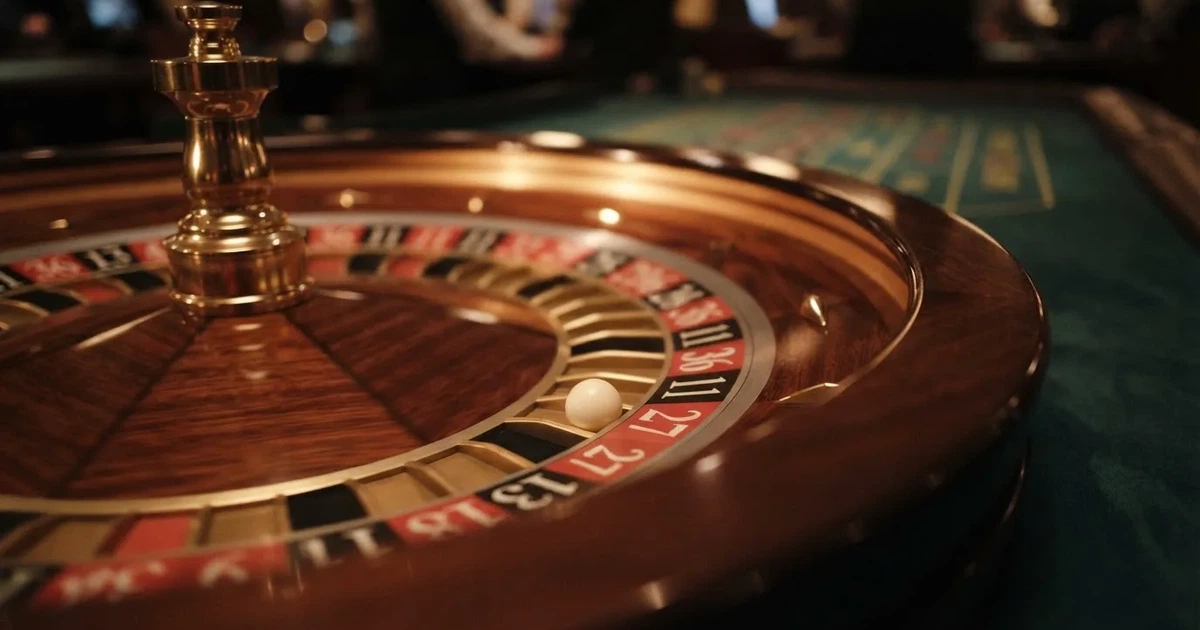
The game the page is about is roulette, and the house edge on a roulette bet is fixed by the wheel, not by the brand. A single-zero wheel — the European layout, 37 pockets in total — gives a house edge of 2.70% on every bet except the five-number combination. A double-zero wheel — the American layout, 38 pockets — gives a house edge of 5.26% on every bet except that same five-number combination, which is the worst in conventional roulette at 7.89%. A triple-zero wheel, rarer and used by a small number of US operators, has 39 pockets (0, 00, 000 and 1-36) and a house edge of 7.69%.
The practical differences:
| Wheel layout | Pockets | House edge on a straight-up bet |
|---|---|---|
| European / single-zero | 37 | 2.70% |
| American / double-zero | 38 | 5.26% |
| Triple-zero | 39 | 7.69% |
Some European tables add an “en prison” or “la partage” rule on the even-money outside bets: a spin that lands on zero either imprisons the stake for one more spin or returns half of it, which drops the effective house edge on those bets to about 1.35%. It applies only to red/black, odd/even and high/low — not to inside bets, and not on American or triple-zero layouts. The rule is worth knowing because live studios use it as a marketing line, but it does not change the table from one wheel to another.
Roulette as a game developed out of the Italian game Biribi, with Blaise Pascal possibly working on a primitive form in the 17th century during research into perpetual motion; the modern game emerged in 18th-century France, with documented play in Paris from 1796. The wheel layouts in use today — single-zero, double-zero and triple-zero — are refinements on that French form, and the difference between them is essentially what share of each bet the house keeps. The wheel does not “know” what is on it; the house edge is set by the paytable for the layout.
How a live roulette payout is processed compared with a slot payout
A live roulette payout, whether requested via PayID or any other method, waits on the same withdrawal review process as any other casino cashout: a pending period for fraud and bonus-wagering checks, then the payment rail. A slot-machine payout on a regulated Australian site goes through the same review; the game type changes nothing about the queue. The difference is what triggers the queue — on a live table, the dealer closes the betting window and the system credits wins and debits losses at the spin’s resolution, after which the player can withdraw whatever the balance sits at, subject to any bonus terms in play. On a slot, the credit happens immediately on a spin and the player can withdraw as soon as the review completes. In both cases the speed ceiling is the payment rail: PayID/Osko to an Australian bank account is typically minutes, an international wire is days.
For an offshore site, the rail is longer and the recourse is shorter. A withdrawal blocked at review, a bonus term applied retroactively, a “max cashout” clause biting on a win above the cap — all of these can be appealed to a licensed regulator’s complaints body on an Australian-licensed site, and none of them can be appealed anywhere on an offshore one.
Patterns do not help. The wheel has no memory.
Watching a spinning wheel repeatedly, especially one with a live dealer, can create the sense that a pattern is forming — that black is “due”, or that a sector of the wheel is hot. The wheel has no memory. Every spin is independent. The probability of red after three blacks in a row is the same as the probability of red on the first spin, which is 18/37 on a European wheel or 18/38 on an American one. Betting systems built on the previous few spins — Martingale, Fibonacci, “follow the streak” — do not change the expected loss per unit wagered; they change the distribution of outcomes, usually by making rare large wins less rare and routine small losses larger. A fixed loss limit matters more on a live roulette table than on most other casino games, precisely because the table is slow enough that a punter can sit and watch a pattern form that isn’t there.
Brands the ACMA has officially warned
A “top 11 live roulette casinos” page is one an honest editor cannot write for the Australian market, because every brand on it would be in breach of the Interactive Gambling Act. The list below is the closest the page can come, and the only ranking criterion it has: the order in which the ACMA itself has acted. Each entry is included because the regulator has had cause to write to the operator behind it. None is recommended. The licence shown on the site footer is irrelevant; offshore licences are licences to operate from that jurisdiction, not licences to supply to Australians.
RocketPlay
The ACMA’s most recent formal warning over this brand is dated March 2026 and names Pulsup Ltd as the operator of Rocketplay.com.au. An earlier warning, dated May 2022, named Dama N.V. alongside five other casino brands, including RocketPlay. Two operators, two warnings, the same brand — a fairly common shape when an offshore site is re-shelled under a new company after a regulator’s first action. The site itself offers a live casino lobby and accepts the funding instruments an Australian-licensed operator is banned from taking since 11 June 2024. The page has no subject-support data to attach.
Level Up Casino
Dama N.V. received a formal warning in May 2022 covering six brands at once — Bambet, Dazard, Level Up, RocketPlay, Wild Tornado and Cobra Casinos. Level Up is one of the six, and the brand is listed on aggregator pages as carrying BGaming content, which is the only subject-support data the research carries for it. The site is still reachable from an Australian IP at the time of writing; whether it remains on the next block list is the ACMA’s call, not the player’s.
Woo Casino
Dama N.V. was warned again over Woo Casino in March 2025. A second warning to the same operator, on a separate brand, is the regulator signalling that the previous action did not produce a withdrawal from the Australian market — and that the second brand is now on the same file. Information regarding specific player support for this site is not available.
Spirit Casino
The third Dama N.V. warning covered in this list was issued in May 2025 over Spirit Casino. Same operator, different brand, same year — the pattern is consistent with Dama N.V. running several Australian-facing sites in parallel through the same back office. No subject-support data is available.
National Casino
The ACMA issued a formal warning in July 2025 to Consolutetish S.R.L. covering National Casino and Bizzo Casino together. National Casino is the subject of a Wikipedia entry noting its operator history, which is the only subject-support data the research carries. The site has been on the ACMA’s file for two years’ worth of warnings in aggregate: National Casino was named alongside Bizzo in 2022 under TechSolutions and again in 2025 under Consolutetish.
Bizzo Casino
Same July 2025 warning, same operator (Consolutetish S.R.L.), different brand. Bizzo had already been the subject of a 2022 formal warning to TechSolutions (CY) Group Limited and TechSolutions Group N.V., so the brand carries two ACMA warnings across two operators — the second one a fairly clean signal that the first action did not stop the brand reaching Australian players. No subject-support data beyond the regulator’s record is available.
Ignition Casino
A formal warning was issued to Bamboo Media in July 2025 over Ignition Casino. Ignition is one of the older offshore skins still reachable from Australia and accepts the deposit methods an Australian-licensed operator would be fined for accepting. No verifiable player support information is associated with this brand.
Instant Casino
EOD Code SRL received a formal warning over Instant Casino in February 2025. The ACMA’s warning provides the only record we have for this brand; no independent player support details are listed.
Jackbit
Ryker B.V. was warned in April 2026 over Jackbit and CasinOK together. Jackbit is the better-known of the two and is one of the brands that leans heavily on the bitcoin-funded live roulette pitch — the wheel is the same wheel, the funding is the same offshore funding, the supply prohibition applies. No subject-support data is available beyond the ACMA record.
Casino Intense
Sterplay Holding Ltd received a formal warning in April 2025 over Casino Intense. Casino Intense is the only brand on this list that the research ties to a named local connection: ABC News reporting on the ACMA’s enforcement record mentions it, as does the regulator’s own file. That is the full extent of the subject-support data: a press reference and a regulatory action.
Sky Crown
Hollycorn N.V. received a formal warning over its Sky Crown and Blue Leo casino services — both brands covered in the same letter. The Hollycorn warning predates most of the others on this list and is the ACMA’s standing record of the operator’s continued presence in the Australian-facing market. No subject-support data is available beyond the regulatory file.
| Brand | ACMA action and date | Operator named by the ACMA | Subject support |
|---|---|---|---|
| RocketPlay | March 2026 (and May 2022) | Pulsup Ltd (March 2026); Dama N.V. (May 2022) | — |
| Level Up Casino | May 2022 | Dama N.V. | listed on aggregator pages as carrying BGaming content |
| Woo Casino | March 2025 | Dama N.V. | — |
| Spirit Casino | May 2025 | Dama N.V. | — |
| National Casino | July 2025 (and 2022) | Consolutetish S.R.L. (July 2025); TechSolutions (2022) | listed on Wikipedia |
| Bizzo Casino | July 2025 (and 2022) | Consolutetish S.R.L. (July 2025); TechSolutions (2022) | — |
| Ignition Casino | July 2025 | Bamboo Media | — |
| Instant Casino | February 2025 | EOD Code SRL | — |
| Jackbit | April 2026 | Ryker B.V. | — |
| Casino Intense | April 2025 | Sterplay Holding Ltd | named in ABC News reporting on ACMA enforcement |
| Sky Crown | September 2022 | Hollycorn N.V. | — |
The empty cells are deliberate. The brands that the ACMA has acted against are listed because of the action, not because the page has a finding to make about them; where the research has nothing to add on subject support, the cell carries the no-data marker rather than a guess. What the table shows is a regulator’s pattern: the same operator under a different company, the same company under a different brand, and the same offshore site reachable through several front names. There is no “best” of these; the only meaningful comparison is which operator the ACMA has had to warn most often.
What the blocking rate says about the pace of the regulator’s work
The first blocking request the ACMA issued was in November 2019. As of the round reported on 26 June 2026, the running total of blocked sites and affiliate marketing pages sat at 1,751. That gives a blocking rate over the intervening years of roughly 1,751 sites across about 79 months — somewhere in the range of 22 new blocks per month on average, with the actual pace far from even. The early rounds moved slowly because the process was new; the recent rounds move in larger batches because the ACMA has institutionalised the workflow. A reader who sees the most recent list of twelve — 7Signs, ChromaBet, Donbet, Duospin, Freshbet, Slots Gem, Jacks Club, Lucky Start, Pointsbetz.com, Spinrise, Vinyl Casino and Wildsino — should not read that as “twelve is the total”; it is one batch. The 1,751 figure is the cumulative count of distinct domains the ACMA has asked Australian ISPs to block since 2019, and the round sizes have ranged from single-digit early batches to the larger multi-brand actions the regulator runs now. The honest reading of the rate is as a band rather than a single figure: the pace has accelerated in recent years as the regulator’s pipeline has matured, and a single quarter’s block list should not be read as the regulator’s steady-state output.
What a “live dealer who speaks English” actually means at the table
A live-dealer studio runs shifts. Most studios running for a global market will run an English-speaking shift as their default; some studios run multiple shifts and let the player pick a language. “English-speaking dealer” is, at the regulatory and product level, no different from any other dealer — the table layout, the wheel, the payouts and the rules are the same. The advertising emphasis is on the language, because a player who can talk to the dealer in plain English can ask about side bets, tipping, table limits and rule variations without translation friction. It does not change the wheel or the math. It is also not a regulatory signal: an English-speaking dealer in a Curacao-licensed studio does not bring the studio under Australian jurisdiction, and an ACMA warning over the brand does not depend on the language the dealer uses.
A live roulette table runs either a single-zero or a double-zero wheel, and the player can usually see which one from the layout image in the lobby. Some live-dealer lobbies also offer a French-layout single-zero wheel with the la partage rule, which is the same wheel as European roulette with the half-back on zero on the even-money bets. The dealer language is independent of the wheel layout.
A few things an honest page should say plainly
No online roulette table streamed to an Australian is licensed to take Australian play. The IGA names the activity rather than the technology, and the ACMA enforces against the operator, not the player. BetStop covers Australian-licensed wagering only — an offshore live roulette site does not see a BetStop exclusion. Crypto funding is the same product prohibition as card funding, and is additionally banned as a funding route for any Australian-licensed operator since 11 June 2024. The 26 June 2026 block list of 12 sites is one round; the cumulative figure of 1,751 since November 2019 is the one that matters. A pattern does not form on the wheel — the spin is independent, and a fixed loss limit is the only protection a reader really owns.
The legal minimum age for any form of gambling in Australia is 18. The National Gambling Helpline is 1800 858 858, free and 24/7, with web chat at Gambling Help Online.
Frequently asked questions
Is it legal to play live roulette for real money at an online casino in Australia?
No. The Interactive Gambling Act 2001 prohibits the supply of online casino games to a person in Australia, and the law names the activity rather than the technology — a live roulette stream is an online casino game whether the dealer is live or the wheel is software-driven. No state or territory licences this product. The IGA targets the operator; the individual player is not prosecuted.
What is the practical difference between a single-zero and a double-zero roulette wheel?
The single-zero (European) layout has 37 pockets and a house edge of 2.70% on every bet except the five-number combination. The double-zero (American) layout has 38 pockets and a house edge of 5.26% on every bet. The triple-zero layout, rarer, has 39 pockets and a house edge of 7.69%. A “la partage” or “en prison” rule on a European table drops the effective house edge on the even-money outside bets to about 1.35%, but does not change the wheel.
Why might a live roulette table specifically advertise English-speaking dealers?
The studios running live tables for a global audience operate in shifts, and most studios run an English-speaking shift as their default or as one of several language options. The dealer language is a product feature — easier conversation about side bets, table limits and rule variations — but does not change the wheel or the math, and does not affect the regulatory position of the site under Australian law.
Does a bitcoin-funded live roulette table use a different wheel to a card-funded one?
No. The funding instrument changes nothing about the table. The wheel, the dealer, the paytable and the house edge are identical. The IGA prohibition on online casino supply attaches to the game, not to the funding; the bitcoin-funded version is also prohibited on the supply side, and is outside the Australian payment rules on the funding side as of 11 June 2024.
Can betting patterns based on previous spins improve the odds on a live roulette table?
No. The wheel has no memory; every spin is independent. The probability of red after three consecutive blacks is exactly the same as the probability of red on the first spin, which is 18/37 on a European wheel. Betting systems built on observed streaks change the distribution of outcomes, not the expected loss per unit wagered. A fixed loss limit is the practical safeguard on a live table.
How is a live roulette payout processed compared with a slot machine payout?
The game type changes nothing about the queue. Both go through a pending review for fraud and bonus-wagering checks, then the payment rail. On a regulated Australian site, the rail is the difference: PayID/Osko to an Australian bank account is typically minutes, an international wire is days. On an offshore site, the rail is longer and there is no Australian complaints body to approach if a withdrawal is held.