
Pokies Parlour Casino Australia 2026: The Offshore Picture
Pokies Parlour turns up across a handful of domains, each one dressed to look like an Australian-facing online casino. None of them is licensed to accept Australian players. The Interactive Gambling Act 2001 makes it an offence to supply online casino games or online pokies to anyone physically in Australia, and the Australian Communications and Media Authority has acted against the brand more than once. This page is the working-out of what that means for someone who has searched for Pokies Parlour casino Australia in 2026 — what the brand is, why the legal prohibition is what it is, what the ACMA has done, and where the same money is better spent.
Current as of 23 November 2026; licence claims verified against the ACMA’s published register of formal warnings and blocking orders.
Table of Contents
- The legal frame: why Pokies Parlour sits where it does
- What the ACMA has done about Pokies Parlour
- What an Australian punter actually has access to
- Where to get help if the gambling has gone past play
- Payments, payout speed and what the offshore site actually offers
- Bonuses and free spins: the marketing word and the arithmetic
- What the paytable page actually shows
- The brands the ACMA has acted against
- The blocking rate as a working number
- Which operator this is worth writing about, in detail
- How to read an offshore casino review from Australia
- Tax: the part that is rarely a problem
- Frequently asked questions
The legal frame: why Pokies Parlour sits where it does
Australia does not license online casinos. The Interactive Gambling Act 2001, tightened by the Interactive Gambling Amendment Act 2017, makes it a criminal offence to provide prohibited interactive gambling services to Australians — and “prohibited interactive gambling service” is the IGA’s term for any online casino game, online pokie or in-play betting product offered to someone in Australia. Sports and racing wagering placed before the event is the one online wagering product Australian operators can run, and most of them are licensed through the Northern Territory for tax reasons — the Northern Territory Racing and Wagering Commission supervises 52 of the country’s online bookmakers, including Sportsbet, Bet365 and Ladbrokes, and it does so with no full-time staff and a single monthly meeting in Darwin.
That asymmetry is the whole story. The NTRWC’s 52 bookmakers are racing and sports. Online pokies, online roulette, online blackjack and live dealer tables are not in scope anywhere in Australia — not New South Wales, not Victoria, not the Territory. A casino site of any kind, running on a Curaçao licence or a Kahnawake licence or anything else offshore, is supplying a prohibited service the moment it accepts an Australian player. The IGA targets the provider, not the punter, so no Australian has been jailed for clicking through. But the offshore site gives no Australian consumer protection: there is no local complaints body, no local regulator to escalate to, no guaranteed payout, and the site can be blocked by ISPs at the ACMA’s request with a balance still sitting on it.

The legal status of Pokies Parlour is the legal status of every offshore casino site accessible from Australia. What makes Pokies Parlour worth a paragraph of its own is that the ACMA has named it specifically.
What the ACMA has done about Pokies Parlour
The Australian Communications and Media Authority’s enforcement work on offshore gambling falls into two overlapping tracks. The first is the formal warning, a written notice under section 64A of the Interactive Gambling Act telling a named operator that what it is doing is an offence and that further action will follow if it does not stop. The second is the blocking order, in which the ACMA asks Australian internet service providers to make named domains unreachable from inside the country.
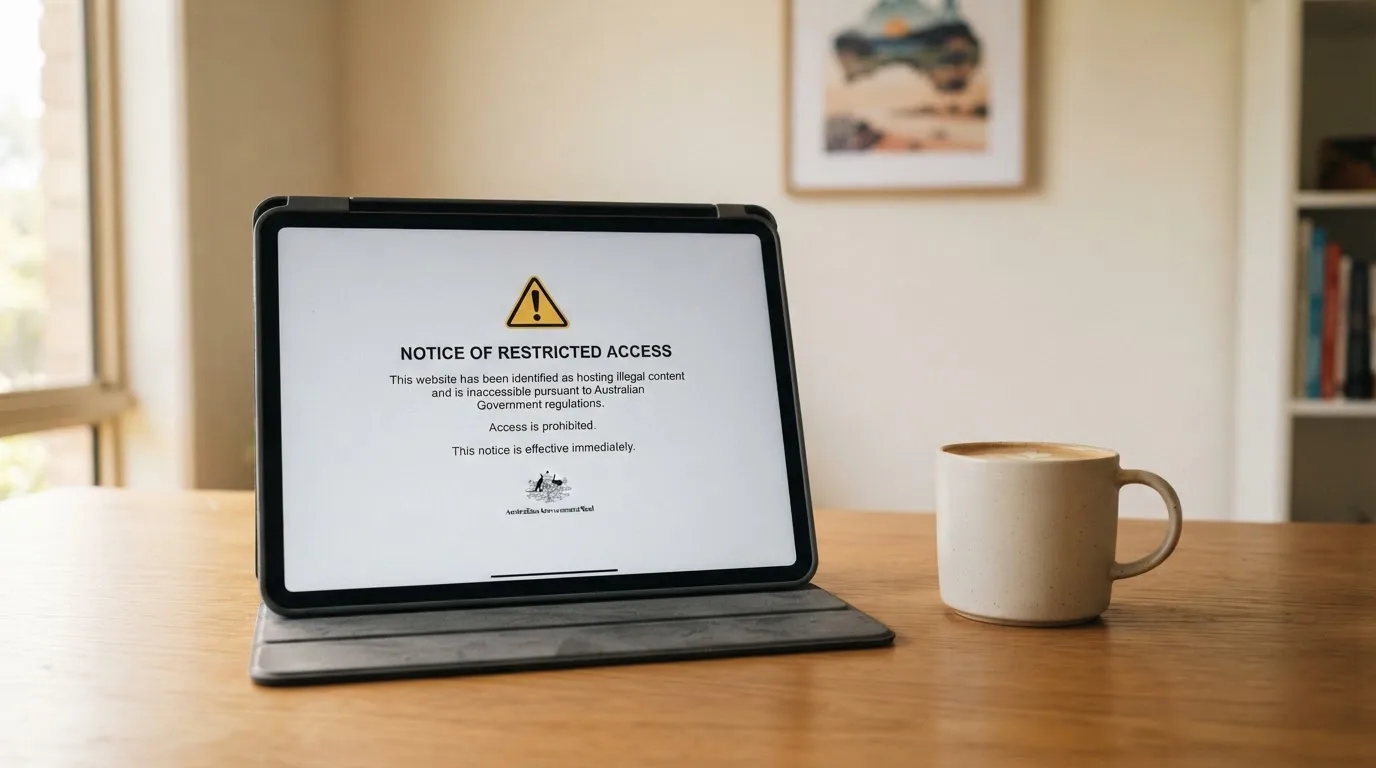
Pokies Parlour has been on the receiving end of both. In 2022 the ACMA issued a formal warning to Deloraze Limited and Versus Odds (BV) as the operators of Pokies Parlour, finding that the site provided a prohibited interactive gambling service to Australians. The same year, the ACMA ordered Australian ISPs to block Pokies Parlour along with five other offshore names — Ninja Spins, Pokies Online Casino, CasinoAus, Australian Casino Sites and AU Online Casino — after the same finding under the Interactive Gambling Act 2001. A blocking order does not wipe the brand; it makes the main domain unreachable from a typical Australian connection. The brand resurfaces on a new address, the cycle repeats, and the ACMA publishes each new round.
The wider picture is large enough that one brand is barely a line in it. According to the ACMA as reported in June 2026, a total of 1,751 illegal gambling and affiliate marketing websites had been blocked since the first blocking request in November 2019. More than 230 unlicensed gambling services had left the Australian market entirely since enforcement was strengthened in 2017. A single blocking round reported on 26 June 2026 took out 12 more: 7Signs, ChromaBet, Donbet, Duospin, Freshbet, Slots Gem, Jacks Club, Lucky Start, Pointsbetz, Spinrise, Vinyl Casino and Wildsino. The pattern is the pattern, not the exception.
The economic weight of all this is not small. H2 Gambling Capital’s 2025 report puts Australian losses to illegal gambling sites at around A$3.9 billion a year, and tracks the share of gambling going through legal Australian channels falling from 74 per cent in 2021 to 64 per cent by the time of the report. The legal market is shrinking as a share of the total, and the offshore market is doing the growing.
What an Australian punter actually has access to
The product the law does license is online wagering on sport and racing before the event, plus lotteries and keno. The minimum age is 18. Australian-licensed online and phone wagering services are bound by BetStop, the National Self-Exclusion Register, which went live in August 2023 — anyone who signs up to BetStop is excluded by every participating licensed operator for a period of their choosing, with no way to revoke the exclusion early. Offshore casinos are not connected to BetStop, which is one of the cleanest illustrations of where the local rules do and do not reach.
Payment rules underline the same line. Since 11 June 2024, Australian-licensed online wagering services cannot accept credit cards or credit-related products, and the ban extends to digital wallets linked to credit. Legal deposit routes for licensed wagering are debit card, bank transfer, PayID or Osko instant transfer, and BPAY. Penalties for licensed operators that take a credit-card wager run up to A$247,500. A site asking an Australian customer for a credit card or a cryptocurrency deposit is not operating under the Australian rules — it is operating offshore, with whatever consumer protection its home regulator offers, which is usually none for an Australian player.
The Interactive Gambling Amendment (Gambling Reform) Bill 2026 passed Parliament on 19 August 2026, and its advertising and inducement measures commence on 1 January 2027. It is law with a future start date, not a rule binding today.
Where to get help if the gambling has gone past play
A page about an offshore casino site has to be plain about what the offshore site is not. It is not BetStop-connected, which means the strongest self-exclusion tool available in Australia does not apply to it. It is not bound by any Australian responsible-gambling code. Its “responsible gaming” page, if it has one, is a marketing page that owes nothing to a regulator.
The Australian help lines are free, confidential and built for this. The National Gambling Helpline is 1800 858 858, available 24 hours a day. Gambling Help Online runs live text-based support. State-level services exist in every state and territory, with face-to-face counselling available through referral. The counselling offered is for the person and the family around them, not for the offshore site — the offshore site is the thing to step away from, and these services are the bridge to doing that.
A blunt point worth making once and not again: BetStop, the helpline and the counselling services are free because they are paid for collectively. The offshore casino is paid for by the punter alone, including when it stops paying out.
Payments, payout speed and what the offshore site actually offers
Pages about Pokies Parlour and similar brands often run through a list of payment methods the offshore site claims to accept. The list is mostly cosmetic — it does not change the legal status, and it tells a reader very little about whether a withdrawal will arrive. Still, the methods recur often enough that they need a paragraph each.
American Express was founded in 1850 as a freight-forwarding company, became a card issuer later, and launched its first charge card on 1 October 1958. It runs as a three-party scheme — issuer, processor and network under one roof — where Visa and Mastercard run four-party networks. The Reserve Bank of Australia’s July 2025 review of merchant card payment costs proposes removing surcharges on eftpos, Mastercard and Visa transactions, and explicitly leaves American Express outside the scope of the proposed surcharge ban. Amex’s higher merchant fee in Australia is the reason it is often the one card a site will not take.
Australian banks have begun adding gambling blocks at card level. Westpac’s gambling block refuses authorisation on transactions registered under the merchant category code for betting and casino gambling on eligible personal credit and debit cards. ANZ’s gambling block, activated in the ANZ app, blocks gambling transactions made through a digital wallet such as Apple Pay on an eligible card, not just the physical card; once turned on, removing it again takes a 48-hour waiting period. ANZ also warns that not every gambling transaction will be caught and that some non-gambling transactions might be blocked in error. Apple’s own position is that transaction limits and PIN requirements for Apple Pay are set by the issuer or the merchant, not by Apple; Apple does not charge consumers for using Apple Pay in stores, online or in apps, so any surcharge is the merchant’s processing fee, not Apple’s. By the end of 2025, Apple Pay, Google Pay and Samsung Pay together accounted for around 45 per cent of all card payments in Australia by number — the wallet is now mainstream enough that a gambling block has to be wallet-aware to be useful.
PayID and Osko are the domestic answer. Osko, run by Australian Payments Plus, sends a bank transfer between participating Australian banks in under a minute, 24 hours a day including weekends, to either a BSB and account number or a PayID. Paying to a PayID shows the name of the account holder before the transfer is sent — Australian Payments Plus warns that being asked to transfer to a PayID on an illegal gambling site almost certainly means a scam. PayID-based instant transfers are available at over 100 Australian financial institutions. Australia’s New Payments Platform became accessible to the public on 13 February 2018, and more than 25 million PayID identifiers had been registered on it by April 2025. The platform’s monthly outages are contractually capped at two minutes, and in 2021 the ACCC authorised the merger that created Australian Payments Plus out of NPP Australia, BPAY and eftpos.
BPAY is the older domestic rail. It has operated since 18 November 1997, sits in the online banking of over 140 banks and financial institutions, and is offered by more than 95,000 businesses. A BPAY payment uses a Biller Code and a Customer Reference Number printed on the bill. It is owned equally, through Cardlink Services Limited, by ANZ, Commonwealth Bank, National Australia Bank and Westpac.
The AUSTRAC threshold-transaction-report rule applies to transfers of A$10,000 or more in physical cash, not to ordinary electronic bank transfers, which are not subject to that per-transaction reporting requirement regardless of amount.
None of this makes any difference to an Australian punter funding an offshore casino account. The methods sit in the offshore cashier; the funds leave an Australian account; the receipt is a PayID name or a card statement entry that does not say “illegal offshore casino”. What the methods do, taken together, is show how thin the protective layer is. A bank-level gambling block is the strongest single defence an Australian can put on the payment side. It does not stop a direct bank transfer to a new account name, and the offshore site knows that.
Bonuses and free spins: the marketing word and the arithmetic
The bonus pages written about Pokies Parlour and its lookalike domains tend to run the same playbook: a headline figure, a “across your first several deposits” structure, a percentage match and a “free spins” add-on, all glued together with the marketing word that recurs across the offshore segment. One of the several domains styled as Pokies Parlour advertises up to A$2,777 across the first seven deposits. The number is large enough to be the headline and structured enough to spread across a longer relationship with the punter, which is exactly the point.
A bonus is not free money. It is a marketing word for a set of conditions — a percentage match on a deposit, a wagering requirement expressed as a multiple of bonus or bonus plus deposit, a maximum bet per spin during the clearing period, a list of games that count at less than 100 per cent, an expiry date, and usually a maximum cash-out ceiling. The marketing word says “free”; the small print says how the free is paid for. Across the offshore segment the wagering multiple commonly sits in the 35x to 50x range on the bonus alone, sometimes on the bonus plus deposit, and the max-cash-out clause is what converts a bonus from a marketing tool into a binding ceiling on how much of it a punter can ever withdraw.
Spreading a bonus across the first seven deposits is a structural choice. A single deposit bonus produces a single decision: take it or leave it. A seven-stage package produces seven decisions and a longer exposure of the punter to the site, with each stage resetting the wagering clock. The structure is not a gift; it is the marketing funnel, and the longer funnel is the marketing word working as intended.
The simplest check is the one a punter can do without any of the page’s arithmetic. Divide the bonus by the wagering multiple and you get the required turnover. Divide that by an average slot bet and you get the spins. A 35x requirement on a A$1,000 bonus is A$35,000 of turnover, which at A$1 per spin is 35,000 spins. The house edge on a typical online pokie sits between 3 and 6 per cent, so the expected cost of clearing that bonus — the amount a punter will on average lose while meeting the turnover — is roughly A$1,050 to A$2,100. The bonus is not free. The marketing word said it was.
What the paytable page actually shows
Pages that walk through Pokies Parlour’s “paytable” tend to mean the casino’s promotional detail: the headline match bonus, the maximum bonus amount, the free-spins allocation, the wagering multiple, the eligible games. None of it is technical detail about any single pokie machine — it is the casino’s promotional page re-presented as if it were slot data. The reel display behind the paytable page is a casino game running in a browser tab.
This is worth saying because the term “paytable” carries weight a punter has learned to trust. A real paytable lists, for one named pokie, the symbol values, the line configurations, the bonus-round triggers and the theoretical return to player. The casino-promotion “paytable” is a different document, dressed in similar language, with a similar-looking grid, and that is exactly why it works as marketing.
The brands the ACMA has acted against
The ACMA’s published list of formal warnings and blocking orders is the only thing that lets a punter separate an offshore brand from another offshore brand, because none of them is licensed in Australia and the marketing pages all look alike. The list below is drawn from the ACMA’s own publications; the brands are ordered as research lists them, and the order is not a ranking. Each entry carries the ACMA action, the date, and the operator named by the ACMA.
| Brand | ACMA action and date | Operator named by the ACMA | Subject support |
|---|---|---|---|
| RocketPlay | Formal warning — March 2026 (Pulsup Ltd); earlier May 2022 (Dama N.V.) | Pulsup Ltd | listings-only |
| Level Up Casino | Formal warning — May 2022 | Dama N.V. | listings-only |
| Woo Casino | Formal warning — March 2025 | Dama N.V. | no data |
| Spirit Casino | Formal warning — May 2025 | Dama N.V. | no data |
| National Casino | Formal warning — July 2025 | Consolutetish S.R.L. | listings-only |
| Bizzo Casino | Formal warning — July 2025 (Consolutetish); earlier 2022 (TechSolutions) | Consolutetish S.R.L. | listings-only |
| Ignition Casino | Formal warning — July 2025 | Bamboo Media | no data |
| Instant Casino | Formal warning — February 2025 | EOD Code SRL | listings-only |
| Jackbit | Formal warning — April 2026 | Ryker B.V. | no data |
| Casino Intense | Formal warning — April 2025 | Sterplay Holding Ltd | listings-only |
| Sky Crown | Formal warning — September 2022 | Hollycorn N.V. | no data |
The “listings-only” tag for subject support means the subject appears in third-party listings such as Gambling Insider or PayID.au, not in any ACMA document about the brand itself. “No data” means no listing was found in the consulted set. None of this changes the legal position: every brand on this table has been the subject of an ACMA formal warning under section 64A of the Interactive Gambling Act 2001, and every one of them is offshore.
The Hollycorn N.V. entry covers two casino services that share an operator — Sky Crown and Blue Leo. Dama N.V. is the operator behind a longer list, of which Level Up Casino, Woo Casino and Spirit Casino appear above. The brand-to-operator mapping is not one-to-one; the same operator runs several brands, and an ACMA warning to the operator covers the whole stable. Pokies Parlour itself is the outlier on this list: it is run by Deloraze Limited and Versus Odds (BV), not by any of the operators named above.
The blocking rate as a working number
The ACMA’s first blocking request went out in November 2019. As reported in June 2026, a total of 1,751 illegal gambling and affiliate marketing websites had been blocked since that first request. The simple arithmetic: 1,751 sites over roughly 79 months gives a working band of around 22 sites blocked per month on average, or about 265 a year. That is the wrong figure to quote as a single number, because blocking rounds vary in size from single digits in a quiet month to a dozen or more in a busy one, but the band is the band.
The point of running the arithmetic is not the precise number. It is to put a concrete shape on the enforcement problem. A blocking round of 12 in June 2026 alone is around half of the long-run monthly average; a round of zero in a quieter month is just as common. The ACMA’s enforcement work is continuous but uneven, and the brands on the receiving end of it are not necessarily the ones a punter might guess.
Where the rate matters for a punter is in the time-to-disappear. An offshore casino brand surfaces on a fresh domain after a blocking order, and the cycle begins again. A brand that has been on the ACMA’s list for years — Dama N.V.’s stable, the TechSolutions stable — has demonstrated that blocking orders do not end the brand, only the current domain. The same is true of Pokies Parlour.
Which operator this is worth writing about, in detail
Each brand on the ACMA list sits in the same legal position: prohibited under the IGA, no Australian licence, named by the ACMA in a formal warning. The differences between them are not in the legal column — that column is identical — but in the specifics of the ACMA action, the operator behind the brand, and what consumer-protection listings say about the brand’s payment rails and self-exclusion status. The detail below covers each one and arrives at the verdict the section above the verdict does not make for itself.
RocketPlay
The ACMA issued a formal warning to Pulsup Ltd over RocketPlay in March 2026, and an earlier warning to Dama N.V. covered Rocketplay in May 2022. The brand is one of the Dama N.V. stable that has changed operator hands at least once since the 2022 warning. Third-party listings carry the brand. The two warnings, four years apart, tell a reader the ACMA has had to come back to this brand more than once.
RocketPlay’s verdict sits in the second warning, not the first. The 2022 warning did not stop the brand. The 2026 warning to a new operator shows the brand re-emerged under a different corporate roof, and the cycle that produces blocking orders every few years is the cycle a punter signs up for when signing up at all.
Level Up Casino
Dama N.V. received an ACMA formal warning covering Level Up Casino in May 2022, alongside Bambet, Dazard, Rocketplay, Wild Tornado and Cobra Casinos. The 2022 batch is one of the wider single-operator warnings in the ACMA’s published register, and it is the entry point on this list for the Dama N.V. stable — which extends to Woo Casino and Spirit Casino further down. Third-party listings carry the brand.
Level Up Casino is the brand through which the wider Dama N.V. picture becomes visible. The stable is large, and the stable has been the subject of repeated ACMA warnings across multiple brands. A punter looking at Level Up Casino is looking at one face of a much larger corporate picture.
Woo Casino
Dama N.V. received a further ACMA formal warning in March 2025 covering Woo Casino. The 2022 warning covered six brands, and the 2025 warning singles out Woo Casino specifically. The shift from a batch warning to a brand-specific warning is a tightening of focus on this part of the stable. No third-party listing was found in the consulted set for the subject support line.
Woo Casino’s verdict is that the ACMA has had to come back to Dama N.V. specifically for this brand. The 2022 warning did not end the brand, and the 2025 warning is the regulator’s next move on the same operator.
Spirit Casino
Dama N.V. received a further ACMA formal warning in May 2025 covering Spirit Casino. The pattern is the same as for Woo Casino: a 2022 batch warning followed by a 2025 brand-specific warning to the same operator. No third-party listing was found for this brand in the consulted set.
Spirit Casino’s verdict is the same as Woo Casino’s. The 2022 batch warning to Dama N.V. did not include Spirit Casino by name; the 2025 warning singles it out. The ACMA has come back to the stable twice.
National Casino
The ACMA issued a formal warning to Consolutetish S.R.L. over National Casino in July 2025. Third-party listings cover the brand across the ACMA’s own site, AUSTRAC and BetStop. The BetStop listing is a third-party directory entry, not a BetStop integration; National Casino is not bound by BetStop because it is not an Australian-licensed operator.
National Casino is the cleanest illustration on this list of how the offshore segment’s consumer-protection story is told. The brand shows up across listing pages because listings are how the marketing reaches Australian searchers, not because the brand is part of any Australian protection regime.
Bizzo Casino
The ACMA issued a formal warning to Consolutetish S.R.L. over Bizzo Casino in July 2025. Bizzo Casino had already been the subject of a 2022 formal warning to TechSolutions (CY) Group Limited and TechSolutions Group N.V., which makes it the brand on this list with the longest ACMA history. Third-party listings carry the brand.
Bizzo Casino is the brand through which the cycle shows itself most clearly. The 2022 warning was to one corporate operator; the 2025 warning is to a different corporate operator. The brand has resurfaced under new ownership and the ACMA has come back to it twice.
Ignition Casino
The ACMA issued a formal warning to Bamboo Media over Ignition Casino in July 2025. No third-party listing was found for the brand in the consulted set.
Ignition Casino is the simplest entry on this list: one ACMA action, one named operator, no further history published by the ACMA. The verdict on the action is what it is.
Instant Casino
The ACMA issued a formal warning to EOD Code SRL over Instant Casino in February 2025. Third-party listings cover the brand across EcoPayz and PayID. The PayID listing is a directory entry, not a PayID integration — Instant Casino cannot receive an Osko transfer from an Australian bank account, because no Australian bank would route one to an offshore casino.
Instant Casino is the brand through which the payment-rail question becomes most concrete. The listings that name PayID and EcoPayz are naming the rails the marketing pages mention; they are not naming any Australian integration.
Jackbit
The ACMA issued a formal warning to Ryker B.V. over Jackbit and CasinOK in April 2026. No third-party listing was found for Jackbit in the consulted set. The 2026 date makes this the most recent ACMA action on the table.
Jackbit’s verdict sits in the recency. The brand was acted against in April 2026, and a brand that fresh on the ACMA’s list is a brand whose marketing is reaching Australian searchers now.
Casino Intense
The ACMA issued a formal warning to Sterplay Holding Ltd over Casino Intense in April 2025. Third-party listings cover the brand across AUSTRAC, BetStop and Gambling Insider. The AUSTRAC listing is a third-party directory entry; Casino Intense is not subject to AUSTRAC’s threshold-transaction-report rule because that rule applies to physical cash transfers of A$10,000 or more, not to ordinary electronic bank transfers.
Casino Intense is the brand through which the “listings-only” status of subject support is most visible. The brand shows up across three listings, none of which is an Australian integration.
Sky Crown
The ACMA issued a formal warning to Hollycorn N.V. covering Sky Crown and Blue Leo. The Hollycorn N.V. warning is one of the earlier entries on the ACMA’s published register, and the same operator runs both services named in the warning. No third-party listing was found for Sky Crown in the consulted set.
Sky Crown is the entry through which a one-operator-two-brands picture becomes visible. A punter who has only seen Sky Crown in marketing has not seen that Hollycorn N.V. also runs Blue Leo, and the ACMA’s action covered both at once.
How to read an offshore casino review from Australia
A “review” of Pokies Parlour or any of the brands above, written for an Australian searcher, almost always follows the same template: an introduction identifying the brand and its licence, a paragraph on the welcome bonus, a paragraph on the games, a paragraph on payment methods, a paragraph on withdrawals, and a verdict. The licence paragraph is the one worth pausing on.
The licence an offshore casino displays is not an Australian licence. It is a licence issued by the regulator in the country where the operator is incorporated — Curaçao, Kahnawake, the Isle of Man, Malta for the larger operations. None of these licences gives the operator any standing to take Australian players under Australian law. The review will not say this; it will describe the licence as if it were the same kind of thing as an NTRWC sports bookmaker licence, which it is not.
The bonus paragraph is where the marketing word sits, and the marketing word is what the rest of the review is selling. A welcome offer of A$2,777 across the first seven deposits is not a fact about the casino’s generosity; it is a fact about how the casino structures its relationship with a new punter.
The withdrawal paragraph is the one most often padded out by reviews. Withdrawal time is the figure most quoted, and the figure most often wrong. Reviews routinely cite “instant” or “24 hours” for crypto withdrawals without saying which crypto, or say “1-3 business days” for bank transfers without saying the bank is in another country and the transfer is cross-border. The honest reading of an offshore withdrawal paragraph is that a withdrawal may arrive and may not, and that the punter has no Australian complaints body to take it to if it does not.
Tax: the part that is rarely a problem
Recreational gambling winnings in Australia are not assessable income under section 6-5 of the Income Tax Assessment Act 1997, and gambling losses are not deductible — unless the person is carrying on a business of gambling, which a recreational punter is not. The ATO’s guidance is the practical frame: keep records, do not assume winnings are tax-free if gambling is a significant part of income, and treat any ATO position as one to check with the ATO itself. This is true whether the gambling takes place at a licensed Australian operator or at an offshore casino.
The tax angle is rarely the reason a punter should choose a licensed operator over an offshore one. The reasons are consumer protection, dispute resolution and the responsible-gambling code, all of which an offshore casino does not provide. The tax treatment is the same either way.
Frequently asked questions
Why does the site styled as Pokies Parlour appear across several different domain names?
The brand resurfaces on a new domain after each ACMA blocking order takes the current one offline. The first Pokies Parlour warning and blocking round took place in 2022, and the brand has cycled through addresses since. The site itself is the same marketing template with a different URL.
Is a site styled as Pokies Parlour actually licensed to accept Australian players?
No. No state or territory of Australia licenses online casino games, online pokies or live dealer tables. Any licence the offshore site displays — Curaçao, Kahnawake, Malta — is a licence issued by the regulator of the country where the operator is incorporated. It gives the operator no standing to accept Australian players under the Interactive Gambling Act 2001.
What deposit bonus does a site styled this way typically advertise on its various domains?
One of the several domains styled as Pokies Parlour advertises up to A$2,777 across the first seven deposits, with a percentage match and a free-spins add-on attached. The structure — a package spread across several deposits rather than a single first-deposit bonus — is the standard offshore template, and the headline figure is the largest in a chain of smaller per-deposit offers.
How can someone tell which of several similarly named domains is currently being advertised?
The ACMA’s published list of formal warnings and blocking orders is the cleanest reference. A domain that has been blocked by the ACMA is unreachable from a typical Australian internet connection, and a brand that has cycled through several addresses will have a published history on the ACMA’s site.
What do reviews of a site like this usually say about its withdrawal process?
Reviews tend to quote short withdrawal times — “instant” for crypto, “1-3 business days” for bank transfer — without naming the rails or the jurisdictions. The honest reading is that a withdrawal may arrive and may not, and an offshore casino gives the punter no Australian complaints body to escalate to if it does not.
Why would a brand like this run a sign-up bonus across the first several deposits rather than just the first?
A multi-stage bonus is a longer relationship. Each stage resets the wagering clock, extends the punter’s exposure to the site, and produces a sequence of decisions rather than one. The structure is the marketing funnel; the headline figure is the largest in a chain of smaller per-deposit offers.