
Video slots in Australia in 2026: licensed machines at home, prohibited offers offshore, and what the difference costs
A search for the best video slots in Australia runs into a wall almost immediately. Online casino games — including video slots — cannot be licensed anywhere in Australia. The Interactive Gambling Act 2001 makes offering them to a person physically in Australia an offence, and the Australian Communications and Media Authority (ACMA) has spent seven years tightening the screws on the offshore operators who advertise here anyway. As of the ACMA’s June 2026 round, 1,751 illegal gambling and affiliate marketing websites have been blocked since November 2019, and more than 230 unlicensed services have left the Australian market since enforcement was strengthened in 2017. Another twelve sites — 7Signs, ChromaBet, Donbet, Duospin, Freshbet, Slots Gem, Jacks Club, Lucky Start, Pointsbetz, Spinrise, Vinyl Casino and Wildsino — were added to the block list in that June round.
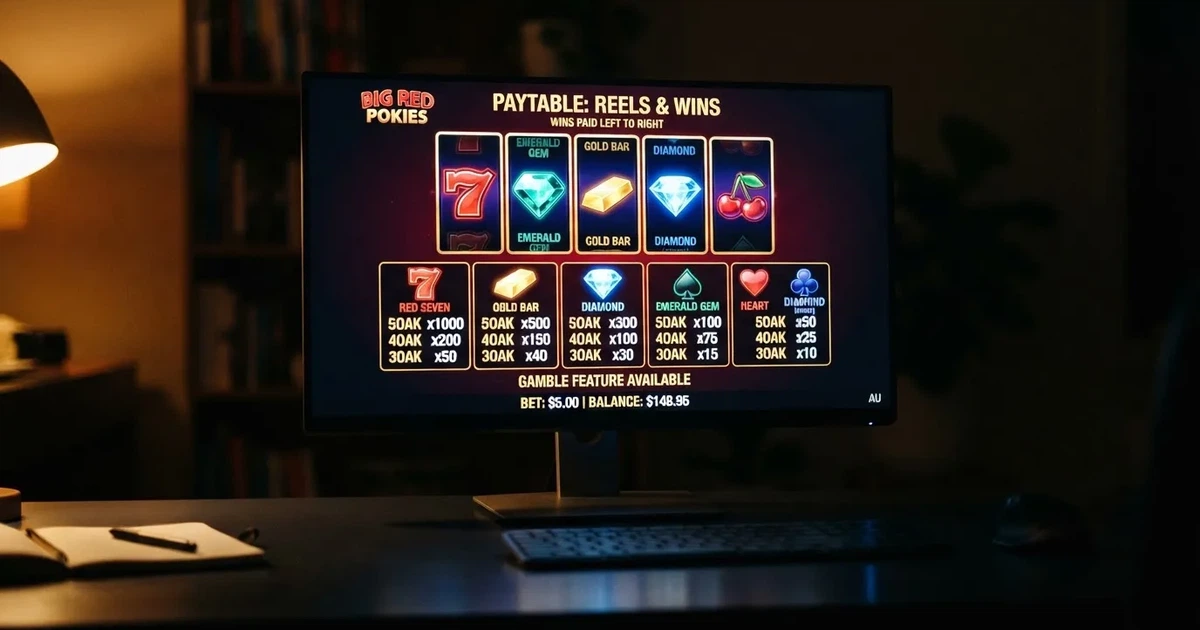
What Australians can actually play is the licensed electronic gaming machine found in pubs, clubs and casinos, run by state and territory regulators. The video slots marketed by offshore casinos are real games, but the marketing is addressed to people who, by law, cannot legally be offered the product. This page lays out what that gap looks like, who the ACMA has formally warned for crossing it, and what alternatives an Australian actually has.
Currency and licence claims on this page reflect the position as at 23 November 2026, cross-checked against the ACMA’s published register of formal warnings and blocking requests.
Table of Contents
- How the Interactive Gambling Act draws the line
- What player protection actually covers — and what it does not
- Bonus offers, free spins and the price the player pays for them
- Video slots on a mobile screen: the mechanics, the app question
- Which games the offshore catalogue actually contains — and what the licensed venues offer instead
- How a shortlist of video slot options is actually built
- The blocking rate: how fast the ACMA is catching up
- The ACMA’s record on the offshore video slot brands
- How a serious review of an offshore video slot operator should read
- The economic backdrop: H2 Gambling Capital’s 2025 figures
- What the choice looks like in 2026
- The end of the choice, and what the page did not promise
- FAQ
How the Interactive Gambling Act draws the line
The Interactive Gambling Act 2001 (IGA), tightened by the Interactive Gambling Amendment Act 2017, makes it a civil penalty offence to provide certain gambling services to a person in Australia. Two product groups sit inside the prohibition. Online casino games — slots, roulette, blackjack, baccarat and the rest — are on the prohibited list. In-play betting on a sporting event after it has started is on the prohibited list alongside them.

| Feature | Licensed Australian Wagering | Offshore Casino Site |
|---|---|---|
| Legal Status | Licensed by State/Territory | Prohibited by IGA |
| Consumer Protection | Yes (BetStop/Regulator) | None |
| Deposit Methods | Debit/Bank/PayID/BPAY | Credit/Crypto |
| Complaints Body | Yes | None |
What is licensable is wagering on races and sport placed before the event, lotteries and keno. In practice the body issuing those licences is the Northern Territory Racing and Wagering Commission (NTRWC), which regulates 52 of Australia’s online bookmakers — Sportsbet, Bet365 and Ladbrokes among them — because the operators chose the Territory for tax reasons. The commission has no full-time staff and meets once a month in Darwin. Minimum age for any Australian-licensed gambling product is 18.
The IGA targets the provider, not the individual player. A punter who opens an account with an offshore casino commits no offence under the Act. The casino commits one for offering the service. That detail does the punters no favours: an offshore site gives no Australian consumer protection, no complaints body, and no recourse if a withdrawal is refused. The site can be blocked by an ISP the morning after a winning session, with a balance still on it. The ACMA estimates — via H2 Gambling Capital’s 2025 report — that Australians lose about A$3.9 billion a year to illegal gambling sites, and that the share of gambling going through legal channels has fallen from 74% in 2021 to 64%.
The reform on the horizon is the Interactive Gambling Amendment (Gambling Reform) Bill 2026, which passed Parliament on 19 August 2026. Its advertising and inducement measures commence 1 January 2027, which makes it law with a start date rather than law in force on a 2026 page. On a 2026 page the IGA as amended in 2017 remains the binding text.
What player protection actually covers — and what it does not
Player protection in Australia is built around the licensed wagering sector, and most of its tools do not reach offshore operators.

BetStop — the National Self-Exclusion Register — has been live since August 2023. Once a person registers, every Australian-licensed online and phone wagering service is obliged to close their accounts and refuse to let them open new ones for the period they nominate. The register is binding on the licensed bookmakers and the licensed racing and sports operators. An offshore casino is not connected to it, so a self-excluded player who moves offshore for their slots play removes the constraint entirely.
The support line behind BetStop is the National Gambling Helpline on 1800 858 858 — free, 24/7, with chat at Gambling Help Online. The same body runs face-to-face counselling in every state and territory. These services take self-referrals, family referrals and referrals from the gambling operators themselves.
Payment rules bind only the licensed side as well. Since 11 June 2024 credit cards, credit-related products and digital currency have been banned as payment for any licensed online wagering, with penalties up to A$247,500 for operators. The legal deposit routes for a licensed wagering account are debit card, bank transfer, PayID/Osko and BPAY. A site asking an Australian for a credit card or a crypto deposit is operating outside the Australian rules on that step as well as on the game underneath it.
The crown of state-level consumer protection sits with the regulators themselves: the New South Wales Casino Control Act 1992 under section 66, the Victorian Gambling and Casino Control Commission (which replaced the VCGLR on 1 July 2022), and equivalent bodies in the other states. These are the bodies that approve a casino’s table-game rules and publish the changes — for example the VGCCC’s public log records renaming Crown Melbourne’s “Perfect Pairs” blackjack side bet to “Crown Pairs” on 23 December 2024, and introducing a “Free Bet” option with a new “Pot of Gold” side bet on 25 March 2024. None of this oversight reaches an offshore site.
Bonus offers, free spins and the price the player pays for them
The marketing around offshore video slots leans on three inducements: a cash welcome bonus, a package of free spins, and “bonus rounds” inside the game itself. The first two are marketing costs the operator sets against the player. The third is a game-design feature.
A cash bonus arrives with a wagering multiple attached — usually between thirty-five and fifty times the bonus amount, sometimes higher. The required turnover is the bonus multiplied by the multiple. Suppose a site offers a A$500 bonus at a 40× multiple: the player must wager A$20,000 before any of the bonus funds become withdrawable. The same A$20,000 wagered on a video slot running at, say, 96% return to player loses on average A$800 — that is the expected cost of clearing the bonus, before considering time spent and the volatility of the specific game. Free-spin packages work the same way: the operator credits the spins at a fixed stake, and any winnings are paid as bonus funds behind the same multiple.
“Bonus rounds” inside a video slot are different. They are features on the reels — pick-a-prize screens, free-spin triggers, expanding wilds, cascading wins — and they do not depend on a deposit. They are part of the game’s mathematics, and they are the reason a player who does not claim a bonus can still lose an entire session to a string of near-misses and features that pay less than they cost to trigger.
The audit story on every offshore bonus is the same: the headline figure looks generous, the multiplier erases it, and the player pays for the privilege of converting bonus money into their own. Where a site refuses to publish its wagering multiple — which is rarer than it used to be — that silence is itself the answer.
The Australian-licensed alternative has no equivalent of a deposit bonus, because the IGA prohibits inducements to open a wagering account and the forthcoming 2027 advertising rules extend that logic further. What licensed wagering offers instead is price: better odds, same-market offers and racing-form tools. Those are inducements in the loose sense, and they are paid for in tighter margins rather than in turnover requirements.
Video slots on a mobile screen: the mechanics, the app question
A video slot is built around a random number generator and a screen: touch input rather than a physical lever, an animation rather than spinning reels. The mechanics a player meets are largely identical between a desktop browser, a mobile browser and a casino’s app — the same reels, the same paylines, the same bonus features — because the random number generator runs on the operator’s server, not on the device. The differences are surface: the reels are rescaled for portrait orientation, the spin button is moved under the thumb, the paytable is condensed into a tap-target.
Whether the operator offers an app or browser-only is a different question. A native app lets a site send push notifications — which is mostly useful for promotional purposes, not gameplay — and lets it cache some assets on the device so subsequent loads are quicker. Browser-only play is the default for offshore operators, partly because Apple’s App Store and Google’s Play Store have historically refused to list real-money casino apps in many jurisdictions. The pragmatic effect is that most offshore video slots are loaded in a mobile browser, often wrapped in a thin PWA shell so the icon sits on the home screen.
The performance question — how smoothly the reels animate, how quickly the screen responds — is settled by the same factors that settle performance on any mobile web app: the operator’s content delivery network, the player’s signal strength, and whether the game’s animations are HTML5 or older Flash-style code. Modern video slots built in the last decade are HTML5-native, which is to say they perform adequately on a five-year-old handset on a 4G connection. A laggy slot on a modern phone is, more often than not, a sign the operator’s hosting is poor rather than a sign the device is at fault.
For Australians, the mobile question has a sharper answer. The licensed venue product — the pub or club poker machine — is not a mobile product at all. There is no licensed, legal video slot in an Australian’s pocket. Anything that runs in an Australian’s pocket is offered by an offshore site, and the regulatory gap that creates is the subject of the next section.
Which games the offshore catalogue actually contains — and what the licensed venues offer instead
The offshore video slots catalogue is wide, and most of it is licensed to a handful of studios that supply the same games to dozens of operators. The titles move around: the same NetEnt or Pragmatic Play or Play’n GO game sits on a dozen sister sites with different colour schemes. That is why a player who has tried one offshore casino has effectively tried the games on its neighbours — the only thing that changes is the bonus wrapper and the licensing sticker.
The licensed Australian offering is narrower in form but more honest in status. New South Wales legalised slot machines in 1956, and by 2010 Australia was operating an estimated 97,103 gaming machines outside casinos — a per-capita rate about five times that of the United States. Outside-casino poker-style slot machines currently number 87,298 in New South Wales (June 2023), 26,380 in Victoria (2021–22), 21,122 in Queensland (October 2023), 11,672 in South Australia (September 2023) and 3,587 in the ACT (November 2023). The licensed casino floor adds baccarat, blackjack, roulette and craps variants. Crown Melbourne, for example, offers three baccarat variants approved by the VGCCC: Traditional Baccarat, Crown Baccarat and 2 to 1 Baccarat.
Baccarat itself is useful for what it shows about how tightly the licensed product is regulated. Under section 66 of the NSW Casino Control Act 1992, a casino operator must not permit a game such as baccarat to be played unless the game and its rules are approved by the regulator, and the operator must make a copy of the approved rules available to patrons on request. In Victoria the equivalent is the Casino Control Act 1991, which requires the VGCCC to approve any rules for table games and any change to those rules before they are introduced at the Melbourne casino. The rules a player sits down to at Crown are rules that have been signed off, named and dated by the regulator. The rules an offshore site applies to its video slots are whatever the operator decided to put on its terms page that morning.
For comparison: the house edge on a Punto Banco baccarat Banker bet is 1.06%; on the Player bet, 1.24%; on the Tie bet, 14.36%. On a blackjack table with optimal strategy and liberal Las Vegas Strip rules (dealer stands on soft 17, double on any two, double after split, resplit aces, late surrender) the house edge is about 0.28%, and about 0.43% under Atlantic City rules. On a craps Pass/Come bet the house edge is 1.41%; on Don’t Pass/Don’t Come, 1.36%; on Any Craps, 11.11%. None of these edges is published for the offshore video slot catalogue on a single comparable page. The maths is set inside the game and the player has no audit trail into it.
How a shortlist of video slot options is actually built
The “top ten video slots” article is built one of two ways. The honest version compares games on measurable attributes: return-to-player percentage, volatility classification, hit frequency, bonus-feature frequency, max payout and minimum stake. The dishonest version ranks games by how prominently the operator advertises them, with an affiliate link attached.
The honest version starts with the published paytable. A modern video slot can run five or more reels with 50 or more symbols per reel, which produces odds as high as 300 million to one against the top combination. Compare that to a classic mechanical three-reel machine with about 10 symbols per reel, where the total number of possible combinations is around 1,000. The expanded reel set is the reason a five-reel video slot can offer features the three-reel original could not — bonus rounds, free-spin triggers, expanding wilds, cascading wins, hold-and-spin mechanics — and is also the reason the volatility can swing harder. A game with 50 symbols per reel has more losing combinations than a game with ten, and the difference between a frequent small payout and a rare large one is what game designers tune.
Volatility is the second axis. Two slots with the same 96% RTP can produce wildly different session experiences: one pays out in a steady stream of small wins, the other builds suspense for a long run of dead spins followed by a single bonus trigger that returns a third of the session’s losses. Within a single provider’s catalogue, volatility is a deliberate choice rather than an accident, because it changes which players enjoy the game. A provider that wants to attract casual play tunes the volatility down; a provider that wants to attract the high-roller end tunes it up.
The third axis is hit frequency, which is distinct from RTP. Hit frequency is the proportion of spins that produce any return at all. A high hit frequency at a low average return keeps a session feeling busy even when the player is net-negative. A low hit frequency at a high average return produces the opposite feeling — long dead stretches and the occasional meaningful win.
The dishonest version of a “top slots” article skips all of this. It runs the operator’s own headlines, takes the affiliate commission on sign-ups, and never mentions that the offshore site offering the game is one the ACMA has formally warned for offering prohibited services to Australians.
For Australians, the choice between the two versions of a shortlist is constrained: the licensed venue games do not run on a comparison page, and the offshore games that do are the ones the ACMA is currently blocking. A player looking for a real shortlist is therefore looking at licensed venue options in person, where the relevant comparison is which pub has the friendlier return-to-player settings — a setting each state publishes differently, if at all.
The blocking rate: how fast the ACMA is catching up
The ACMA’s blocking work began with the first blocking request in November 2019. By June 2026 the running total of blocked sites had reached 1,751 illegal gambling and affiliate marketing websites, with more than 230 unlicensed services having left the Australian market since enforcement was strengthened in 2017. The blocking rate over that period works out to roughly one site taken offline every business day for six and a half years — a number that flatters the ACMA, because each blocking request can sweep several domains in one round.
The June 2026 round alone added twelve sites: 7Signs, ChromaBet, Donbet, Duospin, Freshbet, Slots Gem, Jacks Club, Lucky Start, Pointsbetz, Spinrise, Vinyl Casino and Wildsino. At that pace the ACMA is removing operators faster than new ones appear, which is the condition that makes the enforcement side of the IGA actually work. The lag is in the gap between a site appearing and the ACMA acting: the operator collects deposits during that window, and the Australian players who funded those deposits are the ones who lose the balance when the block lands.
For a player the takeaway is operational. Any site an Australian can reach today is one the ACMA has not yet blocked; the more famous it is, the more likely the next round already names it. A balance sitting on an offshore site is a balance that can be made unreachable by an ISP-level block overnight.
The ACMA’s record on the offshore video slot brands
The ACMA’s formal-warning register is the public evidence of who has been offering prohibited online casino games to Australians. The warnings are civil, not criminal, but each one is published, dated and tied to a specific operator company.
| Operator | ACMA Action Date | Action Type |
|---|---|---|
| RocketPlay | March 2026 / May 2022 | Formal Warning |
| Level Up | May 2022 | Formal Warning |
| Woo Casino | March 2025 | Formal Warning |
| Spirit Casino | May 2025 | Formal Warning |
| National Casino | July 2025 | Formal Warning |
| Bizzo Casino | July 2025 / 2022 | Formal Warning |
| Ignition Casino | July 2025 | Formal Warning |
| Instant Casino | Feb 2025 | Formal Warning |
| Jackbit | April 2026 | Formal Warning |
| Casino Intense | April 2025 | Formal Warning |
| Sky Crown | Sept 2022 | Formal Warning |
The following brands are the ones this page sets out in the order the research specifies, with the date the ACMA acted.
RocketPlay
The ACMA issued a formal warning over Rocketplay in March 2026 against Pulsup Ltd. The brand had previously been named in a May 2022 warning to Dama N.V. alongside five other Dama casino brands. Online casino games cannot be licensed anywhere in Australia, whatever licence the site displays at the foot of its homepage. There is no Australian licence to verify against, and the AGCO/UKGC/Curacao stamp the site carries is not, on its own, evidence of any right to offer games to a person in Australia. The brand’s prominence on Australian-facing affiliate lists is the reason it sits at the top of the ACMA’s warning list.
Level Up Casino
The ACMA issued a formal warning over Level Up in May 2022 against Dama N.V. The site still appears on Australian-facing affiliate lists; what that listing reflects is its presence in a marketing catalogue, not any right to operate here. The brand has not been re-warned since the original notice, which is a thin kind of comfort — the ACMA does not need to warn twice to maintain that the offering remains prohibited.
Woo Casino
The ACMA issued a further formal warning to Dama N.V. over Woo Casino in March 2025. The earlier 2022 warning covered six Dama brands; Woo was not in that initial six. The fact that the ACMA came back a second time for a different Dama brand is the clearest signal in the register that the operator group’s internal compliance did not move with the first warning. The promotional material Woo runs in Australia — bonus packages and free-spin offers — does not change the legal position: the offering is prohibited at the act of supply, and a bonus does not convert a prohibited supply into a permitted one.
Spirit Casino
The ACMA issued a formal warning to Dama N.V. over Spirit Casino in May 2025, two months after the Woo Casino warning. Dama N.V. is now the most-warned operator company in the ACMA’s register, with at least three separate formal warnings covering eight or more brands. The pattern — same operator, fresh brand name — is the structural shape of the offshore sector: a new skin every few months lets the operator continue to advertise after a warning, and the warning itself does not require the operator to be wound down. The site’s continued appearance on Australian-facing affiliate pages is the predictable outcome of that structure.
National Casino
The ACMA issued a formal warning over National Casino in July 2025 against Consolutetish S.R.L. The same operator was warned the same month over Bizzo Casino. Both brands appear frequently on Australian-facing affiliate listings, which means the ACMA’s July 2025 warning addressed a real marketing footprint rather than a marginal site. The warning is not a criminal prosecution and does not block the site; the ACMA follows up with ISP-level blocking requests where the warning does not produce a withdrawal.
Bizzo Casino
The ACMA issued a formal warning over Bizzo Casino in July 2025 against Consolutetish S.R.L. Bizzo had already been the subject of a 2022 formal warning to TechSolutions (CY) Group Limited and TechSolutions Group N.V. Two operators owning the same brand, both warned, is the cleanest case in the ACMA’s register for how a prohibited offering can be laundered through successive corporate vehicles. A player who looks up Bizzo’s licence today sees a different company name than the one the 2022 warning addressed; the ACMA’s view is that the underlying service is the same one that was warned then.
Ignition Casino
The ACMA issued a formal warning over Ignition Casino in July 2025 against Bamboo Media. Ignition is one of the older offshore brands targeting Australia, and the warning is comparatively recent — which says less about a clean record and more about how long the ACMA takes to act on a brand that has been running for years. The website’s own marketing leans on Bitcoin deposit routes, which are themselves prohibited for licensed Australian wagering since 11 June 2024. A deposit the operator is willing to take is one Australian consumer law cannot chase.
Instant Casino
The ACMA issued a formal warning over Instant Casino in February 2025 against EOD Code SRL. Instant Casino’s marketing emphasises an account-less sign-up process — no formal identity verification on deposit — which is the opposite of how the licensed Australian wagering sector operates, where the operator is required to verify the customer’s identity before allowing a withdrawal. The absence of a verification step is sold as a feature; the same absence is the reason a player with a complaint has no recourse to anyone.
Jackbit
The ACMA issued a formal warning over Jackbit in April 2026 against Ryker B.V. The same operator was warned the same month over CasinOK. Jackbit is a crypto-first casino, which puts it on the prohibited side of two rules at once — the IGA prohibition on offering online casino games to Australians, and the credit-and-crypto prohibition on funding licensed Australian wagering. A player using crypto to fund a Jackbit account is on the wrong side of both regimes, and any complaint runs into the absence of an Australian complaints body.
Casino Intense
The ACMA issued a formal warning over Casino Intense in April 2025 against Sterplay Holding Ltd. Casino Intense appears in Australian-facing affiliate listings, which means it is being actively marketed here despite the warning. The warning is on the public record; the site’s continued advertising is not. A punter who signs up with Casino Intense in 2026 is signing up with a brand the ACMA has already told once is in breach.
Sky Crown
The ACMA issued a formal warning over Sky Crown (and Blue Leo) against Hollycorn N.V., in a September 2022 publication that remains on the ACMA’s register. Sky Crown is the longest-standing of the brands on this page’s list in terms of unresolved regulatory status — a formal warning four years old and no recorded withdrawal — which says less about the brand and more about the persistence of an offshore operator that finds it cheaper to keep marketing to Australians than to give up the market.
How a serious review of an offshore video slot operator should read
A serious review of an offshore video slot operator looks different from a marketing comparison. The first thing to surface is the legal status: is the offering permitted in the country the reviewer is in? In Australia the answer is no, regardless of what licence the operator displays. The second thing to surface is the operator’s regulatory history: has the ACMA (or the regulator in any other jurisdiction the operator claims) warned, fined or revoked the operator? The third is the bonus terms — but the bonus terms are only meaningful once the legal status is understood, because a prohibited offering cannot be redeemed through a licensed complaints body.
This page’s eleven brand write-ups follow that order. The legal status comes first in each entry; the regulatory history follows; the bonus terms are described qualitatively where they are described at all. The conclusion to each brand write-up takes the position the material supports: the offering is prohibited in Australia, the brand sits on the ACMA’s register for that reason, and the reader who decides to play anyway is paying for that decision with the absence of any Australian protection.
The economic backdrop: H2 Gambling Capital’s 2025 figures
The H2 Gambling Capital 2025 report — summarised in the ACMA’s own communications — puts the annual loss to illegal gambling sites at A$3.9 billion. The same report records that the share of gambling going through legal channels fell from 74% in 2021 to 64%. The fall is the shape of the problem: it is not that Australians have started gambling more, it is that more of what they gamble on has moved offshore, where the ACMA has to chase the operator through blocking requests rather than regulate it from the start.
The losses are estimates rather than audited figures, because the offshore operators do not publish their Australian customer data. The estimate is built from payments data, ISP traffic data and the operators’ own published figures where they exist. The A$3.9 billion number is the best available read on what the prohibited offering extracts, and the 74% to 64% shift is the best read on how the channel mix has changed.
What the choice looks like in 2026
The choice is clear: licensed products offer safety and legal certainty, while offshore alternatives carry the risk of blocked sites and lost deposits. The licensed route is what the IGA leaves standing, and it remains the only option with Australian consumer protections.
The end of the choice, and what the page did not promise
A page that opened promising a ranked list of offshore video slots the reader can sign up for has produced something more useful. The brands are named, the regulatory history is on the record, the legal frame is laid out, and the alternative the IGA leaves standing is described in the figures the regulators publish themselves. The reader who came looking for a “best video slots Australia 2026” list now has the ACMA’s list instead, which is the same set of brands ordered by the regulator’s date of action rather than by an affiliate commission.
What the page has not done is recommend a brand. The IGA prohibits the offering, the ACMA has warned each brand named here, and a recommendation from this page would be a recommendation to use a service the regulator has told Australians is prohibited. The choice that is left is the one the IGA leaves: play the licensed venue product, do not play the offshore product, and treat the ACMA’s register as the working list of brands to avoid.
FAQ
What makes a video slot different from a classic three-reel pokies machine?
A video slot uses five or more reels with many more symbols per reel — typically 50 or more — and runs the outcome from a random number generator rather than from a mechanical spin. That expanded reel set is what produces odds as high as 300 million to one against the top combination, and it is what allows the bonus rounds, free-spin triggers and feature screens a classic three-reel mechanical slot cannot fit. Charles Fey’s original three-reel machine, with five symbols and a top prize of ten nickels for three bells, is the historical reference point the format grew out of.
Do video slots typically include bonus rounds that classic machines don’t have?
Yes. The bonus round is the structural feature that defines the video slot: pick-a-prize screens, free-spin triggers, expanding wilds, cascading wins, hold-and-spin mechanics and similar features are built into the game’s mathematics. A classic three-reel mechanical slot has only the base game, because there is no second screen and no reel room to host a feature. The bonus rounds are also the design lever developers use to set volatility, since they concentrate the payout mass into fewer, larger events rather than spreading it across the base game.
Are video slots on a mobile browser the same game as the desktop version?
Mechanically, yes. The random number generator runs on the operator’s server, and the reels, paylines and bonus features are the same regardless of the device. The mobile version rescales the artwork for portrait orientation and moves the spin button under the thumb, but the game itself is unchanged. Modern HTML5 video slots run on a five-year-old handset on a 4G connection without performance issues; a laggy mobile slot is more often a hosting problem at the operator than a device problem.
How many paylines does a typical modern video slot use?
A typical modern video slot uses between 20 and 50 paylines, with some games running 243 ways, 1,024 ways, or a Megaways layout that changes the number of ways on every spin. The expanded payline count is what makes the five-reel, 50-symbol-per-reel maths possible. Compared with a classic three-reel machine of about 1,000 possible combinations, a modern 50-payline five-reel game is several orders of magnitude larger, and that is the structural reason the odds against the top combination are as steep as 300 million to one.
Why do video slots vary in volatility even within the same provider’s catalogue?
Volatility is a deliberate design choice rather than an accident. Two games with the same return-to-player percentage can produce very different session experiences — one paying out in a steady stream of small wins, the other building suspense for a long run of dead spins followed by a single bonus trigger. Providers tune volatility to target different player segments: casual play tends to run lower volatility, high-roller play tends to run higher. The provider’s catalogue is therefore a set of volatility choices that share art and sound direction, rather than a uniform product line.
Which Australian state has the most licensed gaming machines outside casinos?
New South Wales, by a wide margin. Outside-casino poker-style slot machines numbered 87,298 in New South Wales as at June 2023 — more than the next three states combined. Victoria had 26,380 (2021–22), Queensland 21,122 (October 2023) and South Australia 11,672 (September 2023). The ACT had 3,587 (November 2023). New South Wales was the first state to legalise slot machines, in 1956, and the venue density reflects six decades of licensed growth that no other state has matched.