
Real Money Online Pokies in Australia: What’s Actually Available in 2026
The short version sits at the top, because the rest of the page is built on it: online casino games, online pokies included, cannot lawfully be offered to anyone in Australia. The Interactive Gambling Act 2001, tightened by the Interactive Gambling Amendment Act 2017, makes the provider’s act an offence. No state or territory issues a licence for it. The brands that accept Australian players do so from offshore, under whatever licence a Curaçao or Anjouan envelope displays, and the ACMA keeps a running list of formal warnings against them.

What this page does, then, is not recommend an offshore brand. It walks through what is legal, what is not, what the ACMA has done about it, and where Australians who want to play pokies can still do so without crossing the line: licensed venues, the two land-based casinos in the mainland capitals, and the BetStop register for anyone who wants the spinners to stop. The list of eleven operators below is the ACMA’s own list, not a ranking of where to play.
Data current as of 23 November 2026, verified against the Australian Communications and Media Authority register.
Table of Contents
- The Legal Ground Under Real Money Pokies in Australia
- Player Protection and Responsible Gaming in the Australian Context
- Payments, PayID, and How Money Actually Moves
- The Mobile and App Question
- Gameplay, Paytables, and the Mechanics Behind Real Money Pokies
- The 11 Operators the ACMA Has Acted Against
- What Real Money Online Pokies Look Like in Numbers
- Reading the ACMA’s Enforcement Record Side by Side
- What Stays Legal, and Where the Pokies Still Are
- The Practical Conclusion
- Frequently Asked Questions
The Legal Ground Under Real Money Pokies in Australia
Australia’s online gambling law is federal, sitting in the Interactive Gambling Act 2001, and it draws a sharp line between two categories. Licensed wagering on racing and sport, lotteries and keno is permitted when placed before the event, and it is licensed in practice by the Northern Territory Racing and Wagering Commission, which regulates 52 of the country’s online bookmakers, including Sportsbet, Bet365 and Ladbrokes. Online casino games — pokies, blackjack, roulette, baccarat, live dealer tables — sit on the other side of the line, and the IGA makes it an offence to provide them to a person physically in Australia. The provider, not the player, carries the legal exposure.

The ACMA is the body that investigates, issues formal warnings and can direct Australian internet service providers to block sites. By June 2026 the authority had asked for 1,751 illegal gambling and affiliate marketing websites to be blocked since the first blocking request in November 2019, and more than 230 unlicensed services had withdrawn from the Australian market since enforcement was strengthened in 2017. A single blocking round reported on 26 June 2026 added another twelve names: 7Signs, ChromaBet, Donbet, Duospin, Freshbet, Slots Gem, Jacks Club, Lucky Start, Pointsbetz, Spinrise, Vinyl Casino and Wildsino.
A separate industry report from 2025 puts Australian losses to illegal online gambling at roughly A$3.9 billion a year. The same report records the share of Australian gambling going through legal channels falling from 74% in 2021 to 64% by 2025. That gap is the space the offshore operators occupy, and the ACMA’s enforcement record is the regulator’s response to it.
What the 2001 Act Actually Prohibits
The Interactive Gambling Act 2001 uses a term with teeth: “prohibited interactive gambling service.” Supplying such a service to Australians is the offence. The 2017 amendment broadened it to cover in-play betting on the phone or internet during a sporting event, and it brought affiliate marketing and the routing of customers to offshore sites inside the regime. Minimum age for any form of licensed gambling in Australia is 18, and that includes the offshore bookmakers the NTRWC licences; an online casino is a different matter altogether.
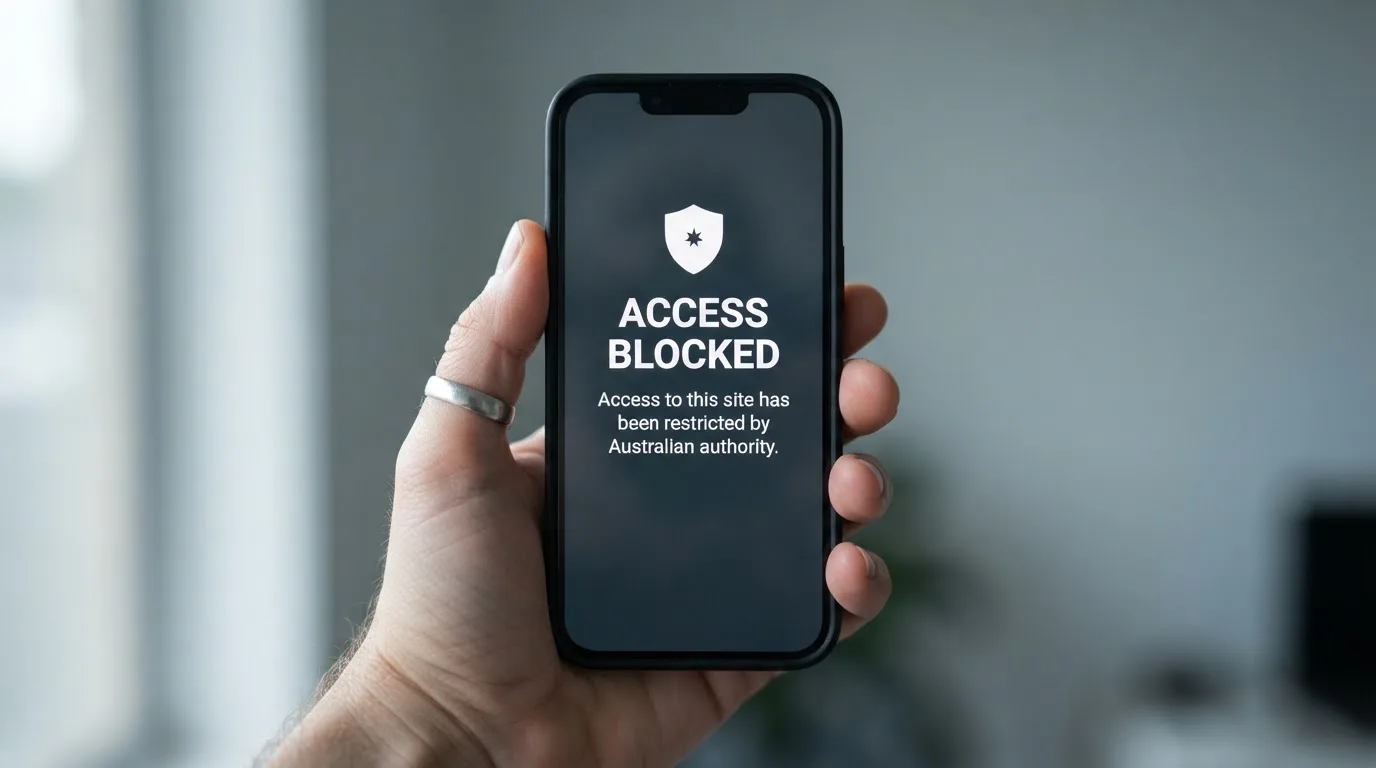
What the law does not do, and this matters for the practical reading, is prosecute individual players. The IGA targets the provider. An Australian punter placing a bet on an offshore casino is not breaking the IGA. They are, however, gambling on a platform with no Australian consumer protection, no complaints body, and no recourse if a withdrawal is refused. The site can also be blocked mid-session with a balance remaining on it. That risk sits on the player alone.
Advertising Reform Coming in 2027
The Interactive Gambling Amendment (Gambling Reform) Bill 2026 passed Parliament on 19 August 2026. Its advertising and inducement measures commence on 1 January 2027. This is law with a future start date: it is on the books but it is not yet in force on a page read in 2026. The 2027 commencement matters because the inducement provisions tighten what licensed wagering operators, the only legally available online category, can use to draw customers in. The offshore operators it touches indirectly, by raising the visibility of compliance within Australia, are not the bill’s main target.
Player Protection and Responsible Gaming in the Australian Context
The Australian framework for player protection assumes the player is on a licensed platform. BetStop, the National Self-Exclusion Register, has been live since August 2023 and binds every Australian-licensed online and phone wagering service. A punter who registers with BetStop cannot open new accounts with those operators, and existing accounts are closed. The exclusion periods run from three months to a permanent block.
The catch is exactly the catch the rest of this page keeps running into. BetStop binds Australian-licensed services. An offshore casino is not on the register, does not connect to it, and cannot be excluded through it. Self-exclusion on an offshore site is a setting in one account on one site; the punter can open the next tab and start again on the next one. For Australians who want the spinners to genuinely stop, BetStop is the option that works; for Australians playing offshore, it does not reach them.
The National Gambling Helpline on 1800 858 858 is free, runs 24/7 and connects to counselling in each state and territory. Chat support runs through Gambling Help Online. Advice is confidential, the call does not show up on a phone bill in a way that identifies it as a gambling service, and the helpline is the right place to ring when the betting has moved past the point of entertainment. Both services are independent of any operator and are not bound to a particular platform.
Self-Exclusion Tools That Reach Australian Players
BetStop is the only national instrument. State and territory regulators run their own programs for the land-based venues: a self-exclusion order at a New South Wales club or pub carries force across all venues in the state and is enforced under the Casino, Liquor and Gaming Control Authority’s framework. Victoria runs a similar scheme through the VGCCC. Western Australia’s Department of Local Government, Sport and Cultural Industries handles exclusions for the state’s one casino and its TAB outlets.
For the online wagering category that is licensed — racing and sport — the bookmakers themselves run additional responsible-gambling tooling on top of BetStop: deposit limits, time-outs, activity statements, and the ability to set a maximum stake. These are operator-level controls and they vary in quality across brands; a punter who wants consistent limits is better off using BetStop, which applies the same exclusion across every participating operator at once.
Payments, PayID, and How Money Actually Moves
The payment rails for licensed Australian online wagering are tightly defined. Credit cards and credit-related products are banned as a means of payment for online wagering since 11 June 2024, and digital currency, crypto in plain terms, is banned in the same regime. Penalties for operators that take a credit card run up to A$247,500. What is permitted for licensed wagering is debit card, bank transfer, PayID/Osko and BPAY.
PayID sits at the centre of the practical side of this shelf. PayID is the instant payment address layer that rides on the New Payments Platform and uses Osko for the actual settlement; a player links a mobile number or an email address to a bank account, and transfers land in seconds rather than days. For Australians paying for licensed wagering, PayID is the fastest legal route. It is set up through a participating Australian bank, it does not add fees on the bank’s side, and it works 24/7. The same PayID cannot be used to deposit into an offshore casino account, because the offshore casino does not have an Australian bank account to give it to.
For an Australian punter using an offshore casino, the deposit route is one of three: a debit card from Visa or Mastercard, an e-wallet like Skrill or Neteller, or a cryptocurrency deposit. All three place the punter on a rail the Australian rules do not cover. If the punter wins and tries to withdraw back to an Australian bank account, the casino runs that withdrawal through its own payment processor; PayID is not available because PayID requires the recipient to be on the NPP. The typical offshore payout is a bank wire or an e-wallet refund, and the time it takes — three to seven business days for a wire, faster for an e-wallet — is set by the offshore operator’s processor, not by Australian rules.
Payout Speed Where the Rules Actually Apply
For licensed wagering, PayID/Osko is the only deposit and withdrawal method a punter needs to know about for speed. The transfer is instant in the technical sense, limited only by the operator’s own internal approval workflow. Most Australian-licensed bookmakers credit a PayID deposit within seconds and a PayID withdrawal within an hour of approval; some advertise instant withdrawals around the clock.
For an offshore casino, the realistic worst-case is a wire transfer that takes a week once the casino has approved it. The realistic best-case is a same-day e-wallet refund, contingent on the casino’s verification process being completed. Verification, the “KYC” the offshore sites run, can stretch across several days for a first withdrawal and is the part of the timeline the punter has the least control over. From the punter’s side, the rule is: the deposit is fast and the first withdrawal is slow, and an offshore casino does not have a complaints body an Australian punter can take a stalled withdrawal to.
The Mobile and App Question
Every Australian-licensed online bookmaker runs a mobile site, and most run a native app on iOS and Android. For the offshore casino category, the picture splits. The Apple App Store and Google Play both prohibit real-money casino apps targeting Australian users; a search for “pokies” in the Australian App Store returns licensed wagering apps and social casino apps that do not pay real money, and not much else. The offshore brands distribute through their own websites as mobile-optimised web apps — bookmarks on the home screen that launch the casino in a browser shell.
What this means in practice: an Australian who wants a real-money pokies app cannot install one from a recognised app store. They can install a web app shortcut from an offshore site, which sits on the home screen like an app and runs inside the browser engine. The functional gap is small for the actual gameplay; the legal and consumer-protection gap is large, because the app is not subject to the same app-store vetting or to Australian rules.
The legitimate native apps for Australian-licensed online wagering are downloadable from the App Store and Google Play and run from Sportsbet, Bet365, Ladbrokes, TAB and the other NTRWC-licensed brands. Their product is sports and racing markets, not pokies, but the deposit rail (PayID, BPAY, debit card) and the responsible-gambling tooling (BetStop binding, deposit limits) carry over to every account on those apps.
Gameplay, Paytables, and the Mechanics Behind Real Money Pokies
A poker machine, the land-based original, is a device with a random number generator, a paytable of symbol combinations and a return-to-player percentage set by the regulator. An online pokie is the same architecture running as software: a virtual reel set, a paytable, an RNG, and a return-to-player figure chosen by the developer and audited by a testing lab.
The land-based machines in Australia are regulated state by state, and the minimum return-to-player varies by jurisdiction. New South Wales, the Northern Territory, Queensland and most of Victoria sit at 85% minimum; Crown Melbourne is the exception at 87%. The Australian Capital Territory and Tasmania set 87%, South Australia 87.5%, and Western Australia 90%. These are minimums the operator must clear; a venue can run a machine at a higher RTP, and most do.
For the table games that sit alongside pokies in any casino lobby, the house edges are set by the rules, not by a regulator’s minimum. Baccarat’s house edge is 1.06% on the Banker bet, 1.24% on the Player bet, and 14.36% on the Tie. Blackjack under liberal Las Vegas Strip rules runs about 0.28% with optimal strategy, and Atlantic City rules take it to about 0.43%. Roulette on a single-zero wheel sits at 2.70%; the double-zero American wheel, the one most offshore casinos run, doubles that to 5.26%.
Baccarat, Blackjack, and What Online Casinos Actually Stock
Crown Melbourne, the licensed casino in Victoria, offers three baccarat variants as approved table games regulated by the Victorian Gambling and Casino Control Commission: Traditional Baccarat, Crown Baccarat, and 2 to 1 Baccarat. The VGCCC took over from the VCGLR as Victoria’s casino regulator on 1 July 2022. New South Wales’ Casino Control Act 1992, section 66, requires the casino operator to keep regulator-approved rules on hand and to produce a copy on request.
Blackjack variants an offshore casino is likely to stock include Spanish 21 (played without 10s, with liberal player-favourable rules on splits and doubles), Double Exposure Blackjack (both of the dealer’s cards dealt face-up), Blackjack Switch (the player swaps cards between two hands), and Super Fun 21 (up to four splits). These are established variants with standard rules; the house edge shifts with the specific rule set, and the variant name alone does not tell a player the edge they are facing.
The history is the part the marketing rarely tells. Punto banco, the baccarat variant most casinos offer, was developed in Havana during the 1940s; the casino banks the game at all times and plays both hands by fixed drawing rules. Chemin de fer, French for “railway,” is a two-player baccarat variant that emerged in the late 19th century and is named for being quicker to play than the original. Blackjack’s immediate predecessor is the English game vingt-un; a related game called veintiuno appears in Cervantes’ Rinconete y Cortadillo, written around 1601-1602, and the modern name is generally placed around 1899 during the Klondike Gold Rush.
The Live Dealer Setup at Licensed Australian Venues
Crown Melbourne runs its table games in dedicated pit areas under VGCCC-approved rules, with the cards shuffled and dealt in the open and the cameras overhead. Crown Perth, Western Australia’s only casino, runs a similar setup under the state’s Gaming and Wagering Commission. The two casinos are the licensed mainland venues with full table-game operations; the smaller state casinos run a narrower product.
For online play, the equivalent is a live dealer studio: a real dealer, real cards, real roulette wheel, with the video streamed to the player’s screen and the bets placed through the casino’s interface. Live dealer studios operate from Malta, the Philippines, Latvia and other jurisdictions outside Australia. The ACMA’s enforcement record does not single out live dealer brands separately from the rest of the offshore casino category, and the prohibition applies regardless of whether the game is RNG-driven or live-streamed.
The 11 Operators the ACMA Has Acted Against
What follows is not a ranking and not a recommendation. Each brand on this list is here because the ACMA itself issued a formal warning over it for offering prohibited online casino services to Australians. The list is current to the ACMA register as of 2026, and the order is the order research records. Where research marks a brand’s subject support as no-data, this section does not assert or deny any product relationship; the brand is presented on the regulatory action alone.
RocketPlay
Pulsup Ltd drew a formal warning from the ACMA in March 2026 over RocketPlay. An earlier Dama N.V. entity drew a warning in May 2022 covering six brands, RocketPlay among them. The ACMA action is the record; no bonus terms or game catalogue claims are made for RocketPlay beyond what research records. The brand is not licensed anywhere in Australia to offer online casino games.
The interesting part for a reader is the timing. RocketPlay changed hands between operators and re-emerged under a different corporate envelope; the ACMA’s action tracked the new operator. For a punter reading the ACMA’s enforcement record as a guide, the pattern — operator changes, brand persists, warning tracks the new corporate entity — is what the regulator is up against.
Level Up Casino
Dama N.V. drew a formal warning in May 2022 covering Level Up among six brands. Research records subject support for Level Up from listings on developer and aggregator pages, not from any first-party source the regulator has verified. The brand operates under Dama N.V. and accepts Australian players under offshore terms. It is not licensed in Australia.
The Dama N.V. cluster is the largest single operator footprint on the ACMA’s enforcement list. The May 2022 warning covered Bambet, Dazard, Level Up, Rocketplay, Wild Tornado and Cobra Casinos. Subsequent warnings over Dama N.V. brands — Woo Casino in March 2025, Spirit Casino in May 2025 — show the regulator returning to the same operator as new brands appear.
Woo Casino
Dama N.V. drew a further formal warning in March 2025 over Woo Casino. Woo is one of the brands where Dama N.V. kept the operating name across the regulator’s prior action; the May 2022 warning covered RocketPlay but not Woo, and the March 2025 warning is the regulator’s first formal action over Woo specifically. These details are provided solely to record the regulator’s action.
Spirit Casino
Dama N.V. drew a formal warning in May 2025 over Spirit Casino, the second Dama N.V. brand to draw a 2025 warning after Woo Casino. The ACMA’s pace of action against the same operator is the figure worth watching: two warnings in two months in 2025 against Dama N.V. and a third follow-up over the same corporate group is a sustained pressure pattern.
National Casino
Consolutetish S.R.L. drew a formal warning in July 2025 over National Casino. Research records subject support for National Casino from listings pages on third-party aggregators. The ACMA’s enforcement action is the regulatory record; no first-party operator claims are made.
National Casino is a brand that has had operator changes, and the ACMA’s July 2025 warning tracked the new Consolutetish S.R.L. envelope. The pattern repeats: a brand persists through operator changes and the regulator follows the new corporate entity.
Bizzo Casino
Consolutetish S.R.L. drew a formal warning in July 2025 over Bizzo Casino. Bizzo had earlier drawn a 2022 formal warning to TechSolutions (CY) Group Limited and TechSolutions Group N.V. The same brand has been the subject of two separate ACMA actions against two separate operators, which is one of the cleaner illustrations of the regulator’s persistence.
For a punter reading the record, Bizzo’s history is a working case study. The brand has been warned under two operators, three years apart, and is still offering services to Australians under the second operator. The ACMA’s record does not show a successful block action over Bizzo specifically in the period research covers; it shows two formal warnings.
Ignition Casino
Bamboo Media drew a formal warning in July 2025 over Ignition Casino. The brand sits in a different operating envelope from the Dama N.V. and Consolutetish S.R.L. clusters, and the ACMA’s July 2025 warning is the first formal action research records against Bamboo Media specifically. No first-party product claims are made here.
Instant Casino
EOD Code SRL drew a formal warning in February 2025 over Instant Casino. The February 2025 action is the opening shot of a year that ran to twelve blocking actions by mid-2026, and Instant Casino is the earliest in that run to draw a formal warning. The brand is presented here as part of the public regulatory record.
Jackbit
Ryker B.V. drew a formal warning in April 2026 over Jackbit and CasinOK together, a single warning covering two brands under one operator. The combined warning is a useful detail: it confirms that the ACMA tracks brand portfolios per operator rather than per brand, which is what makes the Dama N.V. cluster pattern sustainable as an enforcement strategy.
Casino Intense
Sterplay Holding Ltd drew a formal warning in April 2025 over Casino Intense. Research records subject support for Casino Intense from listings pages including third-party coverage, the ACMA register, and Crown Melbourne’s table-games page; none of those listings confirms a product relationship with the offshore brand. The formal warning is the ACMA’s regulatory record.
Sky Crown
Hollycorn N.V. drew a formal warning from the ACMA over its Sky Crown and Blue Leo casino services. The ACMA’s publication of this warning, dated September 2022, is one of the older entries on the list, predating the 2024 credit-card ban and the 2026 reform bill. Hollycorn N.V. has not drawn a more recent formal warning in the period research covers, which does not mean the brand is no longer accepting Australians — it means the ACMA has not moved against it again in this period.
What Real Money Online Pokies Look Like in Numbers
The numbers behind the prohibition are themselves the story. Australia has about 3% of the world’s pub and club poker machines with 0.3% of the global population. In 2020–21 Australians bet almost A$150 billion through gaming machines and lost A$12.18 billion on them. The land-based machines are a working industry, regulated state by state, and that is where the term “pokies” comes from in Australian English.
New South Wales had 87,298 gaming machines outside casinos across 2,195 venues as of June 2023, with player losses of A$8.18 billion in 2022–23. Queensland had 21,122 gaming machines operating in 351 venues in October 2023. Victoria had 26,380 outside Crown Casino in 488 venues in 2021–22, under a 30,000-machine statewide limit. Western Australia banned poker machines in pubs and clubs when Crown Perth opened in 1985, and Crown Perth’s own count has since grown from about 200 in 1985 to roughly 2,500, all approved by the state’s Gaming and Wagering Commission. Tasmania ended the Federal Group’s monopoly over poker machines in 2021 and moved oversight to the Tasmanian Liquor and Gaming Commission.
The legal minimum return-to-player varies by jurisdiction: 85% in New South Wales, the Northern Territory, Queensland and most of Victoria (87% at Crown Melbourne); 87% in the Australian Capital Territory and Tasmania; 87.5% in South Australia; 90% in Western Australia. These are floors, and they exist because the regulator sets the design rules and approves the paytable before a machine goes on a floor. Offshore online pokies have no equivalent floor; the RTP is whatever the developer certified, and the certification is to a testing lab in another jurisdiction.
The Arithmetic of How Many Sites Have Been Blocked
The ACMA’s blocking record is the figure the page closes on, and the arithmetic on it provides a clear view of the regulator’s enforcement. The first blocking request went out in November 2019. By the round reported on 26 June 2026, 1,751 illegal gambling and affiliate marketing websites had been blocked across the intervening period.
Run the numbers: 1,751 blocks across roughly 79 months from the first blocking request in November 2019 to the June 2026 total. That works out to a band of roughly 22 blocks per month on average, or about 265 per year. The pace is not uniform — single rounds can add a dozen or more in one announcement, and quieter stretches run lower — but the long-run band is what an Australian punter can read as the regulator’s sustained throughput. The blocking mechanism is itself worth noting: the ACMA does not ask a court to take a site down, it asks Australian internet service providers to block it at the DNS or IP level, which is why a single round can add twelve names in one announcement and why an already-blocked site reappearing under a new domain is a routine thing for the regulator to chase.
The 230-plus unlicensed services that withdrew from the Australian market between 2017 and mid-2026 is the figure the regulator tends to use as the complement to the block count. A service that withdraws is not the same as a service that has been blocked; withdrawal is the operator’s choice, often after a formal warning, and it removes the brand from Australian-facing marketing without requiring the ISP blocking step. The combined figure — 1,751 blocked and 230 withdrawn — is what the ACMA’s enforcement record actually delivers.
Reading the ACMA’s Enforcement Record Side by Side
The table below lines up the eleven brands on the ACMA’s formal-warning register against the date and the named operator. The “subject support” column captures what research was able to confirm about each brand outside the regulator’s record; where research found listings from third-party sources only, the column reads “listings only,” and where research found no product information, the column is left as the no-data marker. None of this is a recommendation to use any of these operators.
| Brand | ACMA action and date | Operator named by the ACMA | Subject support |
|---|---|---|---|
| RocketPlay | March 2026 | Pulsup Ltd | — |
| Level Up Casino | May 2022 | Dama N.V. | Listings only |
| Woo Casino | March 2025 | Dama N.V. | — |
| Spirit Casino | May 2025 | Dama N.V. | — |
| National Casino | July 2025 | Consolutetish S.R.L. | Listings only |
| Bizzo Casino | July 2025 (also 2022 to TechSolutions) | Consolutetish S.R.L. | — |
| Ignition Casino | July 2025 | Bamboo Media | — |
| Instant Casino | February 2025 | EOD Code SRL | — |
| Jackbit | April 2026 (with CasinOK) | Ryker B.V. | — |
| Casino Intense | April 2025 | Sterplay Holding Ltd | Listings only |
| Sky Crown | September 2022 | Hollycorn N.V. | — |
The pattern the table makes visible is the operator-cluster structure the ACMA has been working through. Dama N.V. accounts for three entries on the list and was warned in 2022 and again in 2025; Consolutetish S.R.L. accounts for two and was warned in 2025. The other six entries are spread across six different operators. The cluster pattern is what the ACMA’s strategy amounts to: follow the corporate envelope, not the brand, and the same operator faces repeat warnings as it launches new brands.
What the table does not show is the part the reader cares about most. There is no column for payout speed, game catalogue, bonus terms, or app availability for these operators, because the ACMA’s register does not record those things and research did not find first-party data on them. The brands are listed because the regulator acted against them, not because anyone has verified what they offer. The honest reading of the table is that the ACMA’s record is the only column with real content, and the other columns are mostly blank.
What Stays Legal, and Where the Pokies Still Are
For an Australian who wants to play pokies without crossing the regulator, the legal options are not online. They are the licensed venues — clubs, pubs and casinos — and the licensed online wagering category, which covers racing and sport but not pokies.
The licensed casinos are Crown Melbourne in Victoria, Crown Perth in Western Australia, The Star Sydney in New South Wales, The Star Gold Coast in Queensland, SkyCity Adelaide in South Australia, SkyCity Darwin in the Northern Territory, and the Wrest Point and Country Club venues in Tasmania. These venues operate table games and poker machines under their state regulator; New South Wales venues fall under the Casino, Liquor and Gaming Control Authority, Victorian venues under the VGCCC, and so on.
The licensed online wagering services — Sportsbet, Bet365, Ladbrokes, the TAB group, and the others under NTRWC licences — offer racing and sports markets. They do not offer online pokies. They are the category the NTRWC actually regulates. The Northern Territory commission has no full-time staff and meets once a month in Darwin, which is one of the reasons the NTRWC’s regulation has been under parliamentary scrutiny; a 2026 reform bill addresses the commission’s resourcing. For the punter, the practical effect is that deposits and withdrawals on these services are fast (PayID/Osko), withdrawals are AUD-denominated into an Australian bank account, and the consumer protection framework runs through the regulator and through BetStop.
Tax and Money: How Winnings Sit With the ATO
Gambling winnings of a recreational player are not assessable income in Australia, under section 6-5 of the Income Tax Assessment Act 1997, and losses are not deductible. The rule is symmetric: a win is not taxed, and a loss does not reduce other income. The exception is a person who carries on a business of gambling, where the ATO treats the activity as a commercial enterprise with assessable income and deductible losses; the rule applies on its own facts and is not a route most recreational players qualify for.
For an Australian punter playing on an offshore casino, the tax treatment on the punter’s side is the same: a recreational punter does not declare winnings, does not deduct losses, and the offshore operator does not issue an Australian tax statement. The compliance risk for the punter is not on the tax side; it is on the consumer-protection and access side. If the offshore site is blocked mid-session with a balance, the punter’s recourse runs through the operator’s own complaints process, which sits in another jurisdiction, not through the ATO.
The Practical Conclusion
The phrase “best online pokies real money Australia” runs into the same wall the regulator runs into: there is no such list, because no such category is licensed. The brands that come up in a search for the phrase are offshore operators the ACMA has acted against, repeatedly in some cases, and the practical protection an Australian punter gets from any of them is whatever the operator’s own terms say.
The 1,751-blocked-sites total across roughly 79 months is the figure the ACMA’s sustained enforcement delivers, and the 230-plus withdrawals since 2017 is the figure that runs alongside it. The arithmetic shows a regulator that returns to the same operator, follows the corporate envelope rather than the brand, and clears several hundred sites a year out of Australian-facing reach. It does not show a regulator that has shut the offshore casino market down; the A$3.9 billion-a-year loss estimate is the figure on the other side of the same scale.
For an Australian punter who wants the gameplay, the licensed venues are the only lawful route. For an Australian punter who wants to step away from offshore play, BetStop is the binding instrument and the National Gambling Helpline on 1800 858 858 is the route into support. For an Australian punter who is going to play offshore anyway, the ACMA’s enforcement record is the public ledger of the operators who have been warned, and the fact that an operator shows up on that list more than once is the part that matters.
Frequently Asked Questions
What’s the difference between a free-play pokie and a real money one?
A free-play pokie runs on virtual credits with no cash attached, so a win on the screen stays on the screen and there is no withdrawal to make. A real money pokie takes a real AUD deposit, pays any win in real AUD after a withdrawal request, and the house edge applies to every spin the same way regardless of stakes. The randomness is the same on both; what changes is whether the result is worth money to the player.
Can real money online pokies be played using PayID in Australia?
PayID is the instant payment rail built on the New Payments Platform, and it works for deposits and withdrawals with Australian-licensed wagering operators — racing and sport. Online pokies sit in the prohibited category, and no Australian-licensed casino exists to take a PayID deposit. An offshore casino will typically accept a debit card, an e-wallet, or a crypto deposit, and the withdrawals route back through the operator’s own processor rather than PayID.
Is it legal for an online casino to offer real money pokies to Australians?
No. The Interactive Gambling Act 2001, as tightened by the Interactive Gambling Amendment Act 2017, makes it an offence to supply a prohibited interactive gambling service — online casino games including pokies — to a person in Australia. No Australian state or territory licences online pokies. The legal exposure sits on the provider, not the player, but the player has no Australian consumer protection on an offshore site.
Is there a dedicated real money pokies app for Australian players?
Not from a recognised app store. Apple and Google both block real-money casino apps targeted at Australian users, so a search for a “pokies app” in the Australian App Store or Google Play returns licensed wagering apps and social-casino apps that do not pay real money. Offshore casinos distribute as mobile-optimised web apps installed via the home screen, which behave like an app but are not subject to app-store vetting or to Australian rules.
How much did Australians wager on gaming machines in 2020–21?
According to the public record, Australians bet almost A$150 billion through gaming machines and lost A$12.18 billion on them in 2020–21. New South Wales alone had 87,298 gaming machines outside casinos across 2,195 venues as of June 2023, with player losses of A$8.18 billion in 2022–23. These are the land-based figures; the online figure is estimated separately at about A$3.9 billion a year in losses to illegal offshore sites.