Best 3-Reel Slots in Australia — the Market That Is Not There
 Available in AU
In Australia, a 3-reel slot exists as a familiar machine on a club floor, as a memory of Charles Fey’s Liberty Bell, and as a thumbnail on an offshore website that the regulator has already told to stop. Online casino games and online pokies are prohibited for anyone in Australia under the Interactive Gambling Act 2001, regardless of reel count. No state or territory issues a licence for them. What this page is, and is not, follows from that single fact: the legal picture is the picture, and “best” can only mean a careful read of what an Australian is actually being offered.
Currency stamp: current as of 17 October 2026, with the ACMA’s published formal-warning register checked for every operator mentioned.
Table of Contents
- How to read the page before deciding what to do
- Responsible gaming — the help that already exists
- What “a bonus on a 3-reel slot” actually means offshore
- What a 3-reel slot is, mechanically
- The brands the ACMA has warned — and what “subject support” actually means
- How fast the ACMA has been blocking — the rate behind the table
- The law the table sits inside
- The mechanics the table hides
- What to actually check on any offshore site
- The numbers on the ground — pub and club pokies
- Why the format is still searched for
- What this page is not for
- FAQ
How to read the page before deciding what to do
The rest of the article walks in the order a reader needs it. It opens with the help services that exist for a punter who feels the game getting out of hand — because if the rest of this page is ever going to be acted on, that paragraph matters first. It then turns to the offshore bonus-and-free-spin language, which is what most readers arrived searching for, and explains the format itself: the three-reel layout, the paytable, the way the math sits behind a five-symbol line. After the game explanation, the operator table sits, with the brands the ACMA itself has warned over Australian players. The page closes on the legislation that makes the table what it is, and on the five questions that keep coming up about 3-reel play on this side of the world.

Every operator named here is an offshore brand, not a recommendation, and none of them is licensed in Australia. The block a reader lands on after this sentence will not change that.
Responsible gaming — the help that already exists
If 3-reel slot play, online or in a pub, has started to feel less like entertainment and more like a problem, the Australian help network is in place around the clock. Gambling Help Online runs a free, confidential phone line on 1800 858 858 and a chat service on its website, twenty-four hours a day. It is staffed by counsellors who will not tell a caller what to do, but will work through the situation with them. A second route sits on top of the wagering side specifically: BetStop, the National Self-Exclusion Register, has been live since August 2023 and binds every Australian-licensed online and phone wagering service at once, so a punter who registers cannot open a new account or place a new bet with any of them for the period they choose. The limit is the shape of the law: BetStop covers licensed wagering, not offshore casinos, so an offshore site that takes Australian players sits outside it. A self-exclusion that does not include the offshore brand a person actually uses is a self-exclusion with a hole in it, and the right person to talk that through with is a counsellor, not a search box.

Beyond the helpline, state and territory bodies run their own face-to-face and financial-counselling programmes, and the Gambler’s Help service in each state is the directory entry point. The national register of self-exclusion is run by the ACMA-side registry body and is free of charge; registering does not appear on a credit file or a bank statement. What it costs a person is the wagering they cannot do while it is active. That trade is the point of the tool.
The page will come back to offshore limits further down, but the help services are the part the reader should know exists before anything else is read. They exist now, they are free, and they are confidential.
What “a bonus on a 3-reel slot” actually means offshore
Almost every search that lands on this page uses some form of the words bonus or free spins alongside 3 reel. On an Australian-licensed site those offers do not exist for casino games, because casino games are not licensed here in the first place. What a reader finds is the offshore version, where a bonus on a 3-reel slot is a cash credit the site will only let a player spend if they first wager the bonus amount a set number of times through eligible games. The number is called a wagering requirement or a playthrough, and it sits at anything from twenty times the bonus upward. A free spin on a 3-reel slot is a spin paid for by the site, on a fixed stake and a fixed title, with whatever the spin wins paid as bonus money subject to the same playthrough.
The size of the bonus is the part the marketing writes largest. The part the marketing writes smallest is the cost of clearing it. A $100 bonus at a thirty-times playthrough requires $3,000 of wagers before the bonus and any winnings from it become withdrawable cash, and on a 3-reel slot with a flat stake and a tight paytable that is a long run of low-variance spins. The expected cost of clearing — the bonus’s real price to the player — is the turnover multiplied by the house edge on the game, and on a 3-reel classic slot with a single payline and a flat jackpot that edge is larger than on a five-reel video slot with bonus features and free-spin rounds. A larger headline bonus is not always a cheaper bonus.
The wagering requirement is not the only condition. Most offshore offers cap the size of a single bet during playthrough, often at $5 or $10, and breach of that cap voids the bonus and any winnings from it. Most also cap the maximum cashout from bonus play — a rule called a max-win or max-cashout — and that cap is the place where a big advertised headline quietly turns into a small real payout. The free-spin side mirrors this: a hundred free spins on a top title sounds generous until the line at the bottom of the promotion says the winnings are capped at, say, twenty dollars.
There is a second problem that does not show up on the offer page. Because the site is offshore, none of the standard Australian consumer protections apply. A withdrawal that the operator delays, a bonus term that is applied retroactively, a winning spin that is reversed after the fact — these have no Australian complaints body to escalate to. The site’s own regulator, where it has one, is the route; that regulator’s record on player disputes is the part of the licence page a reader should actually read. The licence badge at the bottom of the home page is not the part that matters.
The third problem is the simplest. Every site listed below has been the subject of an ACMA formal warning over its offering to Australians. Reading the next section assumes the reader knows that.
What a 3-reel slot is, mechanically
The 3-reel format is the original slot layout. Charles Fey’s late-19th-century Liberty Bell was a three-reel mechanism with five symbols — horseshoes, diamonds, spades, hearts and the Liberty Bell — and three bells across the centre line paid the top prize of ten nickels. Most mechanical three-reel machines that followed kept roughly ten symbols per reel, which puts the number of possible combinations at about 1,000 and the odds against a single three-of-a-kind at about 1,000 to one. Modern video slots, by contrast, can use five reels and fifty or more symbols per reel, which pushes the odds on the rarest top combination as high as 300 million to one. The contrast is not just visual: it is the difference between a game where wins come often and pay small, and a game where wins come rarely and pay large.
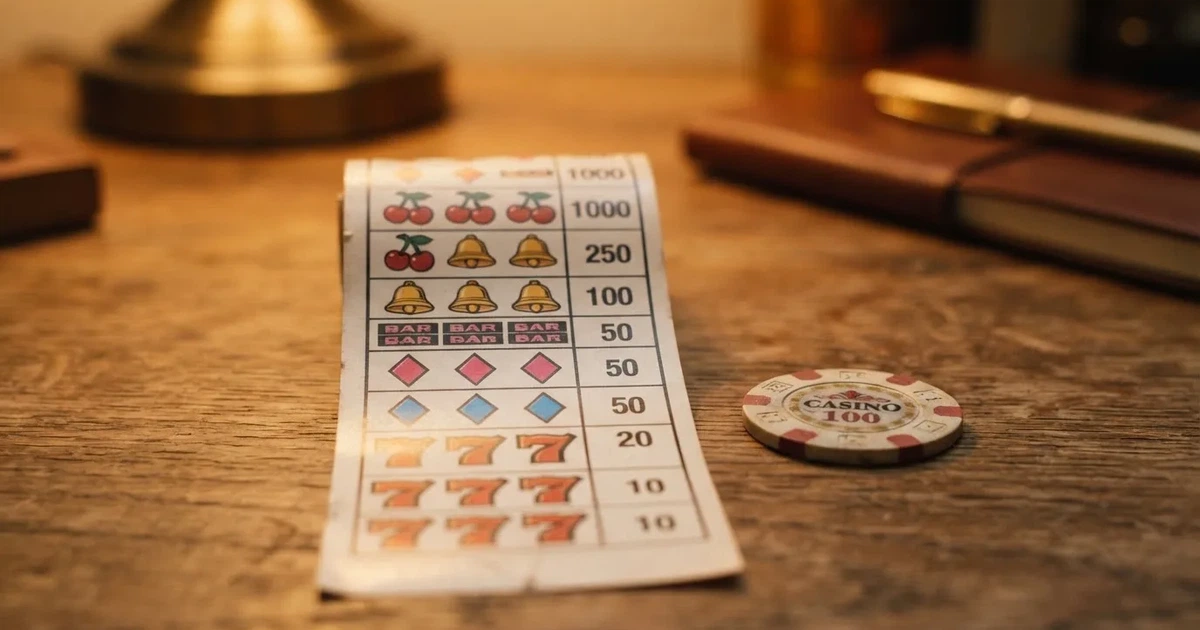
A paytable is the chart that tells the player what each symbol combination pays. On a 3-reel classic it is short — usually a single page, sometimes a single screen — and the highest paying symbol is the one a player learns first. The payline is the line across which matching symbols count as a win; on the simplest 3-reel slots there is just the one horizontal centre line, while modern 3-reel slots sometimes offer three lines (top, centre, bottom) or five (the three horizontals plus two diagonals). The bet per line is multiplied by the number of active lines to give the cost of a spin, and the coin size or denomination is the unit the bet is denominated in. None of these words is unique to the 3-reel format; what is unique is how few of them there are.
The other word that matters is volatility. A high-volatility slot pays large wins rarely; a low-volatility slot pays small wins often. Volatility on a 3-reel classic is, mechanically, often higher than on a five-reel video slot with bonus features, because the top payout on a 3-reel classic is concentrated in the rare three-of-a-kind of the top symbol while a five-reel video slot tends to spread its payouts across free spins, multipliers and scatter wins that come up more often. The shape of a 3-reel paytable is, almost by construction, a high-volatility paytable — which is the inverse of what a casual player might assume from the simpler look.
The RTP — return to player — is the average amount a slot returns across a very large number of spins. It is expressed as a percentage of money in. A 95% RTP means that, over a long run, the slot returns $95 of every $100 wagered, and the remaining $5 is the house edge. State regulation in some US jurisdictions sets minimum payout percentages: Nevada requires at least 75%, Mississippi at least 80%, New Jersey at least 83%. Australian pub and club gaming machines are regulated at state level, with the Northern Territory’s machines capped at a maximum bet per spin and each state publishing its own return-to-player range; the exact numbers are the state gaming authority’s job to publish. On an offshore site, the RTP published on the game’s information page is the operator’s number, and there is no Australian regulator checking it.
What this means for the search the reader arrived with: a 3-reel online slot is, on paper, the simplest slot format there is, but the offshore bonus attached to it sits inside a stack of conditions that the simpler-looking game does not advertise. The simpler game and the harder offer are the same page.
The brands the ACMA has warned — and what “subject support” actually means
The table below lists offshore brands the ACMA has, at the time of writing, issued formal warnings to for offering prohibited interactive gambling services to Australians. It is not a ranking and not a recommendation. The columns are: the brand as the ACMA has named it, the ACMA action and the date the warning was issued, the operator entity the ACMA named on the warning, and the support for the 3-reel subject itself — which is to say, whether the brand has been listed by a third-party directory as carrying 3-reel slot content, or whether no such listing has been found in the consulted set.
| Brand | ACMA action and date | Operator named by the ACMA | Subject support (3-reel) |
|---|---|---|---|
| RocketPlay | Formal warning, March 2026 | Pulsup Ltd (Rocketplay.com.au) | — |
| Level Up Casino | Formal warning, May 2022 | Dama N.V. | Listings only |
| Woo Casino | Formal warning, March 2025 | Dama N.V. | — |
| Spirit Casino | Formal warning, May 2025 | Dama N.V. | — |
| National Casino | Formal warning, July 2025 | Consolutetish S.R.L. | Listings only |
| Bizzo Casino | Formal warning, July 2025 (earlier 2022) | Consolutetish S.R.L. (earlier TechSolutions) | — |
| Ignition Casino | Formal warning, July 2025 | Bamboo Media | — |
| Instant Casino | Formal warning, February 2025 | EOD Code SRL | — |
| Jackbit | Formal warning, April 2026 | Ryker B.V. | — |
| Casino Intense | Formal warning, April 2025 | Sterplay Holding Ltd | Listings only |
| Sky Crown | Formal warning, September 2022 | Hollycorn N.V. | — |
An em dash means the consulted set did not list that brand under the 3-reel subject at all. Listings only means a third-party directory or reference page names the brand in a 3-reel context, but the consulted set carried no confirmation from the operator itself — so the line is written as those listings report it, not as the operator’s own fact.
The ACMA’s action sits on top of the offering itself: every brand above is offering, to Australians, a service that cannot be licensed in Australia. The brand licence the operator displays at the foot of its home page is a licence issued by a regulator outside Australia, and it does not put the operator inside Australian law. Several of the operators in the table share corporate ownership — Dama N.V. alone has three of the rows — which is the relevant fact about a “warning” being a one-off event rather than a pattern: a warning to the operator entity covers every brand it runs, so a Dama N.V. warning in 2022 covers the brands that were live then, and a 2025 follow-up warning adds the brands launched since.
RocketPlay
The ACMA’s March 2026 formal warning named Pulsup Ltd over the Rocketplay.com.au site. Pulsup is the same operator Dama N.V. was warned over in May 2022, when Rocketplay was among six casino brands on a single warning. Two warnings, four years apart, on the same brand from the same regulator are the regulator’s view that the earlier warning did not move the offering offline. The consulted set did not list Rocketplay under the 3-reel subject, which is consistent with the brand’s primary position as a multi-provider video-slot site rather than a 3-reel specialist. For a player who values the regulator’s continued attention as a signal of how seriously an operator treats enforcement, that history is the signal.
Level Up Casino
The May 2022 formal warning over Dama N.V. covered Level Up alongside five other brands, and the brand has not been re-warned since. Level Up is the brand the consulted set does list under the 3-reel subject via a third-party software-provider directory, which means the 3-reel titles are real titles in real game lobbies — but the listing is the directory’s, not the operator’s. The 2022 warning predates most of the current ACMA blocking-round activity, and a warning that has not been followed by further enforcement is a different signal from the RocketPlay pattern above. The reader still cannot play on it from Australia; the difference is in the operator’s compliance posture rather than in the legality.
Woo Casino
Woo was the subject of a fresh ACMA warning in March 2025 — a separate enforcement action from the 2022 Dama N.V. round, which means Woo re-entered the Australian offering landscape after the earlier warning closed, or the earlier warning did not name the Woo domain specifically. The consulted set did not carry a third-party listing of Woo under the 3-reel subject, so the brand is described as the regulator’s record presents it: an offshore casino offering prohibited services to Australians, with no confirmation on the 3-reel subject from the consulted sources. For a reader who takes the regulator’s pattern of warnings as one of the costs of playing on an offshore brand at all, Woo is the case where the same operator entity has had two warnings in different years.
Spirit Casino
Spirit was named in the May 2025 warning round that also covered Woo, again over Dama N.V. That makes Spirit the second Dama N.V. brand warned in 2025 alone. The consulted set did not list Spirit under the 3-reel subject; as with Woo, the line on 3-reel content is what the consulted set carries, not a confirmation from the operator. Spirit sits beside Woo in the ACMA enforcement data for the same operator entity, and the page treats the two the same way: the ACMA’s enforcement is the only fact the page reports.
National Casino
The July 2025 warning named Consolutetish S.R.L. over National Casino, and the consulted set lists National under the 3-reel subject via the same kind of third-party directory the Level Up row carries. National is therefore a brand where the 3-reel claim has a third-party source rather than no source at all, and the regulator’s view of the brand’s Australian-facing offering is recorded in the same formal warning as Bizzo. The combination of a 3-reel listing and a current ACMA warning is the typical shape of the offshore 3-reel market as the consulted set presents it.
Bizzo Casino
Bizzo carries two warnings: the 2022 warning to TechSolutions (CY) Group Limited and TechSolutions Group N.V., and the July 2025 warning to Consolutetish S.R.L. Two operators named on the same brand across three years is the regulator’s record that Bizzo has continued to offer to Australians across at least one change of operator entity — the kind of pattern that does not appear in the ACMA’s file by accident. The consulted set did not list Bizzo under the 3-reel subject directly, and the brand sits in the table on the regulator’s record alone.
Ignition Casino
The July 2025 warning named Bamboo Media over Ignition Casino. Bamboo Media is a different operator entity from the Dama N.V. and Consolutetish S.R.L. entries that share the same warning round, which means the July 2025 action covered at least three distinct operator entities on one batch. The consulted set did not list Ignition under the 3-reel subject. Ignition is one of the older offshore brands in the warning set, and the regulator’s view of it has now been recorded in 2025; the brand’s Australian-facing offering has been on the ACMA’s file for the current enforcement round.
Instant Casino
The February 2025 warning named EOD Code SRL over Instant Casino. The consulted set did not list Instant under the 3-reel subject, so the line on 3-reel content is what the consulted set carries. Instant is one of the brands the regulator warned over earlier than the July 2025 round, and a warning in February 2025 with no further enforcement recorded since is a different shape from the multi-warning brands above: a single warning, on its own, with the consulted set silent on the specific subject.
Jackbit
The April 2026 warning named Ryker B.V. over Jackbit and CasinOK together — a single warning covering two brand names on the same operator entity. Jackbit is the more recent of the two warnings on the regulator’s current page. The consulted set did not list Jackbit under the 3-reel subject, and the brand sits in the table on the regulator’s action alone.
Casino Intense
The April 2025 warning named Sterplay Holding Ltd over Casino Intense. The consulted set listed Casino Intense under the 3-reel subject via a third-party reference page, so the line on 3-reel content has a third-party source. Casino Intense is a brand whose Australian-facing offering has been on the regulator’s record since 2025, and the combination of the warning and the 3-reel listing is what the consulted set carries.
Sky Crown
The September 2022 warning named Hollycorn N.V. over Sky Crown and Blue Leo. The consulted set did not list Sky Crown under the 3-reel subject directly. Sky Crown is the oldest warning in the table — the brand has been on the regulator’s file for nearly four years at the time of writing — and the brand’s appearance in the table is the ACMA’s record, nothing further.
How fast the ACMA has been blocking — the rate behind the table
The ACMA asked Australian internet service providers to block illegal gambling websites for the first time in November 2019. As reported in June 2026, a total of 1,751 illegal gambling and affiliate marketing websites had been blocked since that first request. The 12-site round reported on the same date is one of dozens of rounds the regulator has run, but the cumulative figure is the one that lets a reader see the pace. Across the roughly eighty months between the first blocking request in November 2019 and the 1,751 figure in June 2026, the running total of blocked sites works out to a long-run average of roughly twenty-two sites a month. The pace is not constant — a single round can add twelve, and several months can pass between rounds — but the average is the band a reader can hold in their head: this market is being blocked at a rate that adds up to a new blocked offshore site every couple of days over the long run.
The same June 2026 figure comes with a second line: more than 230 unlicensed gambling services have left the Australian market since enforcement was strengthened in 2017. Left is a different verb from blocked — a service that leaves the Australian market stops offering to Australian players voluntarily, which is what some offshore operators do after a warning or a blocking request, and the regulator counts both routes in the same headline figure. The two numbers together — 1,751 blocked, 230 left since 2017 — describe the regulator’s two tools and the scale of the market the regulator is working against.
The H2 Gambling Capital figure that frames the scale is roughly A$3.9 billion a year in estimated losses to illegal gambling sites by Australians, with the share of gambling going through legal channels falling from 74% in 2021 to 64%. The fall is the part that makes the regulator’s blocking programme a market-share question as well as a compliance question: ten points of channel share have moved off the legal side over five years, and almost all of that movement is going to the offshore sites on the ACMA’s blocking list.
The page treats the rate as a band rather than a single figure because the ACMA’s blocking rounds are not evenly spaced — some are monthly, some quarterly, some larger — and a single point estimate overstates what a constant figure would actually look like. The roughly twenty-two-sites-a-month band is the long-run average; the short-run picture is lumpy.
The law the table sits inside
The Interactive Gambling Act 2001 — the IGA — is the federal statute that prohibits the supply of online casino games, online pokies and in-play betting services to a person in Australia. The Interactive Gambling Amendment Act 2017 strengthened the enforcement provisions and gave the ACMA the powers the table above records: investigation, formal warning, and the direction to internet service providers to block illegal sites. The 2017 amendment is also when the criminal and civil penalty provisions for offering prohibited services were widened to the structure the regulator now operates under. The Interactive Gambling Amendment (Gambling Reform) Bill 2026, passed by Parliament on 19 August 2026, adds advertising and inducement measures that commence on 1 January 2027; on a page read in the current year, that is law with a start date, not law in force.
What the IGA does not do is prosecute the individual player. The offence sits on the provider side; an Australian who opens an account on an offshore site does not commit an offence under the IGA. The protections the player loses are not criminal but civil: no Australian consumer law applies, no Australian complaints body has standing to hear a dispute, no Australian court will enforce a foreign judgment against an offshore operator without a long and expensive process. The site itself can be blocked by the ACMA with a balance still on a player’s account, and the regulator’s blocking round carries no obligation on the operator to refund balances at the moment of blocking. The provider-side prohibition and the player-side loss of recourse are the same shape: the player has fewer protections on an offshore site than on any Australian-licensed service, by design.
What is licensable in Australia is wagering on races and sport placed before the event, lotteries and keno — in practice licensed by the Northern Territory, which is why the Northern Territory Racing and Wagering Commission regulates 52 of Australia’s online bookmakers despite meeting once a month and having no full-time staff. The NTRWC’s regulator-of-record position is a tax-driven arrangement that pre-dates the current online market; the ABC’s reporting on the NT bill to reform the de facto gambling regulator in April 2026 is the public record of how thin that regulator is. The bookmakers themselves — Sportsbet, Bet365, Ladbrokes among them — are the Australian-licensed services the average punter is most likely to encounter, and they offer wagering on sport and racing, not casino games and not online pokies.
The minimum age for any gambling in Australia is 18. The credit-card ban took effect on 11 June 2024: credit cards, credit-related products and digital currency are no longer permitted as payment for licensed online wagering in Australia, with penalties up to $247,500 for operators that breach the rule. The legal deposit routes for licensed wagering are debit card, bank transfer, PayID/Osko and BPAY. A site asking an Australian for a credit card or a crypto deposit is, by definition, not a licensed Australian wagering service; it is the offshore casino side of the market, which the IGA prohibits and the ACMA’s blocking programme targets.
Tax treatment is straightforward for the average punter. Gambling winnings of a recreational player are not assessable income under section 6-5 of the Income Tax Assessment Act 1997, and losses are not deductible — unless the person carries on a business of gambling, which the ATO assesses on a case-by-case basis. The ATO publishes the test; the rest of the answer is “check with the ATO or a tax agent if the activity might count as a business”.
The mechanics the table hides
A reader who skipped the offshore-bonus section above should know this much about it. Every 3-reel slot offered on the offshore brands in the table sits inside the same bonus structure the ACMA has warned over: the bonus is paid in bonus money, the wagering requirement is multiplied into the bonus, the maximum bet during playthrough is capped, and the maximum cashout from bonus play is capped. The 3-reel format is the simpler-looking game; the offer attached to it is the harder offer. A reader who treats the table as a shortlist of places to play has read past the page’s own opening sentence.
The brands the table lists are not the only offshore 3-reel slot brands; the ACMA’s enforcement action is the reason they are in this table. A 3-reel slot on a brand the regulator has not yet warned over is a distinct case, and that distinction is the difference between not on the regulator’s file and not offering to Australians. The two are not the same thing.
What to actually check on any offshore site
If a reader is going to look at an offshore brand despite the rest of this page, the things worth checking are not the things the home page puts largest. The licence badge at the foot of the home page is the operator’s claim, not a regulator’s. The licence register on the regulator’s own website — the Curaçao Gaming Authority’s public register, the Kahnawake Gaming Commission’s licensee list, the Malta Gaming Authority’s licensed entities page — is the part that confirms the claim. The terms and conditions page for the bonus is the part that names the wagering requirement, the maximum bet during playthrough, the game-weighting table (the list of games that contribute 100% to the playthrough versus games that contribute less or zero), the maximum cashout from bonus play, and the expiry window on the bonus. None of those is on the offer page; all of them are on the terms page.
The second thing to check is whether the site offers the deposit routes an Australian can legally use. A licensed Australian wagering service accepts debit card, bank transfer, PayID/Osko and BPAY; an offshore casino asking for a credit card or a crypto deposit is offering a payment the licensed side is banned from taking, which is one of the easier tells of which side of the IGA a site is on. The credit-card ban took effect on 11 June 2024, and a site that still asks for a credit card in 2026 is on the wrong side of it.
The third thing to check is the complaints route. An Australian-licensed wagering service has an Australian dispute resolution body. An offshore casino has the regulator in the jurisdiction it claims to be licensed in, and the regulator’s record on player disputes is the relevant number — not the licence itself. A regulator that has not published a complaint decision in the last twelve months is a regulator the player should expect to be slow on a complaint; a regulator that has published several is one whose track record a reader can read. The licence badge and the regulator’s complaint record are different documents.
The numbers on the ground — pub and club pokies
Outside the offshore world, the 3-reel format has a real Australian presence in the pub and club sector. Pokies-style slot machines outside casinos numbered 87,298 in New South Wales as of June 2023, 26,380 in Victoria across 2021–22, 21,122 in Queensland as of October 2023, 11,672 in South Australia as of September 2023 and 3,587 in the ACT as of November 2023. Across the five states the figure is 150,059 machines outside casinos — a per-capita rate that, in 2010, was about five times that of the United States, and that has held roughly in shape since. New South Wales legalised slot machines in 1956; the format predates the modern video slot by a clear margin, and the pub and club sector has stayed closer to the 3-reel and 5-reel mechanical-style games than the online sector has.
This is the part of the market that is licensed and that an Australian can legally play, subject to the state-level rules on minimum return-to-player, hours of operation, and self-exclusion registers that run in each state. The Victorian Commission for Gambling and Liquor Regulation, the NSW Liquor & Gaming NSW body and the equivalent bodies in each state are the regulators of the pub and club machines, and the state-level self-exclusion registers are the routes that bind this side of the market for a player who wants to stop. The legal-online side of the market is wagering, not casino games; the legal land-based side is pubs, clubs and the casino floors in Melbourne and elsewhere.
Why the format is still searched for
A 3-reel slot is, mechanically, the simplest slot format that exists. The single payline, the small number of symbols, the short paytable, the absence of scatter pays and free-spin rounds: every one of these is a feature that makes the format easier to read than a five-reel video slot with bonus games. For a reader who is new to slots and wants to understand what a slot actually does, the 3-reel format is the place the explanation starts. For a reader who is a returning player and remembers the mechanical and early-video slots of the late twentieth century, the 3-reel format is the place the nostalgia sits. The simpler-looking game is the one both readers arrive searching for.
The harder offer is the offshore bonus that sits on top of it, and the harder law is the IGA that prohibits the offer from being made to Australians at all. The 3-reel slot the reader is searching for exists, mechanically, on every offshore brand in the table above. It does not exist as a thing an Australian can do legally from a laptop in Sydney, and that is the legal shape the rest of the page sits inside.
What this page is not for
This page is not a directory of offshore casinos. It does not list the bonus terms on any of them, because the bonus terms come from affiliate marketing pages and the affiliate marketing pages are the side of the market the ACMA has been warning over for the last seven years. It does not recommend any brand over another; the brands listed are the brands the regulator has acted against, and a regulator’s action is a record of enforcement, not a ranking.
This page is also not a description of where to play 3-reel slots legally online in Australia. There is no such place under the current law. The Interactive Gambling Act 2001 prohibits online casino games and online pokies for anyone in Australia, and the prohibition is the legal shape, not a temporary condition that a future amendment will change. The 2026 reform bill adds advertising and inducement measures that commence on 1 January 2027; it does not legalise online casino play.
FAQ
What makes a 3-reel slot different from a standard five-reel video slot?
A 3-reel slot uses three reels of symbols, typically with one horizontal payline, and a short paytable of single-line symbol combinations. A five-reel video slot uses five reels, often fifty or more symbols per reel, multiple paylines, and usually bonus features, scatter pays and free-spin rounds. The 3-reel format is the original layout, from Charles Fey’s late-19th-century Liberty Bell; the five-reel format is the modern video slot. The odds against a top combination differ accordingly: about 1,000 possible combinations on a 3-reel mechanical machine, against odds as high as 300 million to one on a modern five-reel video slot.
Can 3-reel slot machines be found in licensed Australian pubs and clubs?
Yes. Pokies-style slot machines outside Australian casinos numbered 87,298 in New South Wales as of June 2023, 26,380 in Victoria across 2021–22, 21,122 in Queensland as of October 2023, 11,672 in South Australia as of September 2023 and 3,587 in the ACT as of November 2023. The pub and club sector runs the closest analogue to the original 3-reel format, with state-level regulation on minimum return-to-player, hours of operation and self-exclusion registers.
Do 3-reel slots typically pay out differently than newer five-reel formats?
Yes, on volatility. A 3-reel classic concentrates its payouts in the rare three-of-a-kind of the top symbol, which is a high-volatility shape — large wins rarely. A five-reel video slot spreads payouts across free spins, multipliers and scatter wins that come up more often, which is a lower-volatility shape on average. The published return-to-player percentage is the other relevant number; it is state-regulated on Australian pub and club machines, and operator-published on offshore sites.
Is a 3-reel slot online the same game as a 3-reel machine on a casino floor?
The mechanical layout is the same — three reels, single or few paylines, a short paytable. The regulatory environment is not. A pub or club 3-reel machine is licensed by the relevant state regulator and operates under Australian consumer law. An offshore online 3-reel slot is offered by an offshore operator under a non-Australian licence, sits outside Australian consumer law, and is the subject of ACMA enforcement action if offered to Australians.
Are 3-reel slots for real money available legally from an Australian-based site?
No. Under the Interactive Gambling Act 2001, online casino games and online pokies are prohibited for anyone in Australia, regardless of reel count. No state or territory issues a licence for them. What is licensable is wagering on races and sport before the event, lotteries and keno. The legal land-based 3-reel format is in pubs and clubs under state regulation, not online.
Do reel count and paytable structure affect how a slot’s volatility is described?
Yes. Volatility is the word for how often a slot pays and how large those payouts are. A 3-reel classic with a concentrated top payout is, mechanically, often high-volatility. A five-reel video slot with bonus features that trigger often is, mechanically, often lower-volatility. The paytable shape and the reel count are the two main inputs to the volatility label, alongside the size of the top prize relative to the line payout.
Written by the editors at Casino Jackpot Hub.