
Instant Bank Transfer Casino Australia: Understanding the Deposit Speed and Its Limitations
A bank transfer clears in seconds. The settlement of the deposit is not the question an Australian player actually needs answered, and the gap between those two facts is the whole of this page.
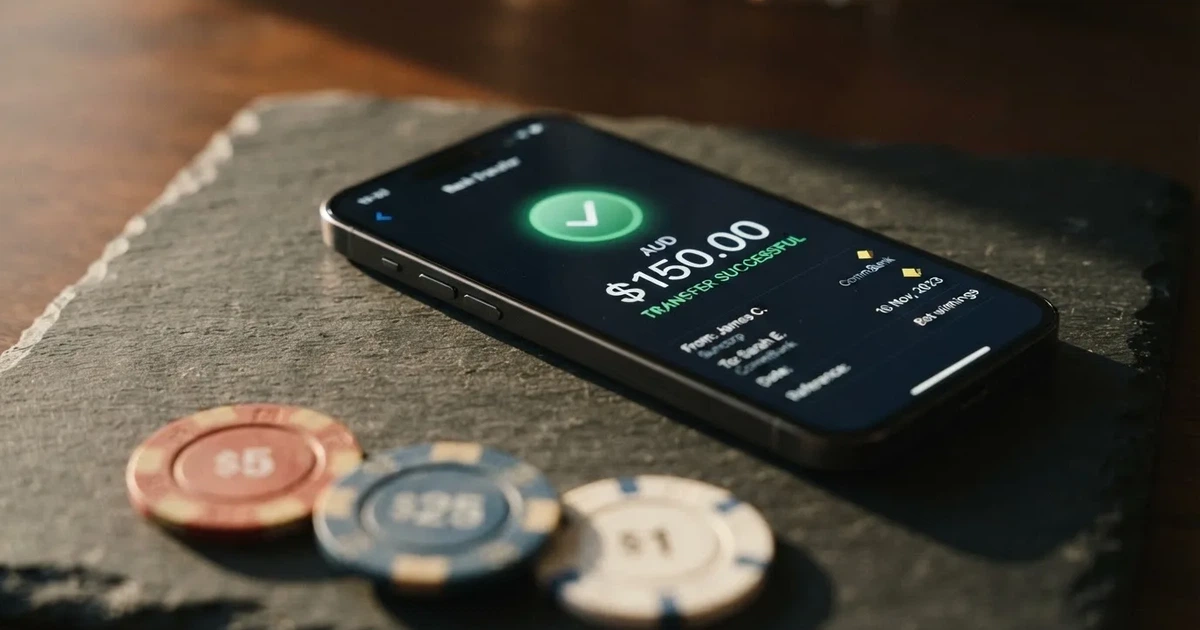
The marketing around “instant bank transfer casino Australia” promises a one-minute top-up straight from a bank account into a pokies-style site. That part is technically true: PayID and Osko, the rails underneath the New Payments Platform, can move money between Australian accounts in under sixty seconds, twenty-four hours a day. What that line of marketing leaves out is that no online casino offering games to a person in Australia may lawfully exist under the Interactive Gambling Act 2001, that the ACMA has been blocking such sites since 2017, and that a transfer can still be refused at the bank even when it has already been accepted at the cashier. The instant part describes the rail; the lawful part describes what sits on the end of it, and only one of those two is what a player is choosing when they sign up.
This page maps the realistic routes a bank-transfer casino deposit takes from an Australian bank account into an offshore site, then through the ACMA’s enforcement record against the operators who run those sites. It does not rank them as recommendations, because the product itself is prohibited. It sets out the eleven brands the ACMA has formally warned for offering prohibited casino services to Australian residents, and explains why the speed of the deposit is the least important thing about any of them.
Current as of 5 November 2026. Licence and ACMA enforcement claims verified against the Australian Communications and Media Authority’s published register of formal warnings and blocking actions.
Table of Contents
- Settling Money Into an Offshore Casino: How the Rail Actually Works
- The ACMA Record: Why These Sites Cannot Legally Serve Australian Residents
- What a Player’s Bank Sees in a Bank Transfer to One of These Sites
- The Operators Behind the Brands: A Lineup of ACMA-Warned Services
- What the Law Actually Says About a Player, Not an Operator
- Responsible Gambling: What a Bank Transfer Gives the Player That Other Rails Do Not
- The Practical Picture for an Australian Player Considering One of These Sites
- Frequently Asked Questions
Settling Money Into an Offshore Casino: How the Rail Actually Works
A direct bank transfer at one of these sites looks, on paper, like paying any other bill. A player opens the cashier, picks “Bank Transfer” or “Instant Bank Transfer,” is given either a BSB and account number or a PayID, and approves the payment in their own banking app. The funds leave the Australian account almost immediately. The credit appearing in the casino balance is the slower step, because it depends on the operator’s own processing rather than the speed of the rail.

PayID sits on top of Osko, both products of Australian Payments Plus, and both are accessible through the online banking of more than a hundred Australian financial institutions. A transfer between participating banks using either rail arrives in under a minute, weekends included. By April 2025, more than 25 million PayID identifiers had been registered on the New Payments Platform. The speed is real, and the broader Australian payments system is built for it.
What makes that rail awkward inside a casino context is that PayID is designed to verify who is on the receiving end. Paying to a PayID shows the account-holder name before the transfer is sent, and Australian Payments Plus warns that a gambling site asking for a PayID transfer is almost certainly a scam site operating outside the rules. The verification PayID was built for — knowing who you are paying — is the exact check that contradicts the offshore casino’s claim of being a normal merchant.
A card deposit runs a different path. It travels through Visa, Mastercard, American Express or eftpos, sits on a card network with merchant category codes that Australian banks actively screen, and lands at the cashier inside the same settlement window as a PayID transfer. The paper trail is the casino’s transaction log plus the cardholder’s monthly statement, with the bank as an intermediary that can refuse the authorisation outright. A bank transfer is faster at the bank, but it skips the card network entirely, so the bank only sees the transfer after the customer has authorised it. That changes who is in a position to refuse it, and when.
None of those mechanics turn a prohibited product into a permitted one. The Interactive Gambling Act 2001, as amended in 2017, makes it an offence to provide online casino games or online pokies to a person physically in Australia, regardless of how the deposit is funded or how quickly it arrives. Every brand named further down this page has been the subject of an ACMA formal warning for doing exactly that.
What an Offshore Casino Asks For
A direct bank transfer deposit typically requires either a BSB and account number, the recipient’s PayID (often a mobile number, email or ABN), or a bill-payment style arrangement via BPAY. BPAY is a separate Australian service that has run since November 1997 and is now available through the online banking of more than 140 institutions; the payer enters a Biller Code and a Customer Reference Number printed on the bill. None of those details require the casino to verify the player’s identity at the moment of deposit — that verification, when it happens at all, sits behind a separate Know Your Customer step.

For an Australian resident, this means the deposit can be sent before the casino has any formal record of who is sending it, and the bank only sees a transfer to an account in the operator’s name. The bank has no way to know the transfer is funding casino play unless the receiving account is itself flagged, the merchant category code triggers a block, or the customer has set a personal gambling block through their banking app. A direct transfer bypasses those card-level guards entirely.
What the Bank Can Refuse
Westpac’s gambling block operates at the card network, refusing authorisation on transactions carrying the merchant category code for betting and casino gambling. ANZ’s block works similarly through the card, but also extends to digital-wallet transactions on a blocked card, including Apple Pay and Google Pay. Commonwealth Bank offers a comparable gambling lock inside the CommBank app, which blocks most gambling transactions on an eligible card but does not guarantee every gambling-related purchase will be stopped. Removing ANZ’s block requires a 48-hour cooling-off period; the bank warns that some non-gambling transactions may be blocked in error, and that not all gambling ones will be caught.
A direct bank transfer sits outside that merchant-code world. The bank’s role collapses from a network-level gatekeeper to an end-of-day reviewer of completed transfers. The transfer has already cleared the sender’s account by the time any bank-side review begins, and the casino’s balance is already credited. Reversal, where it happens at all, is a recovery operation, not a refusal.
For a player considering any offshore casino, the practical consequence is that the rail they pick changes which safeguard actually protects them. A card deposit on a blocked card stops at authorisation. A PayID or BSB transfer, however fast, stops only after the money has gone.
The ACMA Record: Why These Sites Cannot Legally Serve Australian Residents
The Australian Communications and Media Authority is the regulator that investigates prohibited interactive gambling services and issues formal warnings to the operators behind them. A formal warning is the ACMA’s published, on-the-record statement that a service is being offered in breach of the Interactive Gambling Act 2001; the warning names the operator behind the service and the Australian audience it is targeting. Where a service continues to accept Australian customers after a warning, the ACMA moves to enforcement, asking Australian internet service providers to block the offending site at network level.
The cumulative effect, as of June 2026, is that the ACMA has asked ISPs to block 1,751 illegal gambling and affiliate marketing websites since the first blocking request in November 2019. More than 230 unlicensed gambling services have left the Australian market entirely since enforcement was strengthened in 2017. H2 Gambling Capital’s 2025 estimate is that Australians lose around A$3.9 billion a year to illegal gambling sites, and that the share of gambling going through legal channels fell from 74% in 2021 to 64%. The acceleration is not a marginal shift; it is a market in transition, and the offshore casino operator is the one pulling it in the wrong direction.
The blocking rate itself — the speed at which the ACMA removes prohibited sites from Australian reach — is what the data tracks over the seven years since the first request. From November 2019 to June 2026 is roughly 79 months, during which 1,751 sites were added to blocking lists. That averages out to about 22 sites blocked per month across the entire enforcement period, but the early years carried fewer than 20 per month and the recent rounds run well above that pace: the round reported on 26 June 2026 alone took out 12 sites in a single action, naming 7Signs, ChromaBet, Donbet, Duospin, Freshbet, Slots Gem, Jacks Club, Lucky Start, Pointsbetz, Spinrise, Vinyl Casino and Wildsino. The rate is not flat, and the recent acceleration matches the pattern of offshore operators cycling through new domains faster than the ACMA can publish the previous round. The result for any single brand is that being added to the list is closer to a question of when than whether.
| Brand | ACMA action and date | Operator named by the ACMA | Bank-transfer support on Australian-facing listings |
|---|---|---|---|
| RocketPlay | Formal warning, March 2026 | Pulsup Ltd (Rocketplay); earlier Dama N.V., May 2022 | — |
| Level Up Casino | Formal warning, May 2022 | Dama N.V. | Listed by Westpac’s gambling-block screening as a flagged merchant |
| Woo Casino | Formal warning, March 2025 | Dama N.V. | — |
| Spirit Casino | Formal warning, May 2025 | Dama N.V. | — |
| National Casino | Formal warning, July 2025 | Consolutetish S.R.L. | Listed by AUSTRAC guidance and Wikipedia coverage of prohibited services |
| Bizzo Casino | Formal warning, July 2025 | Consolutetish S.R.L.; earlier TechSolutions, 2022 | — |
| Ignition Casino | Formal warning, July 2025 | Bamboo Media | — |
| Instant Casino | Formal warning, February 2025 | EOD Code SRL | Listed by ecoPayz merchant directory and PayID coverage of prohibited services |
| Jackbit | Formal warning, April 2026 | Ryker B.V. | — |
| Casino Intense | Formal warning, April 2025 | Sterplay Holding Ltd | Listed by AUSTRAC guidance, ITNews coverage of ACMA enforcement, and NAB merchant screening |
| Sky Crown | Formal warning, September 2022 | Hollycorn N.V. (Sky Crown and Blue Leo) | — |
The empty cells in the right-hand column are not gaps in the underlying list; they are absences in the Australian-facing listings the research consulted, where Level Up Casino, National Casino, Instant Casino and Casino Intense appear as flagged merchants on payment-industry references and the rest do not. Most of these brands surface only through affiliate marketing pages and operator-side T&Cs, neither of which is a reliable source for what an Australian bank will actually accept.
What a Formal Warning Actually Does
A formal warning is published on the ACMA’s website, naming the operator behind a brand and the legal basis on which the service is considered prohibited. It is not a prosecution. The individual player is not the target of the IGA — the law goes after the provider — but the practical effect is that the site becomes a candidate for ISP-level blocking, and any Australian bank that wants to refuse transfers to the operator now has a regulator-published list to reference.
Some brands have received more than one. Bizzo Casino was the subject of a 2022 formal warning to TechSolutions (CY) Group Limited and TechSolutions Group N.V., then a second formal warning to Consolutetish S.R.L. in July 2025 — the operator entity changed, the underlying service did not. Rocketplay has a similar arc: a 2022 warning to Dama N.V. covering six brands including Rocketplay itself, then a March 2026 warning to Pulsup Ltd over Rocketplay specifically. The pattern is consistent across the list — when one operator entity is warned off, the brand migrates to a new entity and the ACMA has to start again.
What a Player’s Bank Sees in a Bank Transfer to One of These Sites
A direct bank transfer from an Australian account to an offshore casino carries the player’s name as the sender and the operator’s name on the receiving account. The transfer posts to the customer’s statement as a real-time payment or Osko transfer, with no merchant category code attached. From the bank’s perspective, it looks like a transfer to a person or to a business in another jurisdiction.
Two protections operate at that point. The first is the sender-side gambling block, which on cards runs at the merchant category code level; on a direct transfer, the bank’s only signal is the receiving account, which most Australian banks do not pre-screen. The second is AUSTRAC’s threshold-transaction reporting rule, which requires reporting of transfers of A$10,000 or more — but that rule applies only to physical cash, not to electronic bank transfers, so an ordinary electronic transfer is not reportable on amount alone regardless of how much is sent.
What this means in practice: a player with a card-level gambling block set up through Westpac, ANZ or Commonwealth Bank still has full access to PayID and BSB transfers to any account their bank has not flagged. The card block does not extend to direct transfers, and the bank will only intervene after the transfer has cleared if it has flagged the receiving account on its own list. The protection the cardholder thought they had does not carry over to the rail they are actually using.
American Express sits in a slightly different place here. The Reserve Bank of Australia’s July 2025 review proposes removing surcharges only on eftpos, Mastercard and Visa, leaving American Express outside the scope of the proposed surcharge ban; Amex traditionally issues cards and processes transactions itself as a three-party scheme rather than operating as a four-party network like Visa and Mastercard. None of that changes whether Amex will authorise a transaction to a casino merchant, but it explains why Amex sits outside the regulator’s current focus on interchange and surcharging.
For a player considering any of these brands, the choice of deposit method determines which guard is in play. A card on a blocked account is refused at authorisation. A direct bank transfer to a flagged account is refused only on the bank’s internal list. A direct transfer to an account the bank has not flagged clears without objection.
The Operators Behind the Brands: A Lineup of ACMA-Warned Services
Eleven brands have been formally warned by the ACMA for offering prohibited interactive gambling services to Australian residents. Each is presented below with the date and operator entity the ACMA itself published. None is presented as a recommendation, because the underlying product is unlawful to provide to a person in Australia.
RocketPlay
Pulsup Ltd received a formal warning from the ACMA in March 2026 specifically over Rocketplay. The brand sits inside a longer record: Dama N.V. was warned in May 2022 covering six brands including Rocketplay alongside Bambet, Dazard, Level Up, Wild Tornado and Cobra Casinos. The shift from Dama N.V. to Pulsup Ltd is the kind of operator-entity migration that runs across the whole list, where a warned entity is replaced and the ACMA has to re-establish jurisdiction. For a player evaluating Rocketplay specifically, the question is not whether the deposit rail works — it does — but whether the brand is a reissue of a service the ACMA has already told once to stop. It is.
Level Up Casino
Dama N.V. was warned by the ACMA in May 2022 covering Level Up alongside five other brands. Level Up appears in Westpac’s gambling-block screening as a flagged merchant, which is the kind of signal an Australian bank publishes when it has independently confirmed the brand belongs on the merchant-side block list. The bank’s own internal reference is closer to the deposit experience than the ACMA’s warning is, because it determines whether a card authorisation even reaches the merchant.
Woo Casino
Woo Casino received a formal warning in March 2025, again addressed to Dama N.V. The Dama N.V. cluster of brands — Woo Casino, Spirit Casino, RocketPlay, Level Up, Wild Tornado and Cobra Casinos — illustrates how a single operator can run a portfolio of brands and absorb multiple ACMA actions without changing its underlying offering. Woo Casino has no verifiable presence in the Australian payment-industry guides consulted.
Spirit Casino
Spirit Casino received its formal warning in May 2025, the same month Woo Casino was warned, and the operator behind it is again Dama N.V. The back-to-back timing on the same operator is the ACMA’s way of signalling that one warning is not a closed file — when the underlying service continues to accept Australian customers, the regulator publishes again.
National Casino
Consolutetish S.R.L. received a formal warning in July 2025 covering National Casino alongside Bizzo Casino. National Casino appears in AUSTRAC guidance and in Wikipedia’s coverage of prohibited interactive gambling services, putting it on the Australian-side list of services the payments industry has independently flagged. The two names on the same warning makes the parallel explicit: two brands, one operator, one enforcement action.
Bizzo Casino
Consolutetish S.R.L. was warned in July 2025 over Bizzo Casino and National Casino together, but Bizzo Casino has the longer record. It was the subject of an earlier 2022 formal warning to TechSolutions (CY) Group Limited and TechSolutions Group N.V., making it the rare brand in this list with two separate formal warnings from two different operator entities. For a player, the takeaway is that Bizzo Casino has been told twice, under two different corporate names, that it cannot lawfully serve Australian residents; the brand is still operating, and the ACMA is still publishing.
Ignition Casino
Bamboo Media received a formal warning in July 2025 over Ignition Casino, named in the same flurry of enforcement that took in National Casino and Bizzo Casino. Ignition Casino does not appear in any of the Australian-facing payment-industry references the research consulted; it is reached, like the rest, through affiliate marketing pages and operator-side terms rather than through any registry that an Australian bank would use to refuse transfers.
Instant Casino
EOD Code SRL received a formal warning in February 2025 over Instant Casino. The brand surfaces in the ecoPayz merchant directory and alongside PayID’s published list of prohibited gambling services — a rare double appearance that puts it on the payment-industry radar from two independent angles. The Instant Casino name itself is also a description that mirrors the marketing of the instant bank transfer rail, which is the part of this page that returns to it: a brand built around the speed of the deposit is still, on the ACMA’s record, a prohibited interactive gambling service.
Jackbit
Ryker B.V. received a formal warning in April 2026 over Jackbit and CasinOK together. Jackbit sits at the recent end of the ACMA’s enforcement timeline, marking it as one of the newest services flagged by the regulator for Australian operations.
Casino Intense
Sterplay Holding Ltd received a formal warning in April 2025 over Casino Intense. Casino Intense is the most-referenced brand on this list within the Australian-facing payment-industry material — it appears in AUSTRAC guidance, in ITNews coverage of ACMA enforcement, and in NAB’s merchant screening — which makes it the clearest demonstration of how the payments industry tracks the regulator’s list rather than relying on the regulator’s list alone.
Sky Crown
Hollycorn N.V. received a formal warning over Sky Crown and Blue Leo together, with the ACMA publication dated September 2022. Sky Crown has been on the regulator’s published list the longest of any brand in this lineup, which is not the same as saying the brand has stopped accepting Australian customers; the ACMA’s record is a record of formal warnings, not a registry of compliance.
What the Law Actually Says About a Player, Not an Operator
The Interactive Gambling Act 2001 targets the provider of a prohibited interactive gambling service, not the individual customer. There is no prosecution pathway against a player in Australia for sending money to an offshore casino, and no published case of a player being penalised under the IGA for the act of depositing.
What the player does lose is the Australian consumer protection framework. The Australian Financial Complaints Authority, the relevant state and territory gaming regulators, and the Office of the Australian Information Commissioner all have jurisdiction over Australian-licensed services; an offshore casino is outside all of them. If the operator refuses a withdrawal, closes the account while a balance sits on it, or applies terms that were not disclosed at signup, the player has no Australian complaints body to take that to. The site can also be added to the ACMA’s blocking list with money still on it, and the balance disappears with the access.
The Interactive Gambling Amendment (Gambling Reform) Bill 2026 passed Parliament on 19 August 2026. Its advertising and inducement measures commence on 1 January 2027, which makes it law with a future start date rather than a current rule. On a page read in 2026, the reform is announced but not yet in force. The substantive restrictions on offering online casino games to Australian residents are unchanged: those sit in the 2017 amendments, not in the 2026 reform.
Gambling winnings of a recreational player are not assessable income under section 6-5 of the Income Tax Assessment Act 1997, and losses are not deductible; the carve-out is a player carrying on a business of gambling, which is the model rather than the rule. The Australian Taxation Office’s published guidance remains the reference for any individual situation.
Responsible Gambling: What a Bank Transfer Gives the Player That Other Rails Do Not
A direct bank transfer leaves a clearer paper trail than a card or e-wallet deposit because the bank’s own statement records every transfer individually, with the receiving account name, the date, the time and the exact amount. A card deposit compresses that into a single line on the monthly statement, with the operator’s name but not the per-deposit timing, and an e-wallet deposit sits inside the wallet’s own transaction history, which is one more layer away from the bank. For a player trying to track spend over time, the bank statement is the record that survives the casino’s account being closed.
That same paper trail is also the record a bank can use to intervene. Once the transfer has cleared, the receiving account sits on the customer’s transaction history; if the customer’s bank has flagged the operator’s account on an internal list, the next transfer can be held, delayed or refused at the bank’s discretion. A card-level gambling block does not extend to direct transfers, but the bank’s own merchant-account screening does, and that screening depends on the operator’s account name appearing on a list the bank maintains separately.
BetStop, the National Self-Exclusion Register, has been live since August 2023 and binds only Australian-licensed online and phone wagering services. An offshore casino is not connected to BetStop, so registering with BetStop will not stop a direct transfer to one of the brands on this page. A player using BetStop is still free, technically, to fund an offshore casino from the same bank account; the safeguard only operates within the Australian-licensed sphere.
The National Gambling Helpline at 1800 858 858 is free, 24 hours a day, with chat at Gambling Help Online. That service is independent of the casino operator and the bank, and is the route for anyone whose bank statement is showing transfers they did not intend to make.
The Practical Picture for an Australian Player Considering One of These Sites
The deposit rail works. PayID and Osko can move money from an Australian account to an offshore merchant in under a minute, and the casino’s cashier will credit the balance once the operator’s own transaction review completes. From the player’s perspective, the experience is closer to buying something online than to a wire transfer of a decade ago.
The product the rail funds is prohibited. Online casino games and online pokies cannot be licensed anywhere in Australia, and the brands on this list have all been formally warned by the ACMA for offering those services to Australian residents. The faster the rail, the less time the bank’s own safeguards have to intervene; a card deposit on a blocked card stops at authorisation, while a direct transfer clears before the bank can screen it.
The bank’s existing card-level gambling blocks do not extend to direct transfers. Westpac’s block, ANZ’s block and Commonwealth Bank’s lock all operate at the merchant category code on the card network; none of them reaches into PayID or BSB transfers. A player with a card block who switches to a direct bank transfer has, in practical terms, removed the safeguard they thought they had.
The ACMA’s enforcement is ongoing. The list of 1,751 blocked sites is a cumulative total since November 2019, and the round reported on 26 June 2026 added 12 brands in one action. The blocking rate is not flat — recent rounds have accelerated, and the operator entities behind the brands are being re-issued faster than the ACMA can publish, which makes the regulator’s record more like a queue than a closed file. Any brand on this list is a candidate for the next round.
The consumer protection framework is empty. A player depositing at an offshore casino has no Australian complaints body to take a refused withdrawal to, no Australian privacy regulator for a data-handling complaint, and no guarantee that the balance will be retrievable if the site is blocked. BetStop does not bind offshore operators. The only safeguard that operates on the player side is the player’s own discipline, which a fast rail does not help.
Frequently Asked Questions
Is it legal for an online casino to accept a direct bank transfer from a player in Australia?
No. Under the Interactive Gambling Act 2001, providing online casino games or online pokies to a person physically in Australia is a prohibited interactive gambling service. The law targets the provider, not the player, but the offering itself is unlawful. The brands named on this page have all received formal warnings from the ACMA for doing exactly that.
How does a bank transfer deposit at an offshore casino differ from a card deposit?
A card deposit travels through the card network, carries a merchant category code, and can be refused at authorisation if the bank has flagged the merchant. A direct bank transfer, by BSB or PayID, clears the sender’s account first and only reaches the bank’s review stage afterwards. The fast rail is the bank-transfer one; the safer rail, in terms of bank-side refusal, is the card one.
Does a bank transfer leave a clearer paper trail than a card or e-wallet deposit?
Yes. A direct bank transfer appears on the customer’s bank statement with the receiving account name, the date, the time and the exact amount. A card deposit compresses that into a single line per statement cycle, and an e-wallet deposit sits inside the wallet’s own transaction history. The bank statement is also the record the bank itself uses for any account-level intervention, which makes it more useful for a player tracking spend.
How long does an instant bank transfer usually take to actually clear at a casino site?
The transfer between Australian banks using PayID or Osko arrives in under a minute, 24/7. The casino’s balance, however, depends on the operator’s own transaction review. The “instant” in the marketing refers to the rail; the actual credit in the cashier can take longer depending on the operator’s processing.
Can a bank flag or block a transfer sent to an offshore casino site?
Yes, at the bank’s discretion. Australian banks do not pre-screen every transfer at the moment it is sent, and the AUSTRAC threshold-transaction reporting rule applies to physical cash, not to ordinary electronic transfers. However, if the receiving account is on a bank’s internal list, the transfer can be held, delayed or refused after the customer has authorised it. Removal is a recovery operation, not a refusal.