Choosing payment methods for online gambling in Australia, 2026
 Available in AU
The honest answer to “best online casino payment methods for Aussies” is that the choice behind the question does not exist. Offering online casino games to a person physically in Australia is an offence under the Interactive Gambling Act 2001, and no state or territory issues a licence for it. Whatever offshore site a reader is weighing, the question of which deposit route to use is a question about how to fund an illegal service, not a comparison of competing offers. That is where this page starts, and the rest of it works out what is actually still available to someone who has decided to play, and what stays in reach of an Australian who has decided not to.
Data current as of 17 October 2026, cross-checked against the ACMA’s formal-warning register and the blocking notices it has published.
Table of Contents
- Responsible gambling safeguards and the offshore gap
- Crypto deposits, anonymity and the chain of accountability
- How money actually moves, from deposit to Australian bank account
- What the ACMA has actually been doing
- The blocking rate, 2026
- Side-by-side: what the ACMA has published about each brand
- The brand-by-brand read
- The legality frame and the licensed alternative
- Frequently asked questions
Responsible gambling safeguards and the offshore gap
The first thing to know about online casino payment methods for Australians is that the ones the gambling industry advertises most heavily — credit cards, crypto wallets, e-wallets opened in the punter’s name — sit on the wrong side of a regulatory line that the Australian Communications and Media Authority draws every quarter. That line is the Interactive Gambling Act 2001, and it is the reason no Australian-licensed brand competes for the deposits of a player sitting in Sydney, Brisbane or Perth. What an Australian reader instead has is a set of payment rails that work fine, and a regulator that works to keep them disconnected from this particular product.

BetStop, the National Self-Exclusion Register, has been live since August 2023. Registering excludes a person from every Australian-licensed online and phone wagering service at once, across every operator simultaneously, for a minimum period the punter chooses between three months and a lifetime. That is the protective gear that the Australian system does have. It binds licensed wagering and phone betting only, and an offshore casino is not connected to it — a fact that has direct bearing on the payment side of the comparison, because the only tool that would actually stop deposits flowing from an Australian account to a Curacao-licensed operator sits inside the bank itself.
Westpac’s gambling block works at card level. Once turned on through online banking, the card refuses authorisation on any transaction that carries the merchant category code “Betting/Casino Gambling”, which catches debit purchases, credit purchases and tokens issued to Apple Pay or Google Pay from that same card. ANZ runs an equivalent block, with one extra wrinkle worth knowing: removing ANZ’s block requires a 48-hour cooling-off period after the request, and the bank’s own page warns that the filter is not perfect — some gambling transactions will slip through, and some perfectly innocent ones will be wrongly refused. Commonwealth Bank’s CommBank app offers a similar gambling lock on eligible cards, with the same caveat that the bank cannot guarantee every gambling-related purchase is stopped.
These card blocks matter because the alternative — relying on BetStop to do the protecting — does not work here. BetStop is built for the licensed bookmakers on the Northern Territory register; an offshore site has no obligation to honour it, no Australian complaints body to answer to and no obligation to return a balance if a withdrawal is refused. The block that actually catches this kind of transaction lives on the issuing bank’s side, on the merchant-category-code level, and most of the major Australian banks offer one.
For anyone who has already decided to keep playing offshore, the practical sequence is unglamorous and worth following in order: turn on the bank’s gambling block first, set a hard spending limit on the debit card, then open a separate transaction account funded only with what is genuinely disposable. None of this changes the legal status of the deposit. What it changes is the size of the mistake available to make.
Crypto deposits, anonymity and the chain of accountability
A reader who has reached this page by typing “online casino payment methods Bitcoin” or “casino Bitcoin payment” is doing so because someone, somewhere, has been told that cryptocurrency solves the trace problem. It is worth being precise about what it solves and what it does not.
A Bitcoin or Ethereum transfer between two wallets is pseudonymous, not anonymous. Every transaction sits on a public ledger that any person can read; the wallets themselves are alphanumeric strings with no name attached, but the moment one of those wallets converts back into Australian dollars through a local exchange, AUSTRAC’s reporting obligations apply. AUSTRAC’s threshold-transaction-report rule, which requires reports on transfers of A$10,000 or more, applies only to physical cash. Ordinary electronic bank transfers are not subject to that per-transaction rule regardless of amount — but the exchange on the way in or out of crypto has its own reporting triggers, and the exchange records the customer’s identity as part of standard KYC.
The deeper point for an Australian reader is that “harder to trace” is not “untraceable” and is not “legal”. The Interactive Gambling Act 2001 prohibits the supply of online casino games to a person in Australia, and the prohibition is enforced through the operator, not the punter. Tracing the punter is not what the regulator is doing here; tracing the operator’s payment processing and finding a way to block it is. The AUSTRAC framework applies on the Australian end of any conversion between crypto and AUD, which is the part of the chain most readers will not have thought through.
Then there is the consumer-protection angle that the marketing never mentions. A bank transfer to an unlicensed operator can, in some narrow circumstances, be clawed back through the issuing bank’s dispute process. A crypto transfer to an address controlled by an offshore entity cannot. Once the chain confirmation has cleared, the funds are at the address, and the only recourse a player has against an operator that refuses a withdrawal is whatever customer-service email address still resolves. The “anonymous” deposit that took five minutes to send is the same deposit that takes five months to argue about, and the argument happens through a channel that does not recognise the Australian Consumer Law.
What crypto does do, fairly, is move quickly. Settlement is roughly ten minutes on Bitcoin’s base layer, faster on a layer-2 network, available around the clock. For a punter who has decided to play at an unlicensed site anyway, that is a real practical difference against a bank transfer that may queue. But practical convenience is not the question this page is built around, and the speed case collapses the moment the question becomes “and if the operator decides not to pay me out.”
How money actually moves, from deposit to Australian bank account
The payment side of an Australian’s interaction with an online casino splits into three layers, and they run at very different speeds.
The deposit layer is the marketing-facing part of the funnel. Offshore sites accepting Australian customers typically list a handful of options: Visa or Mastercard debit, sometimes American Express, an e-wallet or two, and increasingly a crypto deposit in Bitcoin or Ethereum. The choice at this layer is essentially cosmetic from an Australian legal standpoint and from a consumer-protection standpoint — the deposit arrives almost instantly whichever option the punter picks, and the decision is really about which option the operator has chosen to allow this week. American Express, for what it is worth, sits outside the Reserve Bank’s July 2025 review proposing to ban surcharging on eftpos, Mastercard and Visa — Amex was explicitly carved out — which is a small detail for routine shopping but a useful reminder that the surcharging picture is not uniform across the four-party card networks.
The settlement layer is where the operator holds the funds. With an Australian-licensed online wagering service, settlement rules are tight: credit cards and credit-related products are banned as a deposit method since 11 June 2024, and so is digital currency. Permitted methods on a licensed Australian wagering site are debit card, bank transfer, PayID/Osko instant transfer and BPAY, and the operator is registered with BetStop and subject to the National Consumer Protection Framework. With an offshore casino, none of those rules apply; the operator accepts what its own payment team has signed off on, holds the balance under its own terms, and answers to no Australian regulator if a withdrawal stalls.
The payout layer is the one that decides how an Australian reader feels about the whole experience, and it is also the layer the marketing materials are most careful not to describe in detail. An Osko transfer between participating Australian banks settles in under a minute, twenty-four hours a day, seven days a week, whether it is addressed to a BSB and account number or to a PayID. That is the speed ceiling available on the Australian banking side, and most licensed Australian wagering operators pay out through PayID or Osko. Offshore operators do not move on Australian rails; an Australian bank receiving an inbound international transfer will run it through normal correspondent banking, which means one to five business days once the operator has released the funds, plus whatever queue sits at the operator’s own payments desk before the release is approved. A withdrawal advertised as “instant” by an offshore brand usually means instant on the operator’s side — i.e. they have dispatched it — and not instant on the recipient’s.
PayID deserves a separate mention because it is the one piece of the Australian payments stack that actively works against a punter sending money to an offshore casino. Sending to a PayID displays the registered name of the account holder before the transfer is confirmed. Australian Payments Plus, the operator of PayID and Osko, is explicit that being asked to transfer to a PayID on an illegal gambling site almost certainly means a scam site — because a legitimately licensed Australian operator will know that no Australian should be transacting with an unlicensed casino, and will not be asking them to. Over one hundred Australian financial institutions support PayID-based instant transfers, and more than 25 million PayIDs had been registered on the New Payments Platform as of April 2025. That is the size of the safety net an Australian punter is paying into without using.
BPAY is a different shape of payment altogether: a bill-payment service embedded in the online banking of over 140 Australian financial institutions, run by Australian Payments Plus, and offered by over 95,000 Australian businesses. It works on Biller Codes and Customer Reference Numbers rather than account numbers, which is why no offshore casino takes it — there is no biller relationship to bill against. For a licensed Australian wagering service, BPAY is one of the standard deposit rails. For everything else in this page’s frame, it is not on the table.
Apple Pay, Google Pay and Samsung Pay are the tokenisation layer that sits on top of the underlying card or account. By the end of 2025 these three mobile wallets together accounted for roughly 45 percent of all card payments in Australia by number — a striking share for a service that simply forwards the underlying transaction. From a casino-funding standpoint, what matters is that ANZ’s gambling block extends to transactions made through Apple Pay on an eligible ANZ card, not just to transactions on the physical card itself. The same card-level rule will apply across most Australian banks: blocking the card blocks the token, because the token is the card. Apple itself does not charge fees to consumers for using Apple Pay, and any surcharge a casino applies for a “card” deposit is the merchant’s own processing markup, not an Apple fee.
What the ACMA has actually been doing
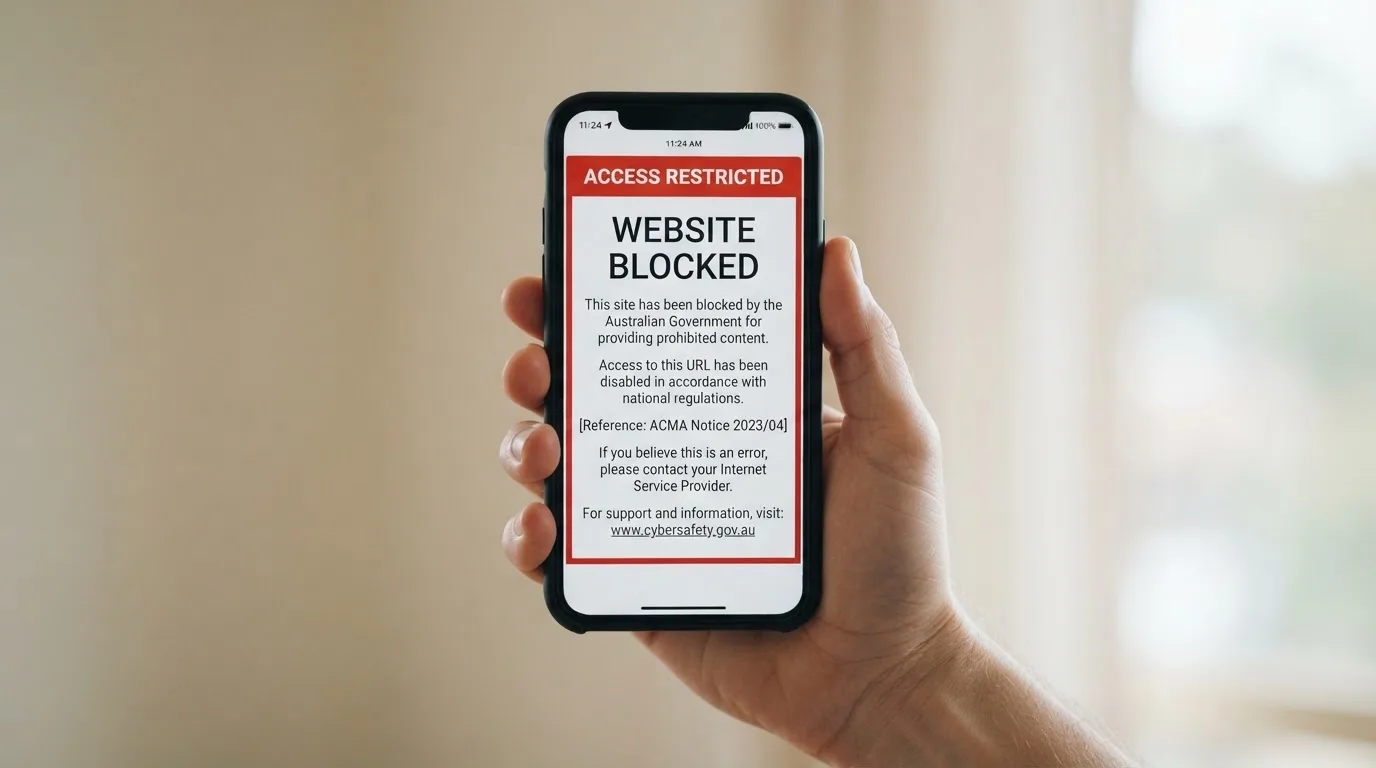
The Australian Communications and Media Authority is the regulator that enforces the Interactive Gambling Act 2001 on the supply side. Its tools are investigation, formal warning, and directing Australian internet service providers to block illegal services at the network level. According to the ACMA’s own published figures as of June 2026, a cumulative total of 1,751 illegal gambling and affiliate marketing websites have been blocked since the first blocking request in November 2019. More than 230 unlicensed gambling services have left the Australian market since enforcement was strengthened in 2017. The number is not a static tally; it grows every time the ACMA publishes a new round.
In the round reported on 26 June 2026, the ACMA asked Australian ISPs to block twelve further sites: 7Signs, ChromaBet, Donbet, Duospin, Freshbet, Slots Gem, Jacks Club, Lucky Start, Pointsbetz, Spinrise, Vinyl Casino and Wildsino. The pattern is consistent across rounds — offshore operators in clusters, often sharing ownership or payment processing, sometimes re-emerging under a new domain once the old one has been blocked.
The formal-warning arm of the ACMA’s work is a different mechanism from blocking. A formal warning does not require an ISP to disconnect a site; it puts the operator on notice that further action will follow if the prohibited service continues to be offered to Australians. The list of operators that have received formal warnings is long and the names recur in combinations that suggest common ownership. Dama N.V. alone has received formal warnings covering six casino brands (Bambet, Dazard, Level Up, Rocketplay, Wild Tornado and Cobra Casinos) in May 2022, then further warnings over Woo Casino in March 2025 and Spirit Casino in May 2025. Bamboo Media was warned over Ignition Casino in July 2025; Consolutetish S.R.L. was warned over National Casino and Bizzo Casino in July 2025, the latter having already been the subject of a 2022 warning to TechSolutions. EOD Code SRL was warned over Instant Casino in February 2025. Sterplay Holding Ltd was warned over Casino Intense in April 2025. Hollycorn N.V. was warned over its Sky Crown and Blue Leo services. Pulsup Ltd was warned over Rocketplay in March 2026; Ryker B.V. over Jackbit and CasinOK in April 2026.
The fastest honest reading of that record is that the ACMA has been steadily closing the door, and offshore operators keep opening new ones. The slowest honest reading is that nothing on this list should be taken as a recommendation of any brand on it. Every brand named below in the ranking section is a brand the ACMA itself has acted against, because the only honest way to construct a “best” list of online casinos accepting Australian payment methods is to list the casinos that have actually surfaced in Australian enforcement, and to be clear about what that means.
The blocking rate, 2026
Running the arithmetic the ACMA’s own numbers make possible, the cumulative blocking count of 1,751 illegal gambling and affiliate websites through to June 2026 against a starting point of zero blocked sites in November 2019, that is roughly 80 to 85 blocked websites per month averaged across the period, or around 1,000 per year over the last two years of accelerated enforcement. The exact figure wobbles: early years were slower, recent rounds have hit twelve sites in a single publication. What the rate actually shows is not the speed of regulator-versus-operator so much as the turnover of illegal sites — each one blocked is replaced, on a delay, by another. The condition on the figure is straightforward: it counts blocking requests the ACMA has asked ISPs to action, not the number of unique operators behind them, and it includes affiliate marketing sites alongside casino and wagering operators themselves.
Side-by-side: what the ACMA has published about each brand
Eleven brands have surfaced in ACMA action over the last four years. The table below sets them out on the same four columns: the brand, the date of the ACMA’s formal warning or blocking action, the operator the ACMA named in that action, and whether any payment-method or player-protection listing has surfaced in the public sources consulted for this page. A dash in the right-hand column means no such listing has been found; that is a finding about the searches conducted, not a finding about the brand itself.
| Brand | ACMA action and date | Operator named by the ACMA | Subject support |
|---|---|---|---|
| RocketPlay | Formal warning, March 2026 | Pulsup Ltd | Listings only (Gamblinginsider.com) |
| Level Up Casino | Formal warning, May 2022 | Dama N.V. | Listings only (Westpac.com.au) |
| Woo Casino | Formal warning, March 2025 | Dama N.V. | — |
| Spirit Casino | Formal warning, May 2025 | Dama N.V. | — |
| National Casino | Formal warning, July 2025 | Consolutetish S.R.L. | Listings only (acma.gov.au, austrac.gov.au, betstop.gov.au) |
| Bizzo Casino | Formal warning, July 2025 (earlier 2022) | Consolutetish S.R.L. (earlier TechSolutions) | Listings only (Gamblinginsider.com) |
| Ignition Casino | Formal warning, July 2025 | Bamboo Media | — |
| Instant Casino | Formal warning, February 2025 | EOD Code SRL | Listings only (Ecopayz.com, Payid.com.au) |
| Jackbit | Formal warning, April 2026 | Ryker B.V. | — |
| Casino Intense | Formal warning, April 2025 | Sterplay Holding Ltd | Listings only (austrac.gov.au, betstop.gov.au, Gamblinginsider.com) |
| Sky Crown | Formal warning (September 2022) | Hollycorn N.V. | — |
The shape of the right-hand column is itself a finding. Most of the eleven brands have not produced any direct public listing that names their accepted payment methods for Australians; a handful have surfaced only because the ACMA’s own publications or third-party news articles mentioned them in passing. None of them carries an Australian licence.
The brand-by-brand read
What follows is not a ranking. Each of the eleven brands below has been named by the ACMA in a formal warning under the Interactive Gambling Act 2001 for offering prohibited online casino games to Australians. The reason each one is on this page is that it has surfaced in Australian enforcement; the reason none of them can be recommended as a place to play is the same reason they are on the list.
RocketPlay
The ACMA issued a formal warning to Pulsup Ltd over Rocketplay.com.au in March 2026. Rocketplay had previously been caught up in the May 2022 warning to Dama N.V. covering six casino brands, including Rocketplay alongside Bambet, Dazard, Level Up, Wild Tornado and Cobra Casinos. The transfer of operator name from one warning to the next is itself a signal — offshore brands change corporate shells faster than the regulator can name them. Rocketplay has surfaced in third-party listings of operators accepting Australian-facing payment methods, but no Australian licence exists for online casino games, including for this brand. The page’s verdict is the same as it is for every brand on this list: the legal status is not a footnote, it is the whole sentence.
Level Up Casino
Dama N.V. received a formal warning over Level Up Casino in May 2022, as part of the same six-brand notice that covered Bambet, Dazard, Rocketplay, Wild Tornado and Cobra Casinos. Dama N.V. has since accumulated further warnings over Woo Casino in March 2025 and Spirit Casino in May 2025, which is the operator-level pattern worth noting rather than any single brand’s individual case. The brand has been referenced in passing on Westpac’s gambling-block documentation, which is an unusual surface for an offshore casino — it confirms that the merchant category code “Betting/Casino Gambling” does catch this brand’s transactions through Australian cards, and that Westpac’s block is operating against it the way it would against any operator coded under that MCC.
Woo Casino
The ACMA issued a formal warning to Dama N.V. over Woo Casino in March 2025. Woo is one of three Dama N.V. brands to feature in a formal warning over the last three years, alongside Spirit Casino and the original six-brand 2022 cluster. No payment-method listings referencing Woo Casino specifically have surfaced in the public sources consulted for this page, which is itself information: the brand’s payment stack for Australian customers has not been the subject of any document that surfaced in this search. The page’s verdict on Woo is that the absence of evidence is not evidence of safety; it is evidence of thin documentation.
Spirit Casino
Dama N.V. received a formal warning over Spirit Casino in May 2025. Spirit sits between Woo Casino (March 2025) and the rest of the Dama N.V. portfolio as the operator has cycled through brand launches and ACMA actions. No direct public listing of accepted payment methods for Australian customers was found in the sources consulted for this page. In short: a name found in the ACMA’s register but nowhere else.
National Casino
Consolutetish S.R.L. received a formal warning over National Casino in July 2025. The same operator was warned over Bizzo Casino in the same notice, and Bizzo had already been the subject of an earlier 2022 formal warning to TechSolutions (CY) Group Limited and TechSolutions Group N.V. — a brand that has changed hands at the operator level and kept its name. National Casino has been referenced across ACMA, AUSTRAC and BetStop documentation in the sources consulted, which puts it among the more visible brands in the table above, but visibility in regulator documentation is not the same thing as visibility in a player-protection framework. BetStop binds only Australian-licensed services.
Bizzo Casino
Consolutetish S.R.L. received a formal warning over Bizzo Casino in July 2025, on top of an earlier 2022 formal warning to TechSolutions (CY) Group Limited and TechSolutions Group N.V. over the same brand. Bizzo is one of two brands in this set with a documented second operator behind it, alongside Rocketplay. It has surfaced in third-party listings of operators serving Australian customers. Ultimately: a brand that has changed operators while remaining under the same enforcement cloud, leaving its standing unclarified.
Ignition Casino
Bamboo Media received a formal warning over Ignition Casino in July 2025. Ignition is the longest-running brand on this list in some respects — it has been a familiar name in offshore-facing poker and casino marketing for over a decade — but longevity of brand is not longevity of licence, and Bamboo Media is not an Australian licensee. No public listing of accepted payment methods for Australians was found in the sources consulted. The verdict: a familiar name whose familiarity predates, and does not affect, the legal situation in Australia.
Instant Casino
EOD Code SRL received a formal warning over Instant Casino in February 2025. Instant has surfaced in listings that reference EcoPayz and PayID among its payment options, which is a useful detail: any operator claiming to accept PayID is either misrepresenting itself or routing funds through a third party in a way the Australian payments system does not support. There is no PayID biller relationship that lets an offshore casino accept PayID as a deposit rail; if the brand is advertising PayID, the customer-facing transaction is something else, and the conversion happens on the operator’s side. The verdict: the brand’s payment surface is itself the warning sign.
Jackbit
Ryker B.V. received a formal warning over Jackbit and CasinOK in April 2026. Jackbit is one of two brands named in that single notice, alongside CasinOK, which means Ryker B.V. is a holding entity with at least two casino brands under enforcement. No public payment-method listing specific to Jackbit was found in the sources consulted for this page. Conclusion: this brand has appeared in enforcement notices without showing up in any public payment listings.
Casino Intense
Sterplay Holding Ltd received a formal warning over Casino Intense in April 2025. Casino Intense has surfaced in third-party listings that include references to AUSTRAC, BetStop and Gamblinginsider.com — the latter being an industry-side publication, not a regulator, and the former two being relevant only because they show up in third-party text rather than because Casino Intense is bound by them. BetStop does not bind Casino Intense. The verdict: a brand whose listing footprint is wide, and whose compliance footprint is not.
Sky Crown
Hollycorn N.V. received a formal warning over its Sky Crown and Blue Leo casino services in a notice published in September 2022. Sky Crown is the older of the two Hollycorn N.V. brands on the ACMA register; Blue Leo runs alongside it. No public listing of accepted payment methods for Australian customers was found in the sources consulted. The verdict: a brand that has been on the ACMA’s published register the longest of any in this set, and has not produced the documentation that would change what being on that register means.
The legality frame and the licensed alternative
The Interactive Gambling Act 2001, as strengthened by the Interactive Gambling Amendment Act 2017, makes it an offence to provide online casino games, online pokies or in-play betting to a person in Australia. No state or territory issues a licence for online casino games; the prohibition is national. What is licensed in Australia is wagering on races and sport placed before the event, lotteries and keno — in practice regulated by the Northern Territory Racing and Wagering Commission, which oversees 52 online bookmakers including Sportsbet, Bet365 and Ladbrokes, and which runs without full-time staff, meeting once a month in Darwin.
The Interactive Gambling Amendment (Gambling Reform) Bill 2026 passed Parliament on 19 August 2026; its advertising and inducement measures commence on 1 January 2027. That is law with a future start date, not in force at the date of this page, and it tightens the rules around how licensed wagering services can market themselves rather than opening up online casino gaming.
The minimum age for any form of legal Australian gambling is 18. For the recreational player, gambling winnings are not assessable income under section 6-5 of the ITAA 1997 and losses are not deductible; the ATO’s position changes if gambling is being carried on as a business, which is a separate question this page does not address. The National Gambling Helpline on 1800 858 858 is free, available 24/7, with online chat at Gambling Help Online.
For an Australian reader who wants to gamble within the law, the licensed alternative is a wagering account with a Northern Territory-licensed bookmaker for sports and racing, a state or territory lottery for draws and keno, or a land-based casino or licensed pokies venue. None of those offer online casino games in the sense the offshore sites use the phrase. The closest lawful equivalent to the “play pokies from the couch” experience is a land-based pub or club venue licensed by the relevant state regulator, with the player present.
Frequently asked questions
What payment methods are commonly advertised by online casinos targeting Australians?
The most commonly advertised options across the offshore brands that target Australian customers are Visa and Mastercard debit, occasional American Express, an e-wallet or two, and cryptocurrency in Bitcoin or Ethereum. Australian-licensed online wagering services accept only debit cards, bank transfers, PayID/Osko and BPAY — credit cards, credit-related products and digital currency have been banned as deposit methods for licensed wagering since 11 June 2024. The advertising gap between the two lists is the advertising gap between legal and illegal offers in this country.
How does an Osko transfer compare with a card payment for speed?
An Osko transfer between participating Australian banks settles in under a minute, twenty-four hours a day, including weekends, whether addressed to a BSB and account number or to a PayID. A card payment, by contrast, confirms in seconds on the merchant side but settles through normal card-network clearing, which takes one to two business days for the funds to actually reach the receiving account. For paying a licensed Australian wagering service, Osko via PayID is the fastest legal rail. For receiving a payout from an offshore casino, an Australian bank sees the transfer as an inbound international payment and runs it through correspondent banking — meaning one to five business days once the operator has actually released the funds, regardless of how “instant” the casino’s own marketing describes the step on its side.
Is it legal for an online casino to process payments from players in Australia?
No. The Interactive Gambling Act 2001 makes it an offence to provide online casino games to a person physically in Australia. The Australian Communications and Media Authority enforces this against the operator; the individual player is not prosecuted. The enforcement is on the supply side, not the demand side. An offshore casino that accepts a deposit from an Australian customer is operating in breach of the Act, which is why the ACMA’s enforcement record is a long list of formal warnings and blocking actions and why no Australian-licensed online casino exists.
Are cryptocurrency payments harder to trace than a bank transfer?
Crypto transfers are pseudonymous on the public ledger — the wallet addresses have no names attached, but every transaction is visible. The moment those funds convert back to Australian dollars through a local exchange, AUSTRAC’s reporting framework applies and the customer’s identity is recorded as part of standard KYC. AUSTRAC’s A$10,000 threshold transaction report rule applies only to physical cash; ordinary electronic bank transfers are not subject to that per-transaction rule regardless of amount. The practical difference between a bank transfer and a crypto transfer for an Australian punter is therefore smaller than the marketing suggests, and the consumer-protection difference is large: a bank transfer is at least disputeable through the issuing bank, while a confirmed crypto transaction is not.
What makes a casino payment method secure rather than just fast?
Three things, and speed is not one of them. The first is whether the payment is reversible in a dispute — a bank transfer or card transaction can be disputed through the issuing bank in some circumstances, a crypto transfer cannot. The second is whether the operator holds the funds under a regulatory regime that has a complaints body and an enforceable code of conduct — an Australian-licensed wagering service does, an offshore casino does not. The third is whether the operator is bound by Australian self-exclusion tools like BetStop — an offshore casino is not. Speed is the easy part; the part that matters when something goes wrong is whether the punter has any way back.
Does PayID offer any extra protection compared with a BSB and account number?
Yes, in the specific way that matters for someone reading this page. Sending to a PayID displays the registered name of the account holder before the transfer is confirmed. Australian Payments Plus, which runs PayID and Osko, is explicit that being asked to transfer money to a PayID on an illegal gambling site almost certainly means a scam site, because no licensed Australian operator will be asking for a PayID transfer to fund an online casino product. PayID is available across more than 100 Australian financial institutions and more than 25 million PayIDs were registered on the New Payments Platform as of April 2025, which makes it both widely available and a useful early-warning system: an offshore casino asking for PayID is telling the punter something the punter should hear.
Created by the ”Casino Jackpot Hub” editorial team.