
Casino dice games in Australia 2026: from the craps table to the IGA’s block list
Current as of 17 October 2026 · verified against ACMA formal-warning notices and the Interactive Gambling Act 2001 as published by the Federal Register of Legislation.
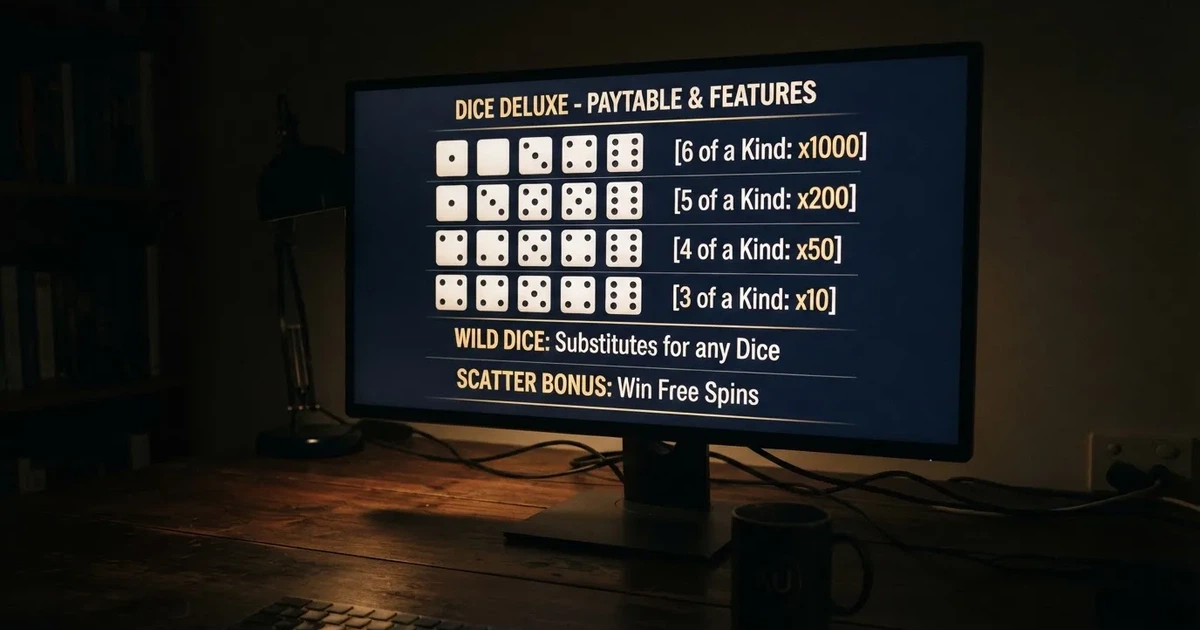
Dice games are the oldest product on a casino floor, and they are the product that has shifted the least over the centuries they have been played. The bones change shape, the table layout changes, the players’ lingo changes, and the math underneath is what it was. That math is also the lever that decides whether a session at the table costs a player a small amount or a punishing amount, and it is the lever this page is built around. The other thing the page is built around is the Australian legal frame, because for a reader sitting in Australia in 2026 the online version of almost every dice game discussed here is unlawful to be offered, and the brands that offer it have been on the receiving end of formal warnings from the regulator for the better part of a decade.
The angle is choice: which bets cost how much at the table, which games can legally be played where, and what an offshore site claiming to host them actually is.
Table of Contents
- Craps House Edge
- Sic bo: three dice, more combinations, similar lesson
- Two-up: Australia’s own dice tradition, and its peculiar legal status
- Blackjack and baccarat: the games that look like dice but aren’t
- The Australian legal frame in 2026
- Player protection: BetStop and the National Gambling Helpline
- A shortlist, and what to do with it
- Landscape
- What the table really tells the reader
- A reader’s checklist before putting any money on a dice bet
- Where the data stops and why
- Frequently asked questions
Craps House Edge
| Bet | House Edge (%) |
|---|---|
| Pass Line | 1.41 |
| Come | 1.41 |
| Don’t Pass | 1.36 |
| Don’t Come | 1.36 |
| Any Craps | 11.11 |
Craps is the dice game most players outside Australia meet first, and it is also the one where the gap between a cheap bet and an expensive bet is widest. The game runs on a single decision the shooter makes with two six-sided dice before each throw: pass or don’t pass. Every other wager on the layout is some derivation of that one decision, and the price of each derivation is published, in advance, as the house edge.

The Pass Line and the Come bet, which is the Pass Line bet placed after a point is established, both carry a house edge of 1.41 percent. Don’t Pass and Don’t Come, the bets against the shooter, sit just under that at 1.36 percent. A player who limits themselves to these wagers is paying the casino roughly A$1.41 for every A$100 they cycle through the table over the long run. That is the cheapest the game gets.
The Any Craps bet, a one-roll wager that the next throw will be 2, 3 or 12, carries a house edge of 11.11 percent. Same dice, same shooter, same outcome space, an entirely different price. A player laying A$100 an hour on Pass and a player laying A$100 an hour on Any Craps are playing two different games as far as expected cost is concerned, and the difference is roughly eight times. The bet matters more than the game does, and that single sentence is what a craps session actually costs.
The same logic holds for the proposition bets clustered in the centre of the layout. Any Seven pays 4:1 against a true odds of 5:1, which the Wizard of Odds house-edge table puts at 16.67 percent. Hardways sit between 9.09 and 11.11 percent depending on the number. The eye-catching payouts in that block — 30:1 on a hard six or eight, 30:1 on a Yo-leven — are the visual bait of the layout, and the math is what it is because every proposition bet is built the same way: a long-shot payout against odds that are even longer than the payout suggests.
That makes the question a craps table really asks not which dice the shooter throws, but which bets the player puts on them. Two players at the same table, watching the same dice, can leave with arithmetic that looks nothing alike.
Right bettor and wrong bettor
The craps vocabulary splits shooters, and through them players, into two camps. A “right” bettor backs the Pass Line and lays the dice with the shooter. A “wrong” bettor backs Don’t Pass and bets against the throw. The two bets resolve on opposite sides of every outcome, including the very first roll: a 7 or 11 on the come-out wins Pass and loses Don’t Pass, a 2, 3 or 12 loses Pass and — except for the 12, which is a push — wins Don’t Pass.

In money terms the two camps are not equal. Don’t Pass is 1.36 percent, Pass is 1.41 percent. The five-hundredths of a percent in favour of the wrong bettor is small, but it is there, and it has been there long enough that craps tutorials have been telling readers to consider it for decades. The wrong bettor’s other cost is social. Craps is a table game with a small crowd around it, and most of that crowd is right. Betting the dice to lose, in a game where the shooter is usually the centre of attention, is the kind of thing a casino tolerates but other players notice. Whether that matters depends on the player.
The single bet that breaks the symmetry is the 12 on the come-out roll. A 12 is a push on Don’t Pass: the bet returns, neither won nor lost. A 12 loses Pass outright. That one outcome is what makes Don’t Pass a slightly cheaper wager than Pass, and it is the only structural concession the table makes to the wrong-side bettor.
How the Pass Line price is built
The 1.41 percent on Pass Line is not a flat price. It comes from a two-stage game. The come-out roll either decides the bet immediately — a 7 or 11 wins, a 2, 3 or 12 loses — or it establishes a “point”, one of 4, 5, 6, 8, 9 or 10. Once a point is up, the bet wins if that point is rolled again before a 7, and loses if a 7 lands first.
That second stage looks like an even-money bet to a casual eye, and it would be if every point were as likely as a 7. It is not. There are six ways to roll a 7 and between three and five ways to roll any specific point, depending on which point. The asymmetry between the 7 and the point is what the house edge is built on, and the table’s true odds — Pass Line pays 1:1 on both stages — don’t fully reflect it. The price of the bet is the gap.
This is also why craps strategy guides tend to recommend Pass, Come, Don’t Pass, Don’t Come and the odds that can be laid behind them, and recommend almost nothing else. The list is the bets whose price the table has published transparently enough that the player can work it out.
Sic bo: three dice, more combinations, similar lesson
Sic bo is the second casino dice game an Australian reader is most likely to meet, and it shares with craps the property that the same dice produce bets whose prices vary by a factor of ten or more.
Sic bo runs on three dice and 216 equally likely combinations, of which 56 are distinguishable. The bets sit on a grid that looks like a roulette layout scaled up: Small and Big (totals of 4-10 and 11-17, excluding triples) at the cheap end, specific triples at the expensive end.
Small and Big both carry a house edge of 2.78 percent. The triple-zero exception — a triple on a Small or Big bet loses even when the total would otherwise qualify — is what the price pays for. The Specific Triple bet, which wins only on, say, three sixes, carries a house edge that ranges from 11.6 percent up to 30.09 percent depending on the ruleset the casino publishes. A Specific Double sits in between. The visual spread on the layout looks dramatic; the price spread is the same shape.
Sic bo’s history explains why those triples are priced where they are. The game is of ancient Chinese origin and its name literally translates as “precious dice”; the early-twentieth-century version that reached the United States came with Chinese immigrants and has stayed broadly unchanged since. The bets that look exciting on a printed layout are the bets the game has carried for a century, and the math on them is the math the game has carried for a century too.
Two-up: Australia’s own dice tradition, and its peculiar legal status
Two-up is the outlier of the three games on this page, and worth a section of its own because it is the one casino dice game that Australia has its own relationship with.
Two-up is played by tossing two coins rather than rolling dice, and the wager is on whether both will land heads or both tails — odds or evens, in the game’s own vocabulary. The game evolved from the eighteenth-century English and Irish pastime of “cross and pile”, and convicts brought it with them when they were transported. It was legalised in Australian casinos in 1973, when Hobart’s casino opened the floor to it, and is now offered only at Crown Perth and Crown Melbourne among licensed Australian casinos.
Outside casinos, two-up sits in a strange pocket of the law. The Gambling (Two-Up) Act 1998 in New South Wales permits it on Anzac Day only, played in RSL clubs and hotels. Kalgoorlie, in Western Australia, hosts the country’s only year-round legal two-up school. The rest of the country, for the rest of the year, treats it as an illegal lottery. For an Australian reader the question is not whether two-up is offered online — it is whether it is offered anywhere at all, and the answer is that the legal version is a tightly listed set of locations.
The Australian casino two-up pits are the only places a player will see the game with a regulated house edge and a regulator-backed dispute process. Offshore sites that list “two-up” in a casino lobby are offering it under whatever licence the operator displays, and that licence is not an Australian one.
Blackjack and baccarat: the games that look like dice but aren’t
Two more games sit close enough to the dice family that they turn up on a search for “casino dice game” and they share enough of the same arithmetic that they earn a mention before the page moves to the legal frame. Neither uses dice.
Blackjack is a card game with a house edge that runs from 0.28 percent under liberal Las Vegas Strip rules to about 0.43 percent under Atlantic City rules when the player plays optimally. The game comes from the English vingt-un, with a Spanish cousin in Cervantes’ Rinconete y Cortadillo written around 1601-02 and a renaming to “blackjack” around 1899 during the Klondike Gold Rush. Number cards count at face value, face cards at 10, an ace at 1 or 11, a starting two-card total of 21 is the strongest hand, and the dealer must keep drawing to a total of 17 or higher. Variants include Spanish 21 (no 10s but liberal player rules), Double Exposure (both dealer cards face-up), Blackjack Switch (swap cards between hands) and Super Fun 21 (up to four splits). In Victoria the VGCCC must approve the rules and any change to them before they can be introduced at Crown Melbourne, and the public log of approved changes includes the renaming of the “Perfect Pairs” side bet to “Crown Pairs” on 23 December 2024 and the introduction of a “Free Bet” option with a “Pot of Gold” side bet on 25 March 2024.
Baccarat carries a 1.06 percent house edge on the Banker bet, 1.24 on Player and 14.36 on Tie. The game has disputed origins — French nineteenth-century accounts and Italian fifteenth-century ones under Charles VIII — with David Parlett identifying Macao as the immediate precursor. Punto banco, the version played today, was developed in Havana during the 1940s and is banked by the casino at all times under fixed drawing rules. Chemin de fer, named for “railway” because it was quicker to play, is the variant where players choose the draw. Cards count as in craps slang: 2-9 at face value, 10/J/Q/K at zero, ace at one, totals taken modulo 10, dealt from a shoe of 6 or 8 decks. Crown Melbourne runs three approved baccarat variants — Traditional, Crown and 2 to 1 — under the VGCCC, which replaced the VCGLR as Victoria’s casino regulator on 1 July 2022. In NSW, section 66 of the Casino Control Act 1992 requires a casino operator not to permit a game like baccarat unless the regulator has approved it and a copy of the approved rules is available on request.
The reason these two are mentioned in a page about dice is that they share the structure craps and sic bo have. A table of bets, with a published house edge on each, where some bets cost a few percent and others cost ten times that. The headline discipline is the same one craps teaches: read the bet before you put the chip on it.
The Australian legal frame in 2026
The legal frame around online casino dice games in Australia has not changed in years, and that is the most important sentence in this section.
The Interactive Gambling Act 2001, strengthened by the Interactive Gambling Amendment Act 2017, makes it an offence to provide online casino games, online pokies or in-play betting to a person physically in Australia. No state or territory licences online casino games. What is licensable is wagering on races and sport placed before the event, lotteries and keno, and in practice online bookmakers are licensed by the Northern Territory through the NTRWC — 52 of them, including the major Australian-facing brands. The minimum age to play is 18.
For a player, the rule has two consequences. The first is that no offshore site offering dice games online to an Australian reader is doing so under an Australian licence. The site may display a Curaçao, Anjouan or Kahnawake number; it is not an Australian licence. The second is that the player is not the target of the law. The IGA targets the provider. A reader can technically load an offshore site and play, but the consequence is that the site sits outside every Australian consumer protection — no dispute resolution, no local complaints body, no recourse if a withdrawal stalls.
The reform on the horizon for 2026 is the Interactive Gambling Amendment (Gambling Reform) Bill 2026, which passed Parliament on 19 August 2026 and whose advertising and inducement measures commence on 1 January 2027. It is law with a start date, not yet in force on a 2026 page, and it does not legalise the product: it tightens the marketing around the prohibition that already exists.
How the ACMA enforces it
The regulator is the Australian Communications and Media Authority, the ACMA. Its tools are investigation, formal warnings to operators, and directions to Australian internet service providers to block illegal sites.
A round reported on 26 June 2026 put the running total at 1,751 illegal gambling and affiliate marketing websites blocked since the first blocking request in November 2019, with more than 230 unlicensed gambling services having left the Australian market since enforcement was strengthened in 2017. That round alone asked ISPs to block 12 more: 7Signs, ChromaBet, Donbet, Duospin, Freshbet, Slots Gem, Jacks Club, Lucky Start, Pointsbetz, Spinrise, Vinyl Casino and Wildsino.
A blocking-rate calculation
The arithmetic that belongs to this page is a blocking-rate estimate. The ACMA has, by its own published count, requested the blocking of 1,751 sites since November 2019, with a further 230-plus services leaving the market entirely over the same period. Spread over the months between November 2019 and June 2026 — roughly six and a half years, or 78 months — the implied blocking rate is in the low-twenties per month, with the service-exit figure running alongside at a fraction of that. The figure is an average across the whole enforcement period: individual months range from zero in slow stretches to a dozen or more in the rounds the ACMA publishes, and the more recent rounds have tended to bunch a blocking request as a single announcement rather than as a steady drip. Treat the low-twenties-a-month as the typical pace and a single round of twelve as the kind of update that has become routine.
What an Australian player actually gets if a withdrawal stalls offshore
There is no Australian complaints body that can pull a balance back from an offshore operator. The dispute mechanism on the licence the site displays is the only mechanism available. If the operator is licensed in Curaçao and the player is in Australia, the dispute is filed in Curaçao, under Curaçao law, in the language of the operator’s terms. ACMA cannot compel a payout. BetStop, the National Self-Exclusion Register, binds only Australian-licensed online and phone wagering services; an offshore casino is not connected to it.
The practical cost of that asymmetry is sharpest at withdrawal. A deposit made by PayID or BPAY to a licensed Australian bookmaker is a transaction in the Australian banking system, protected by Australian ePayments code and Australian dispute mechanisms. A deposit made by credit card or crypto to an offshore casino is a transaction outside that system, and if the operator decides not to release the funds the player has no local pathway.
Credit card and crypto bans
Since 11 June 2024, credit cards, credit-related products and digital currency have been banned as payment for licensed online wagering in Australia, with penalties of up to A$247,500 for operators that accept them. Legal deposit routes for a licensed Australian bookmaker are debit card, bank transfer, PayID/Osko and BPAY. A site that asks an Australian reader for a credit card or a crypto deposit is, by definition, operating outside the Australian wagering framework.
Tax
For a recreational player, gambling winnings are not assessable income under section 6-5 of the ITAA 1997, and losses are not deductible. The exception is a person who carries on a business of gambling, which a casual reader of this page is not, and the ATO’s guidance is the right place for any reader with a more complex situation to look.
Player protection: BetStop and the National Gambling Helpline
For readers who need them, the support system in Australia is built around two routes.
The first is BetStop, the National Self-Exclusion Register, which has been live since August 2023. A person who registers with BetStop is excluded from every Australian-licensed online and phone wagering service for the period they choose. BetStop does not bind offshore sites, because offshore sites are not connected to the Australian licensing system, which is exactly the point a reader should weigh when deciding which kind of operator to give their money to.
The second is the National Gambling Helpline on 1800 858 858, a free 24/7 line with chat at Gambling Help Online. The helpline is the front door of the support system and is set up to handle the moment a reader is worried about their own play, or someone else’s.
State-level self-exclusion registers exist as well, and apply to the licensed casino floors in the relevant state — Crown Melbourne and Crown Perth for Victoria and Western Australia. They sit alongside BetStop rather than replacing it.
A shortlist, and what to do with it
A shortlist of casino dice games has to start from one decision: the reader is choosing between bets and games, or choosing between operators. The two questions share almost no overlap, and a single list that tries to cover both is a list that has tried to do two jobs and done both badly.
The most useful list for a reader at the table is the bets themselves, in price order. In craps, that’s Pass and Come at 1.41 percent, Don’t Pass and Don’t Come at 1.36 percent, then the odds laid behind any of those four at zero percent (the odds portion of a Pass Line bet carries no house edge at all), then Place 6 and Place 8 at 1.52 percent, Field at 2.78 or 2.27 percent depending on whether the layout pays 2:1 or 3:1 on a 12, and then the proposition bets at 9 to 16-plus percent. In sic bo, it’s Big and Small at 2.78 percent, then Specific Doubles in the low double digits, then Specific Triples from 11.6 up to 30 percent. In baccarat, it’s Banker at 1.06, Player at 1.24, and Tie at 14.36. In blackjack, the answer is one bet at a time and an optimal strategy that costs the player 0.28 to 0.43 percent depending on the rule set.
The most useful list for a reader choosing an operator is shorter. The Australian option is the licensed casino floor in the relevant state. The offshore option is everything else. The two are not the same kind of product and the reader who confuses them is the reader who loses the protections when they need them.
What separates a serious shortlist from a casual one is the criterion the reader is testing. A criterion of “best payout percentage” applied to craps bets gives a Pass Line / Don’t Pass answer. The same criterion applied to operator choice gives an answer that depends entirely on whether the reader accepts offshore wagering as a comparison set. A criterion of “fastest withdrawal” applied to craps bets is meaningless; applied to operator choice it favours licensed Australian wagering because the funds sit in the Australian banking system.
The selection criteria behind any list that compares casino dice games
A shortlist that ranks dice games tends to sort on four things, and the first two dominate the second two.
The first is the published house edge on the bets the game offers. This is a number on a public page that anyone can verify, and it is the most important figure on the table. A craps table where the player only plays Pass and the odds is a 1.41 percent game; the same table with the player on Any Seven is a 16.67 percent game.
The second is the volatility of the bet’s outcome. A flat even-money Pass Line bet returns the player’s stake frequently, with small wins and small losses. A Specific Triple bet on sic bo returns infrequently and in large chunks when it does. Two bets at the same house edge can feel like two different games, and a list that ignores volatility ignores half of what the player is going to experience.
The third is the ruleset. Blackjack at 0.28 percent under liberal Las Vegas Strip rules is not the same game as blackjack at 0.43 percent under Atlantic City rules, and the ruleset is a published specification, not a vague flavour. The fourth is side bets. Baccarat’s Tie bet is a side bet with a 14.36 percent edge sitting on the same table as the 1.06 Banker bet, and a list that says “baccarat” without separating the two has not done the job.
What this list is, and what it isn’t
What follows is not a recommendation. The brands listed below are listed because the ACMA has issued formal warnings to each of them, and the comparison is across the warnings, not across the products. No reader of this page should treat any of these brands as a place to play: they are the brands that have been told by Australia’s regulator that what they are offering is unlawful.
Landscape
The following operators have each been the subject of at least one formal warning from the ACMA for offering prohibited online gambling services to people in Australia. The list runs in plan order, and every entry carries the operator named by the ACMA, the date of the action, and — where the research carries it — any subject support information.
| Brand | ACMA action and date | Operator named by the ACMA | Subject support |
|---|---|---|---|
| RocketPlay | Formal warning, March 2026 (earlier Dama N.V., May 2022) | Pulsup Ltd (RocketPlay), March 2026; earlier Dama N.V., May 2022 | — |
| Level Up Casino | Formal warning, May 2022 | Dama N.V., May 2022 | listings-only |
| Woo Casino | Formal warning, March 2025 | Dama N.V., March 2025 | — |
| Spirit Casino | Formal warning, May 2025 | Dama N.V., May 2025 | — |
| National Casino | Formal warning, July 2025 | Consolutetish S.R.L., July 2025 | listings-only (en.wikipedia.org) |
| Bizzo Casino | Formal warning, July 2025 (earlier TechSolutions, 2022) | Consolutetish S.R.L., July 2025; earlier TechSolutions (CY) Group Limited and TechSolutions Group N.V., 2022 | — |
| Ignition Casino | Formal warning, July 2025 | Bamboo Media, July 2025 | — |
| Instant Casino | Formal warning, February 2025 | EOD Code SRL, February 2025 | — |
| Jackbit | Formal warning, April 2026 | Ryker B.V., April 2026 | — |
| Casino Intense | Formal warning, April 2025 | Sterplay Holding Ltd, April 2025 | listings-only |
| Sky Crown | Formal warning, September 2022 | Hollycorn N.V., September 2022 | — |
The table is a record of regulator action, not a leaderboard. Three operators — Level Up Casino, National Casino and Casino Intense — carry a listings-only data marker from research, which means their subject support information appears in published listings rather than as a confirmed operator fact. The remaining eight brands carry no subject support figure at all, and the table leaves the cell empty rather than fill it with something the research did not carry.
What the table shows, read across its eleven rows, is a regulator working through the same offshore operators across multiple brand names. Dama N.V. shows up three times in the operator column: once for Level Up Casino in 2022, once for Woo Casino in 2025 and once for Spirit Casino in 2025. Consolutetish S.R.L. shows up twice in 2025 alone, for National Casino and Bizzo Casino. The same operator running multiple brands is a feature of how the offshore market is structured, and it is part of why a list of brand names is not the same thing as a list of legal entities.
The H2 Gambling Capital 2025 estimate of Australian losses to illegal gambling sites sits at about A$3.9 billion a year, and the share of gambling going through legal channels fell from 74 percent in 2021 to 64 percent. The trend the regulator is working against is the one the table is the response to.
RocketPlay
RocketPlay is the first name on the list and the most recently warned. The ACMA issued a formal warning to Pulsup Ltd over RocketPlay in March 2026; the same brand had earlier been the subject of a warning to Dama N.V. in May 2022. RocketPlay sits on the plan without a confirmed subject support figure from research, which means nothing about its craps or sic bo offering is verified by this page. The two-step warning pattern — Dama N.V. in 2022, Pulsup Ltd in 2026 — is consistent with the operator migrating the brand across multiple corporate entities, which is a structure the ACMA has had to act against more than once. The reader is not choosing between RocketPlay and another site on this list; the reader is choosing between RocketPlay and the licensed Australian casino floor, and the ACMA’s view of the brand is the data point the page carries.
Level Up Casino
Level Up Casino carries the same May 2022 warning to Dama N.V. as several other brands on this list, and a single listings-only reference for its subject support. The operator-side story is the same one as RocketPlay: the same parent entity, a different front-end brand. The research carries nothing more specific about the brand’s dice offering, and the page leaves the cell empty.
Woo Casino
Woo Casino received a formal warning to Dama N.V. in March 2025, three years after the same operator had been warned over Level Up Casino and others. The pattern across the two warnings is the pattern across most of this list: the regulator’s warning is the consequence of continuing to offer a prohibited product to Australian residents, and the same operator continuing to do so across multiple brands is the structural feature the table is built around.
Spirit Casino
Spirit Casino carries the May 2025 warning to Dama N.V. — the second Dama N.V. warning within the same calendar year, and the third brand on this list tied to the same operator. The page carries no further figure about Spirit Casino, and the cell for subject support is left empty.
National Casino
National Casino’s warning, in July 2025, was issued to Consolutetish S.R.L.. The brand carries a listings-only subject support reference from research, which means the data point exists in published listings rather than as a confirmed operator fact. The 2025 warning to Consolutetish S.R.L. also covered Bizzo Casino, and the same operator warned twice in a single month across two brands is the same Dama N.V. pattern on a different operator.
Bizzo Casino
Bizzo Casino is the brand with the longest regulator history on the list. The July 2025 warning to Consolutetish S.R.L. was the second formal warning the brand had received: TechSolutions (CY) Group Limited and TechSolutions Group N.V. had already been warned in 2022. The page carries no subject support figure for Bizzo Casino.
Ignition Casino
Ignition Casino was the subject of a formal warning to Bamboo Media in July 2025. The operator name on the ACMA notice is different from the rest of the brands on this list, which is itself useful information for a reader who has been comparing parent companies.
Instant Casino
Instant Casino received its warning in February 2025, to EOD Code SRL. It is one of the earlier 2025 entries on the list and one of the brands with no subject support data from research.
Jackbit
Jackbit is the second-most-recent brand on the list. The ACMA issued a formal warning to Ryker B.V. over Jackbit and CasinOK in April 2026. The single operator warning covers two brands, which is the same structural feature the rest of the list shows, and the page carries no further data about the brand.
Casino Intense
Casino Intense carries a formal warning to Sterplay Holding Ltd from April 2025, and the subject support figure is listings-only from research. Casino Intense is the brand on the list with the most concrete research ties to the broader Australian gambling discourse, and the listings-only marker is the marker the cell carries.
Sky Crown
Sky Crown, along with Blue Leo, is the brand on the list whose operator name carries through the ACMA’s older paperwork: a formal warning to Hollycorn N.V. published in September 2022. Sky Crown is the brand on the plan whose most recent confirmed ACMA action is the earliest on the table, and the lack of a more recent warning is the data point the table leaves unsaid.
What the table really tells the reader
Three things, read across the eleven rows.
First, the list is a list of warnings, not a list of operators in any meaningful sense of the word. The same Dama N.V. entity sits behind Level Up Casino, Woo Casino and Spirit Casino. The same Consolutetish S.R.L. sits behind National Casino and Bizzo Casino. The same TechSolutions entity was warned in 2022 for Bizzo Casino, with Consolutetish S.R.L. warned again in 2025. The number of legal entities on the list is much smaller than the number of brands, and a reader comparing brand names is comparing the surface, not the structure.
Second, the regulator’s pace has not slowed. The earliest formal warning on the list is from September 2022; the latest is from April 2026. Across those four years the ACMA has continued to issue new warnings to new operators even as older operators continue to operate under different brand names. The blocking-rate calculation above puts the implied pace at low-twenties sites a month, with single-month bunches of a dozen not unusual.
Third, no brand on this list is suitable for an Australian reader. The page is not a comparison of which offshore dice site is best; it is a record of the brands the regulator has acted against, and the only reader-facing comparison the page supports is between offshore wagering of any kind and the licensed Australian alternative.
A reader’s checklist before putting any money on a dice bet
The list is short on purpose. Anything longer than this is a list that has crowded out the only three things that decide what a session costs.
- The bet’s house edge, from a published source, written down before the session starts.
- The ruleset the table runs on, written down — surrender, double after split, soft 17, deck count.
- The withdrawal path the operator offers, written down — who holds the funds, what the dispute mechanism is, how long a withdrawal is meant to take.
Anything that fails any of those three questions at the moment of asking fails them for the whole session, and the player is the one paying for the missing answer.
Where the data stops and why
The figures on this page stop where research stops. The Wizard of Odds house-edge table is the source for craps, baccarat and blackjack numbers, and the figures it carries are the figures the page carries. The Wikipedia pages for sic bo, two-up and baccarat carry the historical and structural material, and the ACMA’s own formal-warning publications are the source for every operator action in the table above. No figure on this page comes from the operator’s own marketing material, because the operator’s marketing material is the source the regulator’s enforcement record was built against.
The blocking-rate figure is calculated from the ACMA’s running total and the date of the first blocking request, with the result stated as a band rather than a single number because the underlying monthly rate varies and a single figure would imply a precision the data does not support. The H2 Gambling Capital figure for illegal-site losses and the legal-channel share is carried as research carries it, with the year attached.
Two things the page deliberately does not do. It does not name any of the eleven brands as a recommendation, and it does not extend the house-edge table to games for which research does not carry a verified figure. A reader who wants to extend either list has the sources named on the page to do so.
Frequently asked questions
What is the house edge on a Pass Line bet in craps?
A Pass Line bet carries a house edge of 1.41 percent, and the equivalent Come bet carries the same price. The price comes from the asymmetry between the come-out roll (where 7 and 11 win and 2, 3, 12 lose) and the point stage (where the 7 hits more often than any point the shooter has set). Don’t Pass and Don’t Come are slightly cheaper at 1.36 percent, with the 12 treated as a push rather than a loss.
Why does the Any Craps one-roll bet carry a much higher house edge than Pass Line?
The Any Craps bet pays 7:1 against true odds of 8:1, which the wizardofodds house-edge table puts at 11.11 percent. Pass Line pays 1:1 on the come-out stage and 1:1 on the point stage at slightly worse than true odds, for a combined house edge of 1.41 percent. Both bets use the same two dice and the same shooter; the price difference comes from the payout structure rather than from the dice.
Are dice games like craps offered on licensed Australian casino floors?
Craps is offered at Crown Melbourne and Crown Perth among Australian licensed casinos, with two-up also offered at those two venues and legalised in Australian casinos since 1973. In NSW two-up is permitted only on Anzac Day under the Gambling (Two-Up) Act 1998, in RSL clubs and hotels, and Kalgoorlie in Western Australia hosts Australia’s only year-round legal two-up school. The legal version of craps sits on a licensed casino floor, not on an offshore site.
What’s the difference between a ‘right’ bettor and a ‘wrong’ bettor in craps?
A right bettor backs the Pass Line and Come bets, betting with the shooter. A wrong bettor backs Don’t Pass and Don’t Come, betting against the throw. Don’t Pass is 1.36 percent and Pass is 1.41 percent, with the 12 on the come-out roll treated as a push on Don’t Pass, which is the structural concession that makes the wrong-side bet a fraction cheaper.
Can an online dice game legally be offered to someone based in Australia?
No. The Interactive Gambling Act 2001, strengthened by the Interactive Gambling Amendment Act 2017, makes it an offence to provide online casino games — including dice games like craps — to a person physically in Australia, and no state or territory licences them. The ACMA enforces the prohibition through investigation, formal warnings and blocking requests to ISPs. A reader sitting in Australia who plays at an offshore site is doing so outside the Australian consumer protection system.
Do all casino dice games use the same house-edge structure as craps?
No, and the variation is the point. Sic bo’s Big and Small bets run at 2.78 percent, while Specific Triple bets run from 11.6 up to 30.09 percent depending on the ruleset. Craps’ Pass Line runs at 1.41 percent and its Any Craps at 11.11 percent. Two-up’s house edge is set by the operator’s spread on heads and tails rather than by a published house-edge table, and baccarat’s Tie bet runs at 14.36 percent against Banker’s 1.06. Every dice game on a casino floor has at least one bet with a low edge and at least one with a punishing edge, and the player’s job is to stay on the cheap end of each layout.