
Live Dealer Casinos and the Australian Market: What Actually Stands in the Way
A live dealer casino streams a real croupier, real cards and a real roulette wheel to a player’s screen, with optical camera recognition converting the physical action into on-screen data. The product is straightforward enough; what is not straightforward is offering it to someone sitting in Australia. Under the Interactive Gambling Act 2001, doing so is a prohibited interactive gambling service, and the Australian Communications and Media Authority has spent the years since enforcement was tightened in 2017 walking that prohibition through every operator it can reach.
Current as of 17 October 2026 against the ACMA’s published enforcement record and the Interactive Gambling Act 2001.
Table of Contents
- The Australian legal position on live dealer play
- Paytable-shaped gap: what the ACMA has blocked and warned
- Responsible-gambling tools that bind offshore sites
- Crypto and live dealer play
- Welcome bonuses and what the marketing leaves out
- How live dealer games actually work
- Eleven brands the ACMA has warned, and what to read into each
- The eleven brands as a single picture
- What the lawful path looks like
- The tax position, briefly
- The 2026 reform on the horizon
- Frequently asked questions
The Australian legal position on live dealer play
The Interactive Gambling Act 2001, strengthened by the Interactive Gambling Amendment Act 2017, makes it an offence to provide an interactive casino-style gambling service to a person physically in Australia. Live dealer blackjack, roulette and baccarat fall squarely inside that definition: they are interactive, they are casino-style, and they are played for real money. No state or territory issues a licence that would cover them, and the Northern Territory Racing and Wagering Commission, which regulates 52 of Australia’s online bookmakers for tax reasons, covers wagering on races and sport placed before the event, lotteries and keno, not casino tables.

What is licensed in Australia, and therefore lawful to advertise and to play, narrows to sports and race wagering (pre-event only, never in-play), lotteries and keno. The minimum age is 18. A site that offers an Australian a live dealer table is operating outside that frame regardless of what licence the site footer displays, because no Australian regulator can issue the licence the product would require.
The 2026 reform picture adds a layer without changing the present. The Interactive Gambling Amendment (Gambling Reform) Bill 2026 passed Parliament on 19 August 2026; its advertising and inducement measures commence on 1 January 2027. Until that commencement date, the law is the law as it stood before the new measures, not as the new measures describe it.
What the ACMA actually does
The ACMA investigates complaints, issues formal warnings to operators it judges to be offering prohibited services, and can direct Australian internet service providers to block illegal sites. The individual Australian player is not the target: the Interactive Gambling Act 2001 is aimed at the provider. The consequence for the player is upstream of prosecution: an offshore casino that takes deposits from Australians is not connected to any Australian consumer protection regime, has no Australian complaints body and gives no Australian recourse if a withdrawal is refused or a balance is held. It can also be blocked while a balance is still on the account.
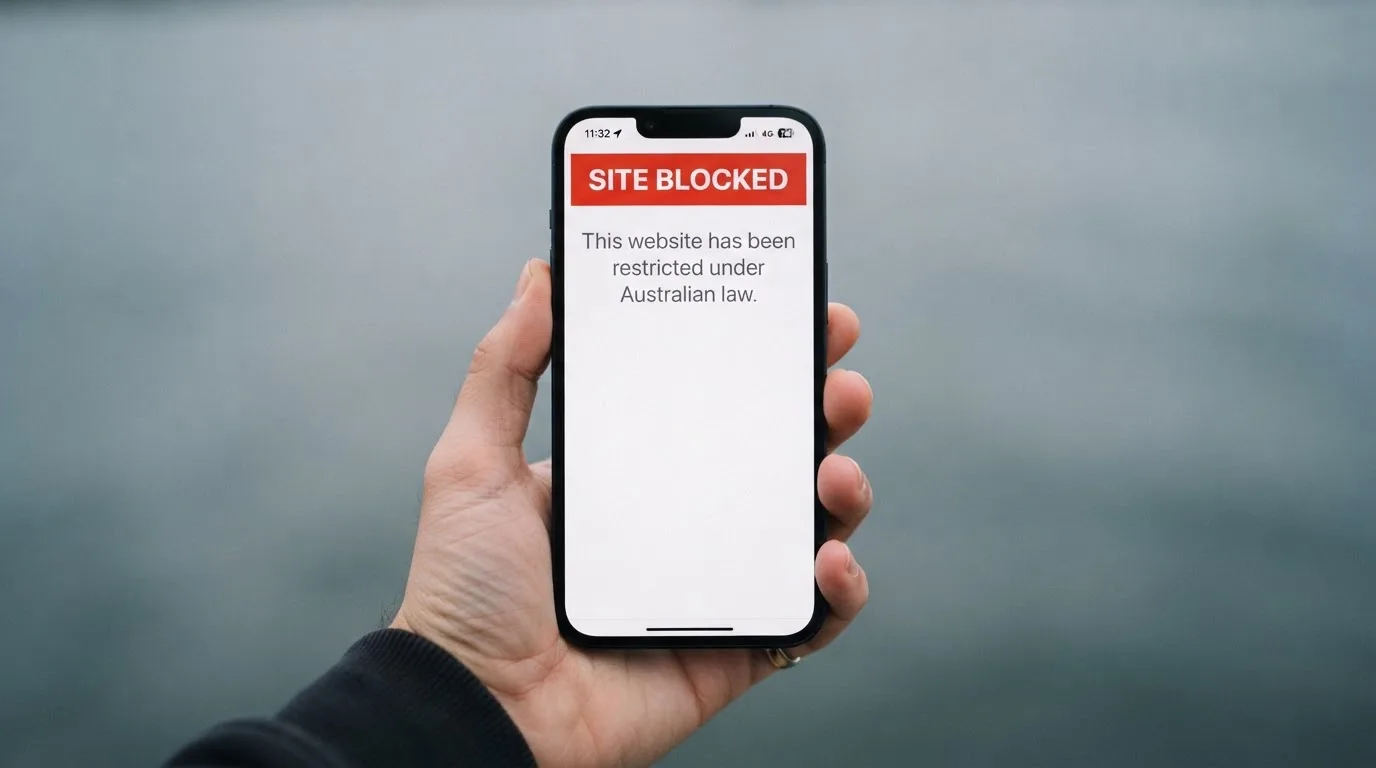
The ACMA’s enforcement record since 2017 is the clearest picture of what offering live dealer play to Australians looks like in practice.
How an Australian payment reaches an unlicensed site
Since 11 June 2024, credit cards, credit-related products and digital currency have been banned as payment methods for any licensed online wagering service. The penalty for an Australian-licensed operator accepting them runs up to A$247,500. Legal deposit routes on the licensed side are debit card, bank transfer, PayID/Osko and BPAY.
An offshore live dealer site asking an Australian for a credit card or a crypto deposit is therefore doing something that the Australian-licensed side is forbidden to do. The payment route and the prohibition are part of the same picture: a product the law does not licence being funded through channels the law has closed to the product it does licence.
Paytable-shaped gap: what the ACMA has blocked and warned
The enforcement picture is the closest thing to a public catalogue of offshore live dealer brands that have targeted Australians, and it is the spine of this page.
| Brand | ACMA action and date | Operator named by the ACMA | Live dealer presence |
|---|---|---|---|
| RocketPlay | Formal warning, March 2026 | Pulsup Ltd | — |
| Level Up Casino | Formal warning, May 2022 | Dama N.V. | Listed by BGaming as a partner casino |
| Woo Casino | Formal warning, March 2025 | Dama N.V. | — |
| Spirit Casino | Formal warning, May 2025 | Dama N.V. | — |
| National Casino | Formal warning, July 2025 | Consolutetish S.R.L. | Listed on industry directories |
| Bizzo Casino | Formal warning, July 2025 (earlier 2022) | Consolutetish S.R.L. / TechSolutions | — |
| Ignition Casino | Formal warning, July 2025 | Bamboo Media | — |
| Instant Casino | Formal warning, February 2025 | EOD Code SRL | — |
| Jackbit | Formal warning, April 2026 | Ryker B.V. | — |
| Casino Intense | Formal warning, April 2025 | Sterplay Holding Ltd | Listed by Australian media and ACMA materials |
| Sky Crown | Formal warning, September 2022 | Hollycorn N.V. | — |
The single piece of arithmetic that earns its place here is the blocking rate. The ACMA’s running total of blocked sites reached 1,751 by the round reported on 26 June 2026, with the first blocking request issued in November 2019. That is 1,751 blocks across roughly 80 months, a band of roughly 21 to 22 blocks per month on average, with the actual monthly rate varying as the ACMA bundles sites into rounds rather than blocking one at a time. The point is not the precise figure; the point is that the rate has stayed in that band for years, that an offshore operator can join the list within months of opening, and that a balance on an account is not a defence against the next round.
The June 2026 round alone added twelve names: 7Signs, ChromaBet, Donbet, Duospin, Freshbet, Slots Gem, Jacks Club, Lucky Start, Pointsbetz, Spinrise, Vinyl Casino and Wildsino. Several of these are sports-led brands that took live dealer tables as add-ons; others are pure casino products. The ACMA does not distinguish by vertical when it issues the block notice — what matters is the prohibited service being offered to an Australian.
Dama N.V. is the operator that recurs most often in the table, with formal warnings in May 2022 (Bambet, Dazard, Level Up, Rocketplay, Wild Tornado and Cobra Casinos), March 2025 (Woo Casino) and May 2025 (Spirit Casino). Consolutetish S.R.L. sits behind two of the table’s brands and was first warned in July 2025, with Bizzo Casino having been warned earlier under TechSolutions. The repetition is not coincidental: offshore groups tend to operate a portfolio of skins under a single licence, and the ACMA warns the operator, not the marketing wrapper.
Responsible-gambling tools that bind offshore sites
The Australian responsible-gambling architecture is built around licensed operators, which is exactly the group that cannot lawfully offer live dealer casino play. The consequences follow from that.
BetStop, the National Self-Exclusion Register, has been live since August 2023. It binds Australian-licensed online and phone wagering services, which is to say licensed sports and race bookmakers, lotteries and keno. An offshore live dealer casino is not connected to it. A player who has registered with BetStop and then opens an offshore account is not protected by the registration; the offshore operator has no obligation to honour it and, in practical terms, no way to know it exists.
The National Gambling Helpline on 1800 858 858 is free, runs 24/7 and connects to Gambling Help Online for chat-based support. It is open to anyone in Australia regardless of where they have been playing, and it is the part of the system that does not depend on which side of the licensing line the operator sits.
For self-exclusion to mean anything on a live dealer product, the player has to choose the lawful version of play, where BetStop applies. On the offshore side, the player is the only one enforcing the exclusion.
Crypto and live dealer play
Bitcoin and other cryptocurrencies are widely accepted by offshore live dealer sites. They are not accepted by licensed Australian wagering services: the 11 June 2024 payment ban extends to digital currency, alongside credit cards and credit-related products. A deposit in bitcoin on an Australian-licensed sports book is unlawful; a deposit in bitcoin on an offshore live dealer site is the standard offshore route.
That second point does not legalise the product on the receiving end. A crypto deposit on an offshore live dealer site still funds a service the Interactive Gambling Act 2001 prohibits being offered to an Australian, and the operator accepting it is still on the ACMA’s list of candidates for a formal warning and a block. Crypto changes the friction; it does not change the status of what is being bought.
The reason crypto dominates the offshore live dealer funnel is structural. Australian banks apply blocks and friction to gambling-adjacent card transactions; e-wallets and bank transfers do not always clear; bitcoin and a handful of altcoins clear from a wallet that does not carry the bank’s flag. The friction is real, and the offshore industry has routed around it. The reader who reaches a live dealer table through a crypto deposit has solved the payment problem at the cost of stepping outside both the licensing regime and the consumer protections that come with it.
Welcome bonuses and what the marketing leaves out
Offshore live dealer sites compete on welcome packages: deposit matches, free-spin bundles and reload offers. Two structural features decide what those offers are actually worth.
Turnover, or wagering, requirements multiply the bonus, sometimes the deposit, by a factor (commonly 35× to 50×) before any of it can be withdrawn. A A$500 deposit matched at 100% with a 40× turnover requirement on the bonus yields A$20,000 of required play before a withdrawal unlocks, and the house edge on the underlying games decides how much of that A$20,000 returns to the player on average. A 40× requirement on deposit plus bonus doubles the required play again. The headline number is the bonus amount; the actual cost of clearing it is set by the multiplier and by the house edge of the games the bonus is played on.
Game weighting is the second lever. Slots typically count 100% against wagering; live dealer tables often count 10% to 20%, which means the same A$20,000 of required play becomes A$100,000 to A$200,000 of live-table turnover. Some promotions exclude live dealer play altogether, in which case the bonus can be cleared only on slots, not on the product it appeared next to on the landing page. A reader who took the bonus to play live dealer and then finds the wagering does not count on the live tables has accepted a promotion with a hidden exclusion.
No operator write-up below quotes a working bonus code. The only public sources for those were affiliate marketing pages, and this page does not traffic in codes. What each write-up records is the ACMA action, the operator behind it and the product position relative to the prohibition.
How live dealer games actually work
A live dealer casino streams a real table from a studio or, less commonly, from a land-based casino floor. Optical camera recognition technology reads the dealer’s actions, the card dealt, the roulette result, and converts them into data that updates the player’s interface. The game runs in real time, with bets placed through the on-screen interface while the physical action happens on the other side of the camera. The provider runs the equipment, the studio and the dealers; the operator runs the website and the wallet; the player interacts with both through the browser or app.
Evolution, the dominant supplier, was founded in 2006 by Jens von Bahr and Fredrik Österberg. It reached 100 live tables at its Riga studios in 2013, at the time the largest single-site casino operation in Europe, and opened a Malta studio in 2014. It completed its acquisition of NetEnt on 1 December 2020. The Evolution Group also owns the NetEnt, Red Tiger, Big Time Gaming, Nolimit City and Ezugi game-studio brands. The company states that more than 700 gambling platforms worldwide offer its live casino games, streamed 24/7 from its studios.
The most common live dealer games are baccarat, blackjack and roulette. Each has its own structural quirks that the rest of this page does not develop in detail; what matters here is that they are the games the ACMA’s enforcement record targets, because they are the games that define the prohibited interactive gambling service.
Baccarat
Baccarat’s house edge is 1.06% on the Banker bet, 1.24% on the Player bet and 14.36% on the Tie. The variant most played today, punto banco, was developed in Havana during the 1940s and is dealt from a shoe of 6 or 8 decks: number cards count at face value, ten and the face cards count as zero, aces count as one, and hand totals are taken modulo 10. The casino banks the game at all times and plays both hands by fixed drawing rules, which is why there is no decision for the player to make beyond the bet. In New South Wales, section 66 of the Casino Control Act 1992 prohibits a casino operator from permitting a game such as baccarat to be played unless the game and its rules are approved by the regulator. Crown Melbourne offers three approved variants — Traditional Baccarat, Crown Baccarat and 2 to 1 Baccarat — regulated by the Victorian Gambling and Casino Control Commission.
Blackjack
Blackjack’s house edge, played with optimal basic strategy, runs around 0.28% under liberal Las Vegas Strip rules and around 0.43% under Atlantic City rules. The game descends from the English vingt-un and a Spanish veintiuno described by Miguel de Cervantes around 1601-1602; the name “blackjack” dates to roughly 1899 and is credited to prospectors during the Klondike Gold Rush. Variants on the casino side include Spanish 21 (played without tens but with liberal player-favourable rules), Double Exposure (both dealer cards face-up), Blackjack Switch (swap cards between two hands) and Super Fun 21 (up to four splits). Crown Melbourne’s blackjack rules, including the renaming of “Perfect Pairs” to “Crown Pairs” on 23 December 2024 and a “Free Bet” option with a new “Pot of Gold” side bet on 25 March 2024, sit on the VGCCC’s public log of approved changes.
Roulette and craps
Roulette’s house edge sits at 2.7% on a single-zero wheel and 5.26% on a double-zero wheel. Craps is less common on live dealer platforms in the Australian market but is offered by some suppliers; the Pass/Come bet carries a house edge of 1.41%, Don’t Pass/Don’t Come 1.36% and Any Craps 11.11%. Both games have rule sets that vary by studio, and the licensed Australian venues publish their approved rules through the state regulator.
Eleven brands the ACMA has warned, and what to read into each
These are not recommendations. Each brand below is on the page because the ACMA itself issued a formal warning over it for offering prohibited interactive gambling services to Australians. The write-up of each is a description of what the ACMA record shows, not a verdict on whether to play there.
RocketPlay
The ACMA issued a formal warning to Pulsup Ltd over RocketPlay in March 2026. Dama N.V., the operator behind the Rocketplay brand, was also the subject of a wider 2022 warning covering six brands. The site’s live dealer offering is the kind of product the Interactive Gambling Act 2001 prohibits being offered to Australians. The March 2026 warning puts it at the more recent end of the ACMA’s enforcement pipeline.
Level Up Casino
The ACMA’s May 2022 warning to Dama N.V. covered Level Up alongside Bambet, Dazard, Rocketplay, Wild Tornado and Cobra Casinos. The brand is listed by BGaming, a slot supplier, as a partner casino, which tells the reader that game studios do distribute to operators the ACMA has named; it does not tell the reader that the underlying service is lawful to use from Australia. The 2022 date places it among the earlier Dama N.V. portfolio warnings.
Woo Casino
Woo Casino received a formal warning from the ACMA in March 2025, with Dama N.V. named as the operator. It sits in the same Dama N.V. portfolio as Spirit Casino and the 2022 cohort, which is why the same operator name keeps surfacing across multiple rows of the table above. A portfolio-wide pattern is what the ACMA record describes: not a single brand, but a group, and a group whose repeat appearance in the warning list is itself the data point.
Spirit Casino
Spirit Casino received a formal warning in May 2025, again with Dama N.V. as the named operator. Two months after Woo Casino, on the same operator, on the same legal ground: a prohibited interactive gambling service offered to Australians. The repeat pattern is the story; the brand name is the wrapper.
National Casino
The ACMA issued a formal warning to Consolutetish S.R.L. over National Casino in July 2025. The brand is listed on industry directories that index live dealer studios and payment options; it does not appear on any Australian register because no Australian register covers it. The warning is the only Australian-authority document on the brand.
Bizzo Casino
Bizzo Casino sits under two separate ACMA actions: a 2022 warning to TechSolutions (CY) Group Limited and TechSolutions Group N.V., and a July 2025 warning to Consolutetish S.R.L. The change in named operator between the two warnings reflects a change in the corporate vehicle behind the brand, not a change in the underlying conduct. The product on offer to Australians remains a prohibited service; the warning has simply moved with the operator.
Ignition Casino
Bamboo Media was the operator named by the ACMA in the July 2025 warning over Ignition Casino. The brand’s live dealer offering, like every other brand on this page, sits outside anything Australia licences. A reader who has seen the Ignition name on affiliate sites will not find it on any Australian register; the warning is the ACMA’s record of the brand’s offer to Australians.
Instant Casino
EOD Code SRL received a formal warning over Instant Casino in February 2025, one of the earliest of the ACMA’s 2025 actions and the trigger for one of the more prominent blocking rounds. The brand’s live dealer product is the kind the Interactive Gambling Act 2001 prohibits; the February 2025 date places the warning in the same enforcement window that the ACMA’s running total of 1,751 blocked sites was climbing through.
Jackbit
The ACMA issued a formal warning to Ryker B.V. over Jackbit and CasinOK in April 2026. The two brands sit on the same warning notice, the same operator and the same month, which is the standard pattern when an offshore group runs more than one skin. Jackbit leans heavily on a crypto-deposit funnel, which the 11 June 2024 payment ban forbids on the Australian-licensed side; the offshore product uses the route the licensed side cannot.
Casino Intense
Sterplay Holding Ltd received a formal warning over Casino Intense in April 2025. The brand has been the subject of coverage in Australian media and is named on ACMA materials, which is the listings-only support the research carries for it. There is no Australian-licence basis on which Casino Intense could be offered lawfully to an Australian player, and the April 2025 warning is the ACMA’s recorded position on the brand’s offer.
Sky Crown
Hollycorn N.V. is the operator named by the ACMA in the formal warning over Sky Crown and Blue Leo. The ACMA’s publication on this warning dates to September 2022, making it one of the older entries on the page. A formal warning is not a block, and the ACMA’s enforcement escalates from warning to block when the conduct continues; the existence of the warning is itself the record of a prohibited service being offered.
The eleven brands as a single picture
The pattern across the table is not eleven independent cases. It is one enforcement picture drawn through different operators and different brands. Dama N.V. accounts for several rows; Consolutetish S.R.L. accounts for two; the rest are one-off operators, but they all sit on the same legal ground. The product on offer is a prohibited interactive gambling service; the formal warning is the ACMA’s record of that offer; the block is the next step when the conduct continues.
Reading the table in this way changes what an Australian reader takes from it. The brands compete on welcome packages, payment friction and game selection, which are real differences. They do not compete on the Australian legal question, which is settled for all of them by section 15 of the Interactive Gambling Act 2001.
What the lawful path looks like
The lawful alternative to an offshore live dealer site is, in two steps: a licensed Australian wagering account for the things Australia licences, and a land-based casino for live table play.
Licensed Australian wagering is online and phone betting on sports and races, with lotteries and keno. Pre-event only, never in-play; debit card, bank transfer, PayID/Osko and BPAY for deposits; BetStop for self-exclusion; the National Gambling Helpline on 1800 858 858 for support. The list of what is licensed is the list of what an Australian can do without falling foul of the Interactive Gambling Act 2001.
Live table play means a licensed venue. Crown Melbourne in Victoria offers approved baccarat variants under the Victorian Gambling and Casino Control Commission, and approved blackjack variants on the VGCCC’s public log of approved changes. The Star Sydney operates under the New South Wales Casino Control Act 1992, with section 66 of that Act requiring the regulator to approve any game and its rules before it is offered. Every other Australian state and territory has its own casino operator and its own approval regime. The games at a licensed venue are the games the ACMA’s enforcement record does not apply to.
A reader who wants live dealer play and is in Australia is choosing between a prohibited offshore product and a lawful land-based product. The two are not close substitutes; the offshore product is reachable from a couch and the land-based product requires a visit to the venue. The trade is between convenience and legality, and the page does not soften it.
The tax position, briefly
Gambling winnings of a recreational Australian player are not assessable income under section 6-5 of the Income Tax Assessment Act 1997, and losses are not deductible. The exception is a person who carries on a business of gambling, which most players do not. The position is the same whether the play is on a licensed Australian product or on an offshore product; the difference is that an offshore product cannot be reported in a way the ATO can verify, and the winnings are simply outside the Australian tax net. The ATO is the place to confirm the position for any specific case.
The 2026 reform on the horizon
The Interactive Gambling Amendment (Gambling Reform) Bill 2026 passed Parliament on 19 August 2026. Its advertising and inducement measures commence on 1 January 2027. Until that commencement date, the measures are not in force; once in force, they reshape what licensed Australian wagering operators can advertise and what inducements they can offer. The Bill does not change the underlying prohibition on interactive casino-style gambling services to Australians, which has been in force since 2017. The legal ground on which the ACMA’s enforcement rests is unchanged.
For an Australian reading the ACMA’s enforcement record in 2026, the picture is the picture as it stood before the reform, and as it will continue to stand after the reform’s commencement date. The reform changes the surface; it does not change the prohibition.
Frequently asked questions
How many live tables did Evolution operate from its Riga studios by 2013?
Evolution reached 100 live tables at its Riga studios in 2013, at the time the largest single-site casino operation in Europe. The company opened a Malta studio in 2014 and completed its acquisition of NetEnt on 1 December 2020, with the group later expanding to include Red Tiger, Big Time Gaming, Nolimit City and Ezugi as additional studio brands.
Does a live dealer casino accept cryptocurrency deposits?
Offshore live dealer sites commonly accept bitcoin and other cryptocurrencies as deposits. The 11 June 2024 Australian payment ban forbids digital currency as a payment method for any licensed Australian online wagering service. A crypto deposit on an offshore site still funds a prohibited service under the Interactive Gambling Act 2001; the payment route does not change the status of what is being bought.
Is it legal for a live dealer casino to accept Australian players?
No. Under the Interactive Gambling Act 2001, offering an interactive casino-style gambling service, including live dealer blackjack, roulette and baccarat, to a person in Australia is a prohibited interactive gambling service. No Australian state or territory issues a licence for it. The ACMA enforces the prohibition through formal warnings and blocking orders; the individual player is not prosecuted, but the offshore site offers no Australian consumer protection, no complaints body and no recourse on a refused withdrawal.
What responsible-gambling tools should a live dealer casino site provide?
The Australian responsible-gambling architecture — BetStop, the National Self-Exclusion Register, the National Gambling Helpline on 1800 858 858 and Gambling Help Online — binds Australian-licensed services. An offshore live dealer site is not connected to BetStop and has no obligation to honour a self-exclusion registered in Australia. The tools that follow an Australian player are the licensed-operator tools; the offshore operator’s own tools, where they exist, are not part of the Australian framework.
What is usually attached to a live dealer casino welcome bonus?
A turnover, or wagering, requirement that multiplies the bonus (and sometimes the deposit) by a factor before a withdrawal unlocks; game weighting that often counts live dealer play at 10% to 20% of slot play, or excludes it altogether; and maximum cashout caps that cap the winnings withdrawable from a bonus even after the wagering is cleared. The headline figure is the bonus amount; the cost of clearing it is set by the multiplier, the weighting and the house edge of the games the bonus is played on.
Can Australians find a shortlist of licensed live table games anywhere other than online?
Yes, at licensed Australian land-based casinos. Crown Melbourne in Victoria offers approved baccarat and blackjack variants under the Victorian Gambling and Casino Control Commission, and The Star Sydney operates under the New South Wales Casino Control Act 1992, with section 66 of that Act requiring the regulator to approve any game and its rules before it is offered. Every other Australian state and territory has its own casino operator and its own approval regime. The games at a licensed venue are the games the ACMA’s enforcement record does not target.