
Casino sign-up bonuses in Australia — what the law permits and what the ACMA has been blocking
A reader searching for a casino sign-up bonus from inside Australia is, before anything else, looking for something the Interactive Gambling Act 2001 was amended to stop. Offering an online casino game to a person physically in Australia is a prohibited interactive gambling service. No state or territory issues a licence for it. The marketing language is one thing; the legal status of the offer behind it is something else, and on this page the second is what governs. Below: what the prohibition covers, how the ACMA enforces it, what player-protection tools apply, and which paths are open to a person reading from Australia.
Data current as of 17 October 2026, checked against the ACMA’s register of formal warnings and blocking actions.
Table of Contents
- How the prohibition actually works
- The block list, and the rate it has been growing
- Formal warnings, brand by brand
- Player protection — what is binding on what
- Payment routes, and which ones the law has closed
- What a sign-up bonus actually is, and what the small print takes from it
- The brands behind the warnings, in detail
- Choosing, when the choice the page can offer is shaped by the law
- Frequently asked questions
How the prohibition actually works
The Interactive Gambling Act 2001, hardened by the Interactive Gambling Amendment Act 2017, makes it an offence to provide online casino games, online pokies or in-play betting to a person in Australia. The 2017 amendments shifted enforcement from a civil model to one with criminal penalties aimed at the provider — and the ACMA was given the job of running it. A wager placed before the event on a race or sport, a lottery ticket, and keno are the things that are licensable, and in practice they are licensed by the Northern Territory Racing and Wagering Commission, the same body that authorises Sportsbet, Bet365 and Ladbrokes from Darwin and operates with no full-time staff of its own.
The point that gets missed, often because offshore operators make a point of obscuring it, is what “licensed” means in this market. The Northern Territory Racing and Wagering Commission is a bookmaker regulator, not a casino-game regulator. A Curaçao or Anjouan badge on a site’s footer is not an Australian licence and confers none of the protections of one. The ACMA’s formal-warning register is the public ledger of who has been told, in writing, that offering their product to Australians is a contravention of the Act.
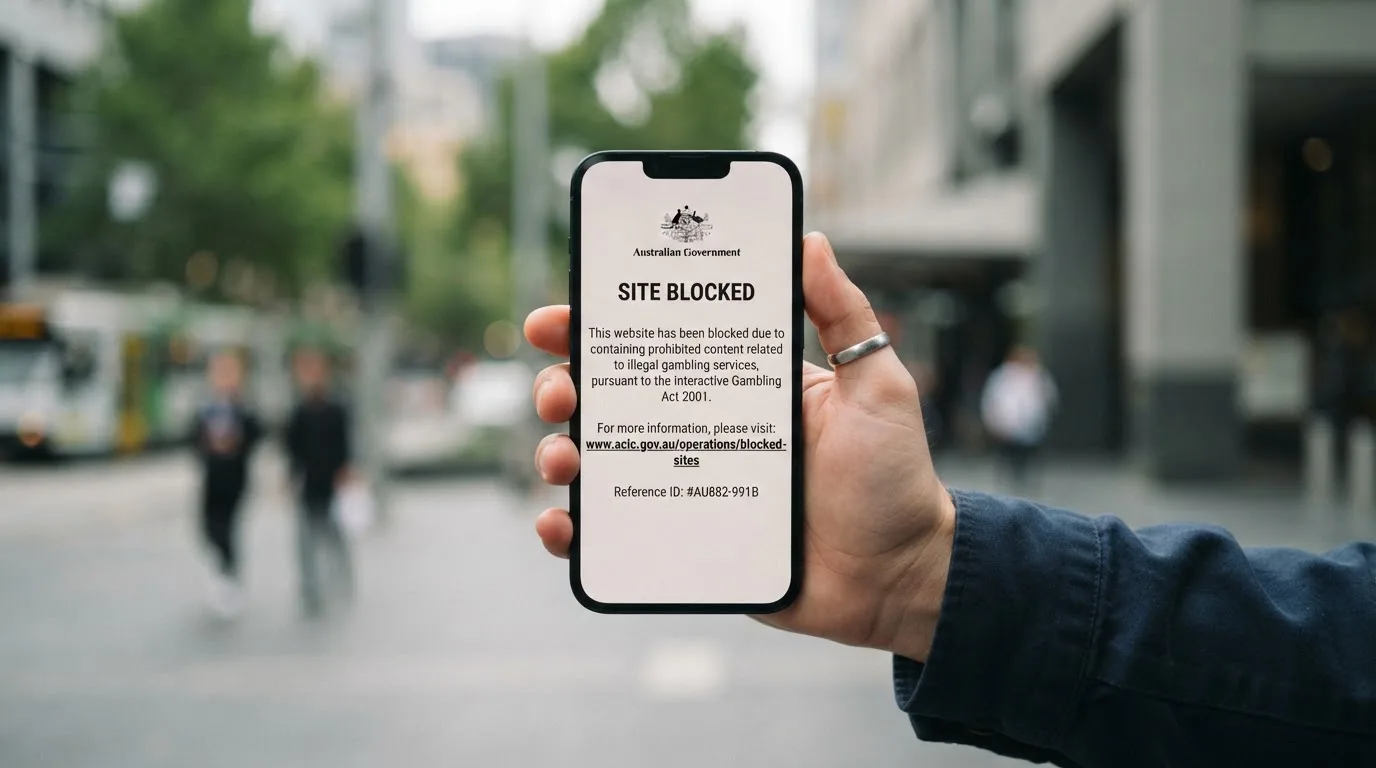
What the ACMA can do once it has decided a service is prohibited: serve a formal warning; refer the matter for civil penalty proceedings; and ask Australian internet service providers to geo-block the offending domain. The provider faces penalties up to A$247,500 per breach for unlicensed wagering. The individual player is not the target of the Act, but a player using an offshore service has no Australian complaints body to appeal to if a withdrawal stalls or is refused — and a blocked site does not refund the balance left on it.
The block list, and the rate it has been growing
As reported in June 2026, the ACMA had asked Australian ISPs to block 1,751 illegal gambling and affiliate-marketing websites since the first blocking request in November 2019, and more than 230 unlicensed services had left the Australian market since enforcement was strengthened in 2017. June 2026’s round alone added twelve names: 7Signs, ChromaBet, Donbet, Duospin, Freshbet, Slots Gem, Jacks Club, Lucky Start, Pointsbetz, Spinrise, Vinyl Casino and Wildsino.

The arithmetic that matters here is the rate. From November 2019 to June 2026 is roughly 79 months. Divide the running total into that span and the ACMA’s blocking rate has averaged around 22 sites per month across the whole enforcement window — with the early years sparser and the recent ones visibly denser. The 230 services that have withdrawn voluntarily over the same stretch adds a quieter, harder-to-measure second column to the picture: the providers who never made it onto the block list because they left before being listed. The most recent blocking rounds, run in batches roughly monthly, are running materially above that long-run average; enforcement has not plateaued.
The cost the prohibition imposes on Australian players is harder to read. H2 Gambling Capital’s 2025 report estimated that Australians lose around A$3.9 billion a year to illegal gambling sites, and that the share of gambling going through legal channels fell from 74 per cent in 2021 to 64 per cent. The legal channel has narrowed, not widened, while the offer behind the prohibited site has kept finding new domains to reappear on. The block list is a leading indicator of enforcement effort; what it does not measure is whether the demand it removes actually relocates to the licensed wagering channel or simply migrates from one offshore brand to the next.
Formal warnings, brand by brand
The table below is the ACMA’s own ledger, transcribed into one place. Every brand listed is a casino the ACMA has, in writing, told to stop offering to Australians. A formal warning is not a conviction; it is the ACMA’s step before civil penalty proceedings. A licence displayed on the site’s footer is not refuted by a warning — but the warning makes plain that offering the product to a person in Australia is a contravention regardless of what that footer says. The columns are: the brand as it appears in the ACMA’s published register, the operator the warning names, the date published, and the broader ACMA action history for that operator. Subject-support notes follow the research carried for each brand — where a brand shows up on third-party listings, that is what the table says; where research has nothing, the cell says so.
| Brand | Operator named by the ACMA | ACMA action and date | Subject support |
|---|---|---|---|
| RocketPlay | Pulsup Ltd | Formal warning, March 2026 (Rocketplay) — earlier Dama N.V., May 2022 | Listed on Gambling Insider |
| Level Up Casino | Dama N.V. | Formal warning, May 2022 | Listed on Westpac’s gambling-block documentation |
| Woo Casino | Dama N.V. | Formal warning, March 2025 | No data carried |
| Spirit Casino | Dama N.V. | Formal warning, May 2025 | No data carried |
| National Casino | Consolutetish S.R.L. | Formal warning, July 2025 | Listed on ACMA, AUSTRAC and BetStop reference pages |
| Bizzo Casino | Consolutetish S.R.L. | Formal warning, July 2025 — earlier TechSolutions (CY) Group / TechSolutions Group N.V., 2022 | Listed on Gambling Insider |
| Ignition Casino | Bamboo Media | Formal warning, July 2025 | No data carried |
| Instant Casino | EOD Code SRL | Formal warning, February 2025 | Listed on ecoPayz and PayID reference pages |
| Jackbit | Ryker B.V. | Formal warning, April 2026 | No data carried |
| Casino Intense | Sterplay Holding Ltd | Formal warning, April 2025 | Listed on AUSTRAC, BetStop and Gambling Insider |
| Sky Crown | Hollycorn N.V. | Formal warning (PDF, September 2022) | No data carried |
Dama N.V. is the operator that recurs most often across this register. Five of the eleven brands above sit under one corporate roof, including two — Woo and Spirit — warned in successive rounds in 2025. Consolutetish S.R.L. appears twice in July 2025 alone. Hollycorn, Bamboo Media, Sterplay, Ryker, EOD Code and Pulsup are each named once in the register carried here. The pattern is not that one rogue operator dominates the list; it is that no operator recurs often enough to suggest the warnings are landing as a deterrent.
What is missing from the table is also information. The ACMA publishes operator and date but does not, in the formal-warning register, publish the geo-blocking status of every domain it has warned. A warning can precede a block by months or follow one. Treating the register as a ranking of “how forbidden” each brand is would be reading it for a purpose it was not designed for. The register tells the reader what the ACMA has done. It does not tell the reader what the brand is currently doing under any of its other domains.
Player protection — what is binding on what
BetStop, the National Self-Exclusion Register, has been live since August 2023. It binds every Australian-licensed online and phone wagering service — which means sports bookmakers and licensed lotteries, not offshore casino sites. A punter who has registered with BetStop and then opens an account with a Curaçao-licensed operator is, from the operator’s side, in good standing; the operator has no way to see the BetStop entry, and has no obligation to act on it even if it did. For a person whose problem is the offshore route specifically, BetStop is necessary but not sufficient.
The two practical guardrails the law does extend to offshore sites are the bank-side blocks and the ISP-side blocks. Major Australian banks let customers switch on a gambling block at card level: Westpac’s block refuses authorisation on transactions tagged under the merchant category code for betting and casino gambling; ANZ runs an equivalent block in its app and extends it to Apple Pay on the same card; Commonwealth Bank lets customers apply a gambling lock through the CommBank app. ANZ warns that removing the block requires a 48-hour waiting period and that not every gambling transaction will be blocked, and that some non-gambling transactions may be blocked in error — a candid acknowledgement that the card-level filter is a guardrail, not a fence.
The gambling block works on the merchant category code the bank sees when authorisation is requested. An offshore site that routes its acquiring through an MCC other than “Betting/Casino Gambling” can sit outside that filter. ANZ’s block, which the bank’s documentation explicitly extends to digital-wallet transactions on an eligible card, catches more; the merchant-code filter catches what the merchant code reaches.
The National Gambling Helpline — 1800 858 858 — is free, 24/7, with chat at Gambling Help Online. For a person who is reading this page from Australia and trying to choose between offers on prohibited sites, the helpline is the route that does not depend on the offshore operator cooperating.
Payment routes, and which ones the law has closed
For an Australian-licensed online wagering service, credit cards and credit-related products have been banned as a payment method since 11 June 2024, with the restriction extending to linked wallets such as Apple Pay. Debit card, bank transfer, PayID and Osko instant transfers, and BPAY remain the legal deposit routes. The point is not subtle: a sign-up bonus page that asks an Australian reader for a credit-card deposit or a crypto transfer is asking for a payment the law has already ruled out for the licensed market, which is one of the markers that the operator is operating outside the Australian regime.
PayID and Osko, both run by Australian Payments Plus, are the practical rails for a deposit into a licensed bookmaker’s account: more than 100 Australian financial institutions offer PayID-based instant transfers, the transfer arrives in under a minute around the clock, and paying to a PayID surfaces the recipient’s name before the money leaves the account — AP+ itself warns that being asked to pay a PayID on an illegal gambling site almost certainly means a scam site. The same network carried more than 25 million PayID registrations by April 2025 and is required to keep monthly outages under two minutes, a level of operational rigour the offshore crypto route does not match.
Apple Pay, Google Pay and Samsung Pay collectively carried around 45 per cent of Australian card payments by number at the end of 2025. Apple does not surcharge consumers for using Apple Pay; transaction limits and PIN requirements are set by the issuing bank or the merchant, not by Apple. From the Australian punter’s perspective, the practical consequence of the credit-card ban interacting with Apple Pay is that a wagering transaction attempted through Apple Pay against an Australian-licensed card will be declined because the underlying funding source is a credit product — a fact the licensed wagering operators must build their cashier around, and a fact an offshore operator has no reason to disclose.
American Express sits in a separate lane from Visa and Mastercard — a three-party scheme where Amex both issues and processes, rather than the four-party model. The Reserve Bank of Australia’s July 2025 review proposes removing surcharges only on eftpos, Mastercard and Visa, explicitly leaving Amex outside the proposed surcharge ban. For a punter who keeps an Amex card and uses it for everything, this is the one piece of the payments stack the RBA has decided not to touch.
BPAY, the bill-payment service available through the online banking of more than 140 Australian institutions, operates in the same Australian Payments Plus family as PayID and Osko — payer enters a Biller Code and a Customer Reference Number, the bill is paid from the linked account. It launched in November 1997 and is owned equally through Cardlink Services Limited by ANZ, Commonwealth Bank, NAB and Westpac. For the licensed wagering channel it is a routine deposit path; for an offshore site it is not on offer, because the operator would need an Australian Biller Code to receive through it, which an unlicensed interactive gambling service cannot obtain.
Crypto is the route the licensed market has explicitly closed. Where a sign-up bonus page asks an Australian reader to deposit in Bitcoin, Ethereum or USDT, the offer is operating outside the licensed Australian regime by construction, and the deposit is not reversible through any Australian channel once sent.
What a sign-up bonus actually is, and what the small print takes from it
A “sign-up bonus” in the licensed market — meaning licensed wagering, the only segment that exists legally in Australia — is a promotional offer tied to opening a new account, usually a deposit match plus, in some cases, a small parcel of bonus bets or free spins on a virtual product. The mechanic is the same as offshore: a headline number that looks like free money, attached to a turnover requirement that converts it into something the player has to earn back before withdrawing.
Two things the marketing language does not say. First, turnover is the wagering multiple — a 10x turnover on a A$100 bonus means A$1,000 must be staked before any of the bonus, or winnings derived from it, can be withdrawn. Second, almost every promotional offer comes with a maximum-bet clause, an expiry on the wagering period, a game-weighting table that gives roulette and blackjack a tiny fraction of the credit slots get, and a maximum-cashout cap. Each of those is a cost the offer imposes in addition to the time it takes to clear.
A no-deposit bonus — a small credit, often A$10 to A$30, attached to opening the account without funding it — sounds cheaper because no money went in. The math is the inverse. A no-deposit bonus almost always carries a higher wagering multiple than a deposit bonus, a hard cap on the maximum withdrawal from bonus-derived winnings, and a tight expiry. The marketing draws the reader in with the no-deposit framing; the small print converts it into something the player has to grind through.
The arithmetic that matters is expected loss. For a bonus of A$100 wagered at 10x on a slot at a 96 per cent return to player, the required turnover is A$1,000, and the expected loss on that turnover is roughly A$40 — the bonus’s real cost to the player, before the cashout cap and the max-bet rule have done their work. The headline bonus is A$100; the cost of clearing it sits at about 40 per cent of that, which is the reason a sharp reader treats the headline as the entry fee and the expected loss as the price.
The 2026 reform picture is one to watch but not to act on yet. The Interactive Gambling Amendment (Gambling Reform) Bill 2026 passed Parliament on 19 August 2026, with its advertising and inducement measures set to commence on 1 January 2027. Law with a start date — not in force on a page being read in 2026. What the bill does is tighten what licensed wagering operators can offer as inducements, and what they have to disclose when they offer it. For an Australian reader comparing offers today, the bill is a reason to re-check the page at the start of 2027, not a rule that changes the offer in front of them now.
The brands behind the warnings, in detail
The block of brands below is the ACMA’s register in one place, written out so the reader can see what each warning named and what the operator’s footprint elsewhere looks like. It is not a recommendation, and a reader who has scanned down to this section looking for “the best one” will not find one — the Interactive Gambling Act’s prohibition is the reason there is no best one to recommend.
RocketPlay
The ACMA issued a formal warning to Pulsup Ltd over Rocketplay in March 2026, and a separate earlier warning to Dama N.V. over six brands including Rocketplay in May 2022. The site is listed on third-party gambling-industry trackers but carries no Australian licence. For a reader looking at Rocketplay because an affiliate review cited it, the warning register makes plain that the ACMA has told two different corporate entities operating the brand to stop offering to Australians, and that the corporate identity behind the brand has changed at least once in that window.
Level Up Casino
Dama N.V., May 2022. Level Up is one of the six brands bundled into the May 2022 warning alongside Bambet, Dazard, Rocketplay, Wild Tornado and Cobra Casinos. Westpac’s gambling-block documentation references the brand as part of its merchant-code filter list — a marker that the bank’s transaction-screening system treats it as a casino gambling destination, not a wagering service, which is consistent with the ACMA’s classification.
Woo Casino
Dama N.V., March 2025. One of two Dama brands warned in successive rounds in 2025 — Spirit Casino was the other, in May. The pattern of two warnings against one corporate group over a short interval is the ACMA’s way of registering that the first warning did not produce a behavioural change, and a reader looking at Woo on the assumption that a recent licence badge has fixed the underlying status is reading the wrong document.
Spirit Casino
Dama N.V., May 2025. The second of the Dama pair. Same operator, same year, two months apart — a pattern the ACMA’s enforcement record shows repeating often enough to read as standard practice rather than coincidence. For a person weighing Spirit against Woo on operator reputation, the only honest answer is that the ACMA has treated them as a single enforcement problem.
National Casino
Consolutetish S.R.L., July 2025. The brand appears on ACMA, AUSTRAC and BetStop reference pages, which is a different kind of visibility from being listed on an affiliate tracker: it means the brand has shown up in Australian regulatory and player-protection contexts, not just marketing ones. For a reader who has come across the brand on a comparison page, that broader footprint is the part of the picture worth weighing.
Bizzo Casino
Consolutetish S.R.L., July 2025 — and a separate, earlier warning to TechSolutions (CY) Group Limited and TechSolutions Group N.V. in 2022. Two operators, three years apart, one brand. The brand has been the subject of formal warnings under two different corporate parents, which is a longer enforcement history than most of the brands on this register carry.
Ignition Casino
Bamboo Media, July 2025. The brand appears on third-party gambling-industry listings. The single warning does not by itself indicate a recurrence pattern — what it indicates is that the ACMA has, once, told Bamboo Media that offering the product to Australians is a contravention. A reader looking at Ignition’s offshore licence badge will not find a counter-notice from the ACMA in the public register; a reader looking for an Australian counter-licence will not find one either.
Instant Casino
EOD Code SRL, February 2025. The brand shows up on PayID and ecoPayz reference pages, which is unusual among the brands on this list: it is being referenced in the context of Australian payment-rail documentation, which means at least one party in the Australian payments stack has had cause to treat the brand as a counterparty for screening purposes. The most likely mechanism is that an Australian customer or bank raised a transaction dispute and the payment provider’s name surfaced in that context.
Jackbit
Ryker B.V., April 2026. One warning, one operator, no third-party listing data carried by the research for this page. For a reader looking at Jackbit because of a crypto deposit offer, the April 2026 warning is recent enough that the ACMA’s view of the offering is current.
Casino Intense
Sterplay Holding Ltd, April 2025. The brand shows up on AUSTRAC, BetStop and gambling-industry listings, which puts it in the same broader-footprint group as National Casino — visible to Australian regulatory and player-protection contexts, not just to the comparison-page economy.
Sky Crown
Hollycorn N.V., formal warning published as a PDF in September 2022. The earliest warning in the register carried by the research, and one of a small number to be published as a standalone PDF rather than as a list entry. The 2022 vintage means the brand has been on the ACMA’s radar longer than any of the others, without a recorded escalation to a blocking request, which is a fact the reader can weigh against the marketing language the brand itself uses.
Choosing, when the choice the page can offer is shaped by the law
The honest comparison on this page is not “which sign-up bonus is best.” It is a narrower choice: between the path the law closes off and the paths it leaves open. For a reader in Australia, the relevant comparison is between offshore sign-up offers and the licensed wagering channel — and the comparison has to be made on the reader’s terms, not on the marketing’s.
The offshore offer has the bigger headline. It also has no Australian consumer protection, no complaints body, and the risk that a withdrawal stalls or is refused with no recourse. The licensed wagering channel has a smaller headline, the credit-card ban, and BetStop actually binding. For a punter who is choosing on the basis of where a dispute would actually get heard, the licensed channel is the one that gives them somewhere to complain. For a punter who is choosing on the basis of where the offer looks largest, neither channel is a good answer.
What the ACMA’s enforcement record changes is the cost of the offshore offer. A site that has been warned is more likely to disappear — and take the balance with it — than a site that has not. The 230 services that have left the Australian market since 2017 is the practical cost of the offshore route measured over the population of offers a reader might be considering. The block rate of around 22 sites per month on average since November 2019 is what tells a reader how often the route they are weighing has historically been closed off mid-engagement.
For a person who has decided to keep punting and wants to stay inside the law, the practical choice is a licensed online or phone wagering service authorised by the Northern Territory Racing and Wagering Commission — Sportsbet, Bet365, Ladbrokes and the 49 other bookmakers the Commission oversees from Darwin — funding through debit card, bank transfer, PayID/Osko or BPAY, with the gambling block on in the bank app. For a person who wants to use the offshore offers anyway, the practical choice is to read the ACMA register first and treat any sign-up bonus from a warned brand as one that has, in writing, been told to stop offering the product to Australians.
For a person who is reading this page because they are trying to stop, BetStop is the binding mechanism, and the National Gambling Helpline on 1800 858 858 is the open door.
Frequently asked questions
What is the difference between a sign-up bonus and a no-deposit bonus?
A sign-up bonus is tied to making a deposit and committing a stake to clear the wagering requirement — usually a deposit match at a defined percentage, with a turnover multiple applied to it. A no-deposit bonus credits the account without a deposit and is smaller, with a tighter expiry, a higher wagering multiple, and a maximum cashout cap that limits how much of any bonus-derived winnings can be withdrawn. The marketing makes the no-deposit look cheaper; the small print makes it more expensive to clear per dollar of headline value.
What does turnover, or wagering requirement, mean for a sign-up bonus?
Turnover is the total amount that must be staked before the bonus, and any winnings derived from it, become withdrawable. A 10x turnover on a A$100 bonus means A$1,000 of qualifying bets across qualifying games within the qualifying period. Game-weighting tables usually give slots 100 per cent credit and table games a much smaller share, and the wagering period expires if it is not cleared in time — at which point the bonus and any bonus-derived winnings are forfeited under most terms.
Is it legal for an online casino to offer a sign-up bonus to players in Australia?
No. Offering online casino games to a person in Australia is a prohibited interactive gambling service under the Interactive Gambling Act 2001, as amended in 2017. No state or territory issues a licence for online casino games. The operator — not the player — is the target of the Act, but an offshore site gives no Australian consumer protection, no complaints body and no recourse if a withdrawal stalls. The ACMA’s formal-warning register is the list of operators the regulator has, in writing, told to stop.
Can a sign-up bonus be claimed using a cryptocurrency deposit?
On an Australian-licensed wagering service, no — credit and credit-related products including digital currency have been banned as payment for licensed online wagering since 11 June 2024, with operator penalties up to A$247,500. On an offshore site, yes, but the offer itself is operating outside the Australian regime and the deposit is not reversible through any Australian channel once sent. A crypto deposit is also the route the licensed market has most explicitly closed, which makes it a marker that the offer is one the ACMA has no jurisdiction over.
Why do sign-up bonus terms usually cap the maximum bet allowed?
The cap exists to prevent the player from clearing the turnover in a single large spin or hand and then withdrawing, which defeats the purpose of the bonus from the operator’s side. The cap is usually set at the equivalent of A$5 to A$10 per spin or hand on a slot, with a smaller cap on table games. Breaching the cap is one of the standard ways an offer is voided and bonus-derived winnings are forfeited, and the operator’s terms usually allow the operator to do so without giving a reason.
What happens to an unused sign-up bonus if the wagering period expires?
Under standard terms, the bonus balance is forfeited along with any winnings derived from it, and the player is left with whatever cash was in the account before the bonus was applied. Some operators return the original deposit but void the bonus; others void both the bonus and the bonus-derived balance. The wagering period is set in the terms at claim time and is not negotiable mid-cycle, which is why reading the expiry before claiming is the part of the small print that costs the least to read and saves the most to know.