Best progressive jackpot slots 2026: the mechanics, the money, and the Australian situation
 Available in AU
Data current as of 17 October 2026 and cross-checked against the Australian Communications and Media Authority’s public register of formal warnings and blocking requests.

A progressive jackpot is the slot machine equivalent of a community raffle where the prize keeps inflating until somebody finally draws the right ticket. The headline numbers — a record €19.4 million, an A$30 million ceiling, “drops every 30 seconds” — pull players in, but the mechanics behind them are old, well-understood, and worth knowing before anyone reads a six-figure prize ticker as an investment. This page lays out how those pools actually grow, which titles sit inside them, why Australian-licensed venues do something fundamentally different from the offshore sites that advertise these games, and what protection an Australian player does and does not have when they look offshore.
Table of Contents
- How a progressive jackpot slot works from the inside
- Paytables, symbols and how the jackpot round triggers
- The Mega Moolah family and the wider online catalogue
- How a shortlist of progressive slots is built
- What Australian law actually allows
- How the ACMA enforces it
- The offshore operators the ACMA has named
- What a player gets at a licensed Australian venue
- Player protection: BetStop and the National Self-Exclusion Register
- Payments: the rules offshore sites don’t follow
- Tax: a brief note
- Comparison at a glance
- How to read an offshore progressive slot offer
- Final reading
- Frequently asked questions
How a progressive jackpot slot works from the inside
A progressive slot takes a small slice of every losing wager and feeds it into a single prize pool. The slice sits on top of the standard house edge, so the player pays for both the base game and the chance at the running total. Until somebody hits the trigger combination, the meter climbs; the moment it pays out, the pool resets to a seed amount and starts accumulating again.

Three structural pieces sit underneath every progressive game, and each one shapes what a player is buying:
The contribution rate. A portion of each wager — typically a fraction of a percent to a few percent depending on the title — is diverted from operator margin into the prize pool. This is why progressive slots tend to return less on the base game than fixed-jackpot slots of similar design. The player is, in effect, subsidising the headline number.
The reset value, or seed. Once a jackpot is won, the meter does not return to zero. It falls to a preset seed — a few thousand dollars on a wide-area network, sometimes more — and begins climbing again from there. A game with a low seed produces frequent small wins; a game with a high seed produces rarer, larger ones.
The link structure. Standalone progressives sit on one machine in one venue; the pool is whatever that single cabinet collects. Wide-area network progressives link machines across many venues, and online, across many sites using the same software. Wider links mean faster climbs and higher ceilings, but also thinner odds per spin. Mega Moolah, the game’s most famous example, links across hundreds of online casinos and has produced wins measured in millions on a single spin.
A separate variant, the “must-hit-by” progressive, behaves differently. The random number generator picks the exact payout amount from a preset range — say, A$1,000 to A$3,000 — immediately after the previous jackpot is won. There is no symbol combination to land; the prize is simply guaranteed to fall within that band within a fixed number of further spins. The mechanic is common on smaller, faster-paying machines and is what produces the constant “someone just won A$1,247” tickers on casino floors.
The base return to player (RTP) on a progressive slot is generally lower than on an equivalent fixed-jackpot slot of the same family, because every spin is paying for both the regular paytable and its contribution into the running prize. The trade is that what is given up per spin is pooled toward an outcome that, when it lands, dwarfs anything a fixed-jackpot game could pay.
For a player looking purely at expected return, the honest summary is this: a wider link and a higher seed mean a bigger ceiling and a longer wait, and a narrower link means a smaller ceiling and a shorter one. There is no version of this trade that bends the other way.
Paytables, symbols and how the jackpot round triggers
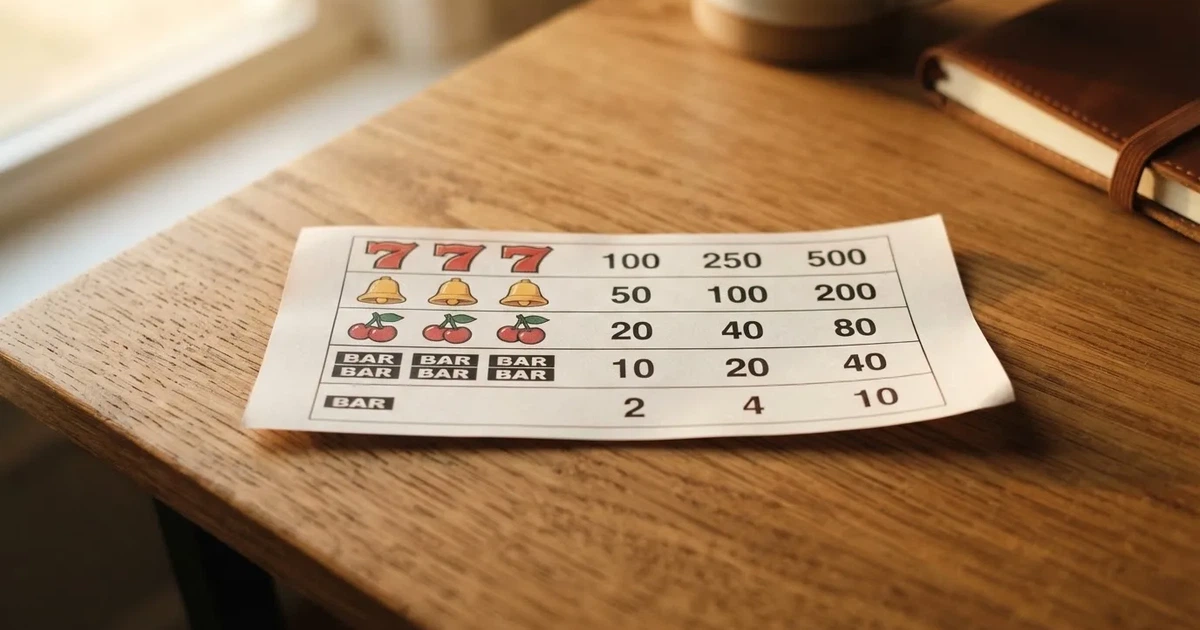
The visible paytable of a progressive slot looks, on first glance, like any other video slot: rows of symbol combinations and the credit value each one pays out. The progressive element sits at the bottom of that paytable, usually in a row reserved for the trigger event. Reading the paytable is what separates a player who understands what they have bought from one who is paying a premium for an outcome they will not see.

The most common trigger is a symbol-driven bonus round. On Mega Moolah, the trigger is a spin of the bonus wheel itself — a separate screen, a wheel with twenty segments, and a guaranteed prize tier (Mini, Minor, Major, Mega) where it stops. The Mega segment is the seven-figure-or-better prize. On Mega Fortune, the trigger is three bonus-wheel symbols on a payline, which opens a second-screen wheel that itself contains a wheel inside a wheel. On age-of-the-gods titles and many of their contemporaries, the trigger is four or more scatter symbols, which open a fixed-pick bonus that awards one of four progressive pools.
A second trigger type is the random award. Some games do not require a specific combination at all; the random number generator simply decides, on any spin, that this one pays the jackpot. The display may show a “mystery” counter ticking up in real time, with the prize pool growing visibly on the screen until somebody wins it.
A third trigger is the bonus buy. Some jurisdictions allow, and some titles offer, a direct purchase of the bonus round for a multiple of the stake (often 100× or more). This collapses the wait for the trigger into a single transaction, but it does not change the probability of the jackpot itself — only the cost of the round that can produce it.
Reading the paytable is therefore not optional if a player wants to know what the game is selling. The contribution to the pool, the seed, the link structure, and the trigger are all printed there; the marketing copy rarely spells them out. A paytable that does not name these four things is a paytable that does not want the player reading it carefully.
The Mega Moolah family and the wider online catalogue
The most-cited progressive jackpot in the world is Mega Moolah, developed by Microgaming and now distributed by Games Global, the business that acquired Microgaming’s distribution operation. The game produced the largest verified online slot jackpot on record: €19,430,723.60, paid on 27 April 2021 to a player in Belgium playing “Absolootly Mad: Mega Moolah” at Napoleon Sports & Casino. Games Global has subsequently confirmed wins of £11.5 million and £13.5 million on the Mega Moolah series.

The catalogue of well-known progressive slots available offshore to Australian players is wider than any one brand. It includes:
- Mega Moolah and its variants (Absolootly Mad, Atlantean Treasures, Fortunium, Juicy Joker) — four-tier pool, Microgaming/Games Global.
- Mega Fortune and Mega Fortune Dreams — NetEnt, multi-wheel bonus, three-tier pool.
- Hall of Gods — NetEnt, Norse mythology, three-tier pool.
- Age of the Gods series — Playtech, shared four-pool network across many themed titles.
- Jackpot Giant — Playtech, single-pool game with a wide-area network.
- Arabian Nights — NetEnt, single-pool, long-running.
- Gladiator and other Playtech progressives.
- Divine Fortune — NetEnt, local-only progressive with three tiers.
These games sit on hundreds of offshore casino sites. The games are the same; the brands change.
Progressive jackpots predate the internet by decades. The first wide-area progressive slot machine, IGT’s Megabucks, paid out its inaugural jackpot of US$4,988,842.17 on 1 February 1987 — almost forty years ago. The mechanic is not new; the distribution has changed.
How a shortlist of progressive slots is built
The page above is not a “Top 11” in the sense of a ranking — there is no objective ordering of progressive slots that holds across players, budgets and preferences. There is, however, a way to construct a shortlist that does not rely on advertising copy.

Four criteria do most of the work:
RTP and contribution rate. The published return-to-player for the base game, and the fraction of each wager that funds the progressive pool. A higher base RTP with a smaller progressive contribution is a different bet from a lower base RTP with a massive pooled prize.
Volatility. High-volatility progressive slots pay less often on the base reels, sometimes for many spins at a stretch, then either pay out nothing or pay out at the very top of the scale. Low-volatility games with a smaller progressive contribution feel steadier.
Seed value and link structure. A standalone progressive on a single site has a low ceiling. A wide-area progressive linking hundreds of sites has a high ceiling but a near-invisible probability per spin. The seed dictates the floor of the reset prize.
Trigger mechanics. A bonus-wheel progressive with a guaranteed prize tier is a different product from a random-trigger progressive where the prize simply materialises. Reading the trigger rules tells a player what they are actually buying.
Two further considerations matter for any Australian player thinking offshore: which jurisdictions licence the operator (Curacao is the most common, with Kahnawake, Malta, the Isle of Man and Cyprus appearing on individual sites), and which payment methods the site accepts. A site asking for credit card or crypto is operating outside Australian payment rules, which started on 11 June 2024 for licensed wagering services and which carry criminal penalties up to A$247,500 for operators.
The honest answer to “which progressive slot is best” depends on what the player is buying. If they want the largest possible single payout and accept a long wait, Mega Moolah’s Mega tier is the obvious name. If they want the most frequent bonus rounds and the lowest minimum cost per spin, a standalone progressive at a lower seed serves the budget better. There is no game that wins on both axes.
What Australian law actually allows
Online casino games, online pokies and in-play betting cannot be offered to a person in Australia under the Interactive Gambling Act 2001, strengthened by the Interactive Gambling Amendment Act 2017. No state or territory issues a licence for them. The Interactive Gambling Amendment (Gambling Reform) Bill 2026, which passed Parliament on 19 August 2026, adds further advertising and inducement rules that commence on 1 January 2027 — law made, but not yet in force.

What is licensable in Australia is wagering on races and sport placed before the event, lotteries and keno. The Northern Territory Racing and Wagering Commission (NTRWC) regulates the largest concentration of those licences — 52 of Australia’s online bookmakers, including Sportsbet, Bet365 and Ladbrokes — for tax reasons. The commission has no full-time staff and meets once a month in Darwin. It is a de facto regulatory home for the wagering sector rather than a casino regulator.
The minimum age for any form of licensed gambling in Australia is 18.
Two practical consequences for an Australian reading offshore progressive jackpot marketing:
- No Australian licence exists for the product on offer. A progressive jackpot slot is an online casino game. There is no Australian licence. Any operator claiming one is misleading.
- No Australian consumer protection extends to offshore play. A complaint about a refused withdrawal, an altered paytable, or a delayed payout cannot be escalated to an Australian regulator or tribunal. The Interactive Gambling Act targets the operator, not the player — players are not personally prosecuted — but the player is also without the safety net Australian-licensed wagering has.
How the ACMA enforces it
The Australian Communications and Media Authority (ACMA) investigates complaints, issues formal warnings, and directs Australian internet service providers to block offshore sites that ignore the Interactive Gambling Act.

The cumulative numbers are substantial. As of a blocking round reported in June 2026, the ACMA had asked ISPs to block 1,751 illegal gambling and affiliate marketing websites since the first blocking request in November 2019. More than 230 unlicensed services had left the Australian market since enforcement was strengthened in 2017. Australians lose an estimated A$3.9 billion a year to illegal offshore gambling, according to H2 Gambling Capital’s 2025 estimate, and the share of gambling revenue going through legal channels fell from 74% in 2021 to 64%.
The most recent blocking round reported in June 2026 covered twelve sites: 7Signs, ChromaBet, Donbet, Duospin, Freshbet, Slots Gem, Jacks Club, Lucky Start, Pointsbetz, Spinrise, Vinyl Casino and Wildsino. A site blocked today can reappear under a new domain within weeks; the ACMA’s blocking list is updated in batches, not continuously.
A formal warning is the ACMA’s intermediate step — a public, dated letter naming the operator and the prohibited service. Warnings matter because they predate a blocking request and they create a public record of the operator’s awareness. The warnings listed in the operator section below are sourced from the ACMA’s own register.
The arithmetic behind the blocking rate is itself informative. Over roughly 79 months between the first blocking request in November 2019 and the round reported in June 2026, the ACMA moved from a single site blocked to a cumulative 1,751 sites blocked. The result is a band, not a point: a long-run average of roughly 22 sites added to the blocking list per month, with the rate noticeably higher in the early 2020s than over the most recent quarters, and with the rate of new warnings rising sharply in 2025 and 2026. The condition that drives the band is regulatory capacity — the ACMA batches warnings and blocks in rounds rather than continuously — which is why a single 12-site block one month can sit alongside a 60-site month shortly afterwards.
The offshore operators the ACMA has named
The brands below are not ranked and are not recommended. They are listed because the ACMA itself issued a formal warning over each one for offering prohibited online casino services to Australians. None of them is licensable in Australia. The list is taken from the ACMA’s public register; the only sources for bonus terms on these brands were affiliate marketing pages, so no offer details are reproduced here.

Each entry names the operator behind the brand, the date the warning was published, and any earlier ACMA action against the same operator. The descriptions below those fields are the page’s own assessment of what each warning means for a reader weighing whether to play offshore.
RocketPlay
ACMA action and date. Formal warning to Pulsup Ltd over Rocketplay, March 2026. A separate, earlier warning covered Rocketplay under Dama N.V. in May 2022.
Operator named by the ACMA. Pulsup Ltd.
Subject support. No data.
RocketPlay is one of a small number of brands to have drawn two ACMA formal warnings — once as one of Dama N.V.’s six brands in May 2022 and again under a different parent company, Pulsup Ltd, in March 2026. Two warnings from different operators in four years is a record that sits above the median of the brands named in the register, and the later warning shows the rebranded operation continuing to target Australian traffic.

Level Up Casino
ACMA action and date. Formal warning to Dama N.V. over Level Up Casino as one of six brands, May 2022.
Operator named by the ACMA. Dama N.V.
Subject support. Listings only.
Level Up was one of six Dama N.V. brands covered by the May 2022 warning — Bambet, Dazard, Level Up, Rocketplay, Wild Tornado and Cobra Casinos. A wider brand-portfolio warning suggests Dama N.V. was a scale operator running multiple sites in parallel, and the warning is the public record of that scale. The brand does not appear in later ACMA actions under a different operator.
Woo Casino
ACMA action and date. Formal warning to Dama N.V. over Woo Casino, March 2025.
Operator named by the ACMA. Dama N.V.
Subject support. No data.
The March 2025 warning to Dama N.V. is a separate action from the May 2022 batch, which means the operator continued to run sites aimed at Australians between those dates despite the earlier warning. Woo Casino is the more recent evidence of that pattern.
Spirit Casino
ACMA action and date. Formal warning to Dama N.V. over Spirit Casino, May 2025.
Operator named by the ACMA. Dama N.V.
Subject support. No data.
The May 2025 warning to Dama N.V. over Spirit Casino is the third distinct brand from the same operator on the public register, after Level Up in 2022 and Woo Casino earlier in 2025. For any reader checking the operator behind a brand, the consistent company name across warnings is itself the most informative signal.
National Casino
ACMA action and date. Formal warning to Consolutetish S.R.L. over National Casino, July 2025.
Operator named by the ACMA. Consolutetish S.R.L.
Subject support. Listings only.
National Casino and Bizzo Casino were named in the same July 2025 warning to Consolutetish S.R.L., which is how the ACMA tends to treat operators running more than one site. Treating them together is consistent with the wider pattern in the register — one warning, multiple brands, one operator behind both.
Bizzo Casino
ACMA action and date. Formal warning to Consolutetish S.R.L. over Bizzo Casino, July 2025; earlier formal warning to TechSolutions (CY) Group Limited and TechSolutions Group N.V., 2022.
Operator named by the ACMA. Consolutetish S.R.L. (2025); TechSolutions (CY) Group Limited / TechSolutions Group N.V. (2022).
Subject support. No data.
Bizzo Casino carries two separate ACMA warnings from two different operators across roughly three years. That makes it a stronger indicator than most of rebranding and continuity — the brand itself is the through-line, and the operators behind it have changed in a way that the ACMA has documented each step of.
Ignition Casino
ACMA action and date. Formal warning to Bamboo Media over Ignition Casino, July 2025.
Operator named by the ACMA. Bamboo Media.
Subject support. No data.
Ignition Casino shares its July 2025 warning with the larger batch that covered National Casino and Bizzo Casino, but under a different operator — Bamboo Media. Two different operators warned in the same month for two different brand groups is a small but useful data point for anyone who treats the operator behind a brand as a fixed thing.
Instant Casino
ACMA action and date. Formal warning to EOD Code SRL over Instant Casino, February 2025.
Operator named by the ACMA. EOD Code SRL.
Subject support. No data.
The February 2025 warning was the ACMA’s first public action against EOD Code SRL. A reader looking at the operator behind the brand for the first time has only this single entry to go on; subsequent warnings would change the picture, but as of the public register, this is the only one.
Jackbit
ACMA action and date. Formal warning to Ryker B.V. over Jackbit and CasinOK, April 2026.
Operator named by the ACMA. Ryker B.V.
Subject support. No data.
The April 2026 warning names Jackbit alongside CasinOK in the same letter to Ryker B.V. — the same operator, two brands, one action. The shared warning is the public record that the two brands share infrastructure, which a reader cannot see from the brand sites themselves.
Casino Intense
ACMA action and date. Formal warning to Sterplay Holding Ltd over Casino Intense, April 2025.
Operator named by the ACMA. Sterplay Holding Ltd.
Subject support. Listings only.
Casino Intense is the lone brand in its April 2025 warning — Sterplay Holding Ltd does not appear elsewhere in the ACMA’s published register for this product. A single-brand warning is the cleanest case in the operator set: one brand, one operator, one dated warning, and no further public escalation in the months since.
Sky Crown
ACMA action and date. Formal warning to Hollycorn N.V. over Sky Crown and Blue Leo casino services, September 2022.
Operator named by the ACMA. Hollycorn N.V.
Subject support. No data.
The September 2022 warning is one of the older entries on the public register — Sky Crown has been on the ACMA’s published list for nearly four years without an updated action. The warning itself remains the public record of the operator’s awareness as of its date; whether the brand has continued to target Australians since then is not in the register.
What a player gets at a licensed Australian venue
The contrast with the offshore picture is sharp. A licensed Australian venue — a casino in Melbourne, a club in regional New South Wales, a pub in suburban Perth — runs electronic gaming machines under state and territory law, with machine-level approval, mandatory return-to-player disclosure, and a machine-by-machine audit regime that varies by jurisdiction.
The progressive machines in those venues are not online slots. They are standalone or venue-linked cabinets, the link runs inside the venue (or in some states across a state-licensed network), and the prize pool is funded from the gross margin of machines within Australia, not from a global wide-area pool. The headline numbers are smaller — venue progressives in Australia typically sit in the tens of thousands rather than the millions — but the regulatory frame around them is the Australian regulatory frame, and the path for a complaint or a dispute is a state-based one.
Nothing in the offshore marketing for a “progressive jackpot slot” maps onto this category. A player looking for an Australian-regulated progressive experience needs to play a venue-based machine in a licensed Australian venue; an offshore online progressive slot is a different product under a different legal regime with no Australian recourse.
Player protection: BetStop and the National Self-Exclusion Register
BetStop, the National Self-Exclusion Register, has been live since August 2023 and binds every Australian-licensed online and phone wagering service. A player on BetStop cannot open a new account with a licensed Australian bookmaker, and existing accounts are closed.
The caveat that matters: BetStop binds licensed Australian operators only. An offshore casino is not part of the register. Self-excluding through BetStop does not stop an offshore casino from accepting a deposit; that requires the offshore site itself to honour a request to close the account, with no Australian regulator to enforce it if it does not.
Steps that do work at the offshore layer:
- Asking the offshore site to self-exclude, in writing, and keeping a copy of the request.
- Asking the bank to block gambling transactions at the card or account level.
- Asking Australian internet service providers, where parental-control options allow it, to add the offshore domain to a household block list.
- Going to the National Gambling Helpline on 1800 858 858 (free, 24/7) or to Gambling Help Online for chat-based support and counselling referral.
The helpline number works whether the gambling in question is licensed or offshore. The exclusion register does not.
Payments: the rules offshore sites don’t follow
Credit cards, credit-related products and digital currency are banned as payment for licensed online wagering in Australia as of 11 June 2024. Penalties for operators accepting those payment types can reach A$247,500. The legal deposit routes for licensed wagering are debit card, bank transfer, PayID/Osko and BPAY.
An offshore progressive-jackpot site that asks an Australian player for a credit card or a crypto deposit is therefore operating outside the Australian payment rules, even where the same site claims a Curaçao or Malta licence for its casino product. The card or wallet restriction is the easiest concrete test of whether a site is operating within Australian norms at all, and any reader using one should treat the absence of that compliance as the loudest signal on the page.
Tax: a brief note
Gambling winnings of a recreational player are not assessable income in Australia under section 6-5 of the Income Tax Assessment Act 1997, and gambling losses are not deductible against other income. A player whose gambling amounts to carrying on a business — professional poker, sports trading at scale — sits in a different position and should check with the Australian Taxation Office.
For most people reading this page, the tax position is the boring end: winnings from a progressive jackpot are not taxable, but they are also not protected by anything Australian when the operator holding them is offshore.
Comparison at a glance
The table below pulls together the eleven operators named above. The columns are: the brand, the ACMA action and date, the operator named in the warning, and any evidence on the public record for whether the brand is associated with progressive jackpot products at all. The last column is the most-honest one on the page: for most of these brands, there is no public, verifiable listing for the specific subject, and the cell carries a dash rather than a fabricated connection.
| Brand | ACMA action and date | Operator named by the ACMA | Subject support |
|---|---|---|---|
| RocketPlay | Formal warning, March 2026 (earlier May 2022 under Dama N.V.) | Pulsup Ltd (2026); Dama N.V. (2022) | — |
| Level Up Casino | Formal warning, May 2022 | Dama N.V. | Listings only |
| Woo Casino | Formal warning, March 2025 | Dama N.V. | — |
| Spirit Casino | Formal warning, May 2025 | Dama N.V. | — |
| National Casino | Formal warning, July 2025 | Consolutetish S.R.L. | Listings only |
| Bizzo Casino | Formal warning, July 2025 (earlier 2022 under TechSolutions) | Consolutetish S.R.L. (2025); TechSolutions (CY) Group Limited / TechSolutions Group N.V. (2022) | — |
| Ignition Casino | Formal warning, July 2025 | Bamboo Media | — |
| Instant Casino | Formal warning, February 2025 | EOD Code SRL | — |
| Jackbit | Formal warning, April 2026 (with CasinOK) | Ryker B.V. | — |
| Casino Intense | Formal warning, April 2025 | Sterplay Holding Ltd | Listings only |
| Sky Crown | Formal warning, September 2022 (with Blue Leo) | Hollycorn N.V. | — |
A dash in the right-hand column means there is no public, independently verifiable listing for that brand carrying the specific subject — a progressive jackpot slot product. A “listings only” entry means a third-party listing references the brand in the context of the subject, but the brand itself is not the source. The structural point of the table is that warnings from the ACMA outnumber, by a wide margin, any independent confirmation of what the brand actually offers the player.
How to read an offshore progressive slot offer
Three checks catch most of what a careful player needs to know:
Read the paytable before you spin. The contribution rate, the seed, the link structure and the trigger event are all printed there. If a brand hides any of the four behind a marketing page rather than the in-game help, treat that as the answer.
Check the operator, not the brand. The ACMA register names the company behind the brand, and the same company often runs several brands at once. A single warning in the register is one data point; a cluster of warnings from the same operator across multiple brands is a stronger one.
Check the payment methods. An offshore site asking for a credit card or a crypto deposit is operating outside the Australian rules that have applied to licensed wagering since 11 June 2024. That single test eliminates a large share of the bad operators without any further investigation.
The mechanics on the screen do not change between operators. The trigger, the contribution, the seed and the link structure are properties of the game, not of the brand. What changes between operators is everything around the game: whether the operator pays out, whether the site disappears overnight, whether the player has any way to recover a balance. The paytable does not answer those questions, and no figure on it makes them go away.
Final reading
A progressive jackpot slot is a fixed-payout game with a chance at a life-changing top prize on top, and that top prize is funded by the player paying a fraction of a percent more per spin than on a comparable fixed-jackpot slot. The biggest online jackpot on record is €19.4 million. The mechanics that produced it are well understood, the catalogue of games offering similar structures is wide, and the regulatory frame in Australia does not let any of those games be offered to an Australian player from an Australian licence.
The choice for an Australian reader is not between progressive slots. It is between an Australian-regulated machine in a venue, where the product is licensed and the recourse is local, and an offshore online site, where the product is not licensed, where the ACMA has already named the operator, and where the recourse is the operator’s own terms.
That second option is the option this page has been written about. The arithmetic on the prize pool is what the marketing sells. The arithmetic on what happens to a withdrawal when an offshore site goes dark is what the marketing does not.
Frequently asked questions
How does a progressive jackpot slot’s prize pool actually grow between wins?
A small percentage of every losing wager is added to the pool on top of the standard house edge. The pool keeps climbing spin after spin until somebody triggers the jackpot event — usually a bonus-wheel spin or a specific symbol combination — at which point the meter resets to a preset seed value and starts accumulating again from there. The contribution rate, the seed value, and the trigger mechanic are all written into the paytable.
What’s the difference between a standalone jackpot and a network-wide progressive jackpot?
A standalone progressive is one machine or one site feeding its own pool; the prize grows only as fast as that single machine’s play. A wide-area network progressive links machines across many venues or, online, across many sites using the same software; the prize grows much faster and the ceilings reach into the millions, but the probability of any single spin hitting the top tier is correspondingly smaller. Mega Moolah is the canonical online wide-area example.
Do licensed Australian pokies venues offer progressive jackpot machines?
Yes. Licensed Australian casinos and clubs offer electronic gaming machines with progressive jackpots, and the prize pools are funded from the gross margin of the machines themselves. The progressive networks operate inside the venue (or, in some states, across a state-licensed network), not across international sites. The headline prizes are smaller than the offshore wide-area networks, but the regulatory frame is the Australian one and consumer protection applies.
Why do progressive jackpot slots typically have a lower base return-to-player than fixed-jackpot games?
Because a slice of every wager funds the running prize pool in addition to paying for the regular paytable. The slot has to recover its base-game RTP, the contribution to the progressive, and the operator’s margin from the same wager. A lower base RTP is the visible cost of buying into the chance at the headline number, and it shows up as lower returns on the non-jackpot paylines in exchange for the possibility of the top prize.
How is a record progressive jackpot payout verified?
Operators of record-sized jackpots issue press releases naming the title, the date, the prize amount, and often the venue or platform. Independent industry publications carry the announcement, and in jurisdictions with licensed operators, the regulator confirms the payout through its own audit trail. The €19.4 million Mega Moolah win in April 2021 was confirmed by Games Global (then Microgaming) and reported by independent outlets on the same day. For offshore sites that do not disclose the same audit trail, the player’s only verification is the operator’s word.
What triggers the jackpot round on a typical progressive jackpot slot?
It depends on the title. The most common triggers are a bonus-wheel spin (Mega Moolah), a specific scatter combination opening a pick-style bonus (Age of the Gods series), three or more bonus symbols on a payline opening a multi-wheel screen (Mega Fortune), or a randomly awarded prize with no symbol trigger at all. Reading the paytable tells the player exactly which trigger applies to the game they are playing.
Published by the Casino Jackpot Hub team.